

Article
C. Raja Mohan, Darshana M. Baruah
{
  "authors": [
    "C. Raja Mohan"
  ],
  "type": "legacyinthemedia",
  "centerAffiliationAll": "dc",
  "centers": [
    "Carnegie Endowment for International Peace",
    "Carnegie India"
  ],
  "collections": [],
  "englishNewsletterAll": "ctw",
  "nonEnglishNewsletterAll": "",
  "primaryCenter": "Carnegie India",
  "programAffiliation": "SAP",
  "programs": [
    "South Asia"
  ],
  "projects": [],
  "regions": [
    "North America",
    "United States",
    "Middle East",
    "Iran"
  ],
  "topics": [
    "Political Reform",
    "Security",
    "Military",
    "Foreign Policy",
    "Nuclear Policy"
  ]
}
Source: Getty
Iran's elections may present a window of opportunity for the United States and the West.
Source: Indian Express
It is easy to be cynical about yesterday's elections in Iran to choose a new president. After all, the elected president does not dominate Iran's complex political system. That privilege belongs to the Supreme Leader, Ayatollah Ali Khamenei. This does necessarily mean the current elections are inconsequential.
The 1979 Islamic revolution in Iran replaced the monarchy with a system called velayet-e-faqih, or rule by the clerics. Khamenei, sitting on top this structure, is only the second supreme leader since the republic was founded by Ayatollah Khomeini. While the president's powers are limited, not everyone is allowed to run for the job. Women are barred and the men are carefully vetted by the Guardian Council, the powerful 12-member body that has the mandate to interpret the constitution and approve candidates for the presidency and the parliament, called the Majlis.This year, more than 600 men registered as candidates. The Guardian Council approved only eight. Those rejected included Akbar Hashemi Rafsanjani, a former president, and Esfandiar Rahim Mashaei, a close confidant of the outgoing president, Mahmoud Ahmadinejad. The exclusion of Rafsanjani and Mashaei, who were at odds with Khamenei, has resulted in the widespread dismissal of the current elections as a sham. But politics has a way of asserting itself even within the highly controlled Iranian electoral process.
Mohammad Khatami surprised the world with his victory in the presidential elections of 1997 and 2001. Although he failed to change the system from within, the reformist current gained ground again in 2009 in the electoral battle between incumbent president Ahmadinejad and the challenger, Mir Hossein Mousavi.
When Ahmadinejad was declared winner by Khamenei, supporters of reformist Mousavi demonstrated for weeks, accusing the Supreme Leader of rigging the result. While Mousavi has been under detention since 2009, Ahmadinejad soon fell out with Khamenei and tensions between the two have dominated Iran's political landscape in the last few years.
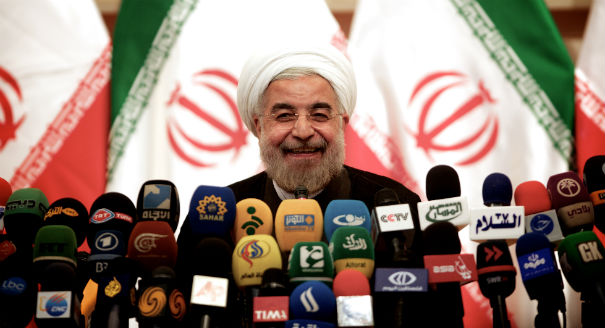
With two of the eight candidates dropping out last week, the election has acquired a political edge that was missing until now. Moderate cleric Hassan Rouhani has gained some ground after the only reformist candidate on the slate, Mohammad Reza Aref withdrew this week.
Two former presidents, Rafsanjani and Khatami, have backed the candidacy of Rouhani, who had earlier served as Iran's national security advisor. In the last few days, Rouhani has promised women that he will end gender inequality in Iran and told students he will end their harassment by the ubiquitous moral police. Skeptics say Rouhani, once dubbed a radical, is hardly a reformer. Rouhani's supporters are wearing purple wristbands, much in the manner that Mousavi's backers wore green during the last elections and the protests that followed.
All the other candidates—including the popular mayor of Tehran, Mohammad Baqer Qalibaf, top nuclear negotiator Saeed Jalili and former foreign minister Ali Akbar Velayati—are said to enjoy the blessings of Khamenei.
A lot will depend on the turnout; more than 50 million are eligible to vote. If the supporters of change, demoralized since the last elections, turn up in large numbers, there could be a close contest. If no candidate wins 50 per cent of the vote on Friday, there will be a runoff between the top two candidates. If Rouhani is one of the two, the next round of the election on June 21 could turn out to be exciting. Many observers, however, say Rouhani's prospects are slim despite the inability of the conservatives to unite behind one candidate.
Although all candidates are opposed to Western sanctions and support Iran's right to develop a peaceful nuclear program, a recent television debate among the presidential candidates revealed considerable variation.
In the heated debate, Velayati, the former foreign minister accused Jalili, the current nuclear negotiator of being inflexible. "The art of diplomacy," Velayati said, is about "preserving our rights" and not "inviting sanctions." Rouhani said, "it is nice to have the centrifuges running, provided people's lives are also running." In his campaign rallies, Rouhani has promised to end the nuclear dispute with the international community and help remove economic sanctions.
The lack of flexibility is also a problem in the West, which has demonized Iran and treated it as a black box. Despite their limitations, the elections in Iran may offer a brief window for the United States to pursue an unconditional dialogue with Tehran on all issues of mutual concern.
This article was originally published in the Indian Express.
Former Nonresident Senior Fellow, Carnegie India
A leading analyst of India’s foreign policy, Mohan is also an expert on South Asian security, great-power relations in Asia, and arms control.
Recent Work

C. Raja Mohan, Darshana M. Baruah


Alexander Gabuev, Paul Haenle, C. Raja Mohan, …
Carnegie India does not take institutional positions on public policy issues; the views represented herein are those of the author(s) and do not necessarily reflect the views of Carnegie, its staff, or its trustees.

In any defense establishment, change is an ongoing process. However, despite the best of intentions, existing bureaucracies, bound by habit and years of socialization, have their limits in implementing transformative change.

Anit Mukherjee

How is AI reshaping space security, creating governance challenges, and where does international diplomacy stand today?


Tejas Bharadwaj, Almudena Azcárate Ortega

After the chill in ties between 2020 and 2024 that brought India–China relations to their lowest point in several decades, the two countries have engaged each other afresh. This paper argues that there are predominantly four imperatives guiding India’s approach to China, and they exist in an order of priority.

Saheb Singh Chadha

This piece argues that India’s central challenge is not managing a single flashpoint but resolving the underlying tension between expansion and institutional coherency of the BRICS grouping.

Vrinda Sahai

A partnership between India, a country of subcontinental size, and Africa, a continent of fifty-four countries, may seem asymmetric until one notes that both are home to nearly the same number of people—1.4 billion. This essay spells out the existing challenges to the partnership, its optimal potential, and the possible pathways to realize it over the next quarter-century.

Rajiv Bhatia