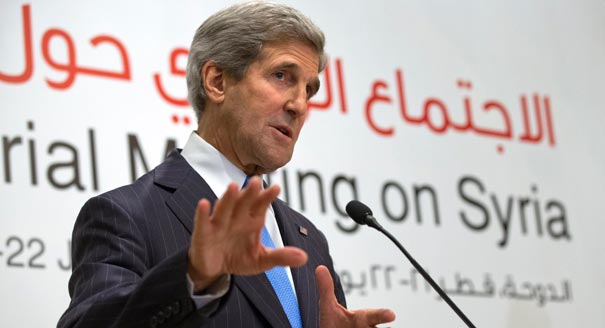
The closing statement of the Friends of Syria meeting in Doha on June 22 appeared tougher and more practical than usual. Ministers from nine of the “core” group’s eleven nations agreed to “provide urgently all the necessary [military] materiel and equipment to the opposition on the ground,” through the rebels’ Higher Military Council. The Friends of Syria additionally pledged “to pursue all appropriate avenues in the UN to support and protect the Syrian people,” implicitly reviving the option of seeking a Chapter 7 resolution on Syria from the Security Council, which could authorize mandatory diplomatic and economic sanctions—and possibly military intervention—-against the regime.
According to Qatari foreign minister Hamad bin Jasim Al Thani, the decision to arm the Syrian opposition is aimed at “
reaching a balance between the sides fighting in Syria and thus getting closer to a political solution.” In other words, the objective is to enable the opposition and its external backers to attend a possible Geneva peace conference in a position of reasonable strength. But this requires an ability to anticipate and shape outcomes that has yet to be demonstrated by the Friends of Syria. It also assumes an unequivocal commitment by the international grouping to arm the Syrian opposition, and this too remains uncertain.
The real problem for the Friends of Syria is that providing the rebels with technologically advanced anti-tank and anti-aircraft infantry weapons is the last card they can play without engaging in direct military intervention. Opposition figures such as National Coalition secretary-general Mustafa Sabbagh have repeatedly made extravagant claims that “tipping the balance on the ground
would take only a few hours if there is the political will.” But some rebel groups have
already acquired modest numbers of advanced infantry weapons beginning in November 2012, without benefiting from a discernible tactical impact, let alone a strategic one.
The foremost challenge facing the rebels is to resolve their inherent flaws: weak command and control, continuing fragmentation and poor coordination, and the absence of credible political leadership. The Friends of Syria have tried repeatedly to help address these problems by endorsing the formation of joint command structures, but without achieving any notable success.
Should arming the rebels with anti-tank and anti-aircraft weapons prove not to be a game-changer – or if the regime escalates massively in response – then the Friends of Syria will face stark choices. Hypothetically, their next option would be to provide heavy weapons – tanks and other armored vehicles, and artillery – as some opposition leaders and rebel commanders have already urged in recent months. But this would require a much higher level of material and political commitment, which appears problematic given the long period of time that was needed by the Friends of Syria to get to the point of – perhaps – providing modest amounts of advanced infantry weapons.
More importantly, the Friends of Syria would have to provide air cover for supply lines, depots, and staging areas, to secure a minimum level of support for any heavy weapons it might provide. U.S. Senator John McCain explicitly made this linkage when he argued that “
the Free Syrian Army needs heavy weapons to counter tanks and aircraft, they need a no-fly zone, and Assad’s air assets have to be taken out.”
It is precisely this escalatory logic that generates hesitation by the Friends of Syria and explains the extreme caution and prevarication by the US and the European Union, in particular, when it comes to arming the opposition at all. Even now, their steps are halting, as they prolong their policy decisions on arming the opposition with man-portable anti-tank and anti-aircraft weapons, in order to maximize the political and psychological effects of a limited resource.
When U.S. Deputy National Security Adviser Ben Rhodes announced President Barack Obama’s decision to supply direct military assistance to the Syrian opposition on June 14, he tied this specifically to the use of chemical weapons by the regime of President Bashar al-Assad. In his prepared statement, Rhodes carefully described the use of nerve agents, including sarin on two occasions, as being “
on a small scale.” This was a clear signal that the Obama administration wishes to deter the regime from further use of chemical weapons, in order to deflect pressure to act more decisively. Rhodes made this clear by arguing, in response to media questioning, that setting up a no-fly zone would be costly and not make a “
huge difference” anyway.
Ironically, the United Kingdom and France, which for months have led the charge to arm the Syrian opposition, have experienced an even worse case of cold feet than the Obama administration. On May 28, the two countries vetoed a move to extend the European Union arms embargo on Syria, which would allow the supply of weapons to the opposition. But after enforcing this stance on the remaining 25 member states, British Prime Minister David Cameron abruptly backpedalled in reaction to the U.S. decision to provide lethal military assistance to the rebels, saying his government had taken “
no decision” to arm them. Indeed, it has not yet allocated a budget for the purpose, according to inside sources. French President Francois Hollande also
prevaricated, stating that “we can only act within the framework of international law” in response to the regime's use of chemical weapons, effectively rendering any more decisive action hostage to the Russian veto at the United Nations Security Council.
The Friends of Syria are nonetheless inching closer to providing the rebels with a more effective anti-tank and, less certainly, anti-aircraft capability. If supplied in sufficient numbers and backed with effective training and well-planned deployment, these weapons will boost the rebels' ability to slow regime forces, buying time for the opposition. But the Friends of Syria still lack the means to impose the view they reiterated in Doha last weekend, namely that “Bashar al-Assad has no role in the transitional governing body or thereafter.” Indeed, they cannot be sure that the arms they supply will enable the rebels to impose a strategic equilibrium with the regime. And what if the balance tips the other way?
The Friends of Syria may soon discover that direct involvement in the war is the only way to avoid open retreat. This need not mean imposing a blanket no-fly zone over all of Syria, or putting troops on the ground. The Friends of Syria might instead designate limited Balkan-style safe areas along Syria’s borders with Turkey and Jordan, which they commit to protecting from regime attack. But this presupposes a willingness both to enforce such a policy – which the concerned countries failed to do in Bosnia-Herzegovina – and to stand up to Russia. Both remain highly unlikely.
Unless the Friends of Syria are ready to impose new rules of engagement, then arming the rebels is little more than a stopgap measure. It is the cheap option, even if leading members of the “core group” pledged nearly $1.5 billion in new humanitarian aid at the G8 summit, only days before their Doha meeting. Worse, it reveals that the Friends of Syria have no plan – whether diplomatic or military – to end the Syrian conflict or prevent it from descending to new depths of violence and mass displacement.