

In The Media
David Rothkopf
{
  "authors": [
    "David Rothkopf"
  ],
  "type": "legacyinthemedia",
  "centerAffiliationAll": "",
  "centers": [
    "Carnegie Endowment for International Peace",
    "Malcolm H. Kerr Carnegie Middle East Center"
  ],
  "collections": [
    "Arab Awakening"
  ],
  "englishNewsletterAll": "",
  "nonEnglishNewsletterAll": "",
  "primaryCenter": "Carnegie Endowment for International Peace",
  "programAffiliation": "",
  "programs": [],
  "projects": [],
  "regions": [
    "North Africa",
    "Egypt"
  ],
  "topics": [
    "Political Reform",
    "Democracy",
    "Foreign Policy",
    "Civil Society"
  ]
}
Source: Getty
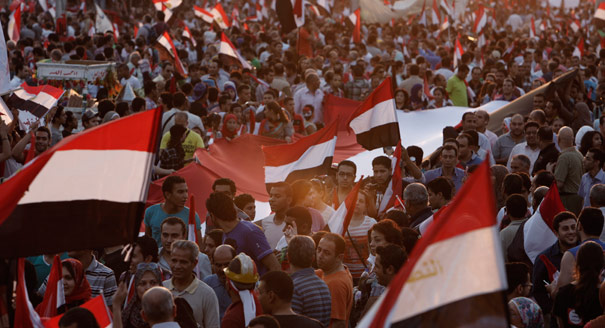
Analysts are currently poring over the language of U.S. law to see whether the United States is now obligated to cut back aid to Egypt because what has just taken place there can hardly be defined as anything other than a military coup.
Source: Foreign Policy
Analysts are currently poring over the language of U.S. law to see whether the United States is now obligated to cut back aid to Egypt because what has just taken place there can hardly be defined as anything other than a military coup. Given that America's $1.25 billion-a-year aid to Egypt is key to the economically fragile country, few issues could be more important for Washington to resolve swiftly. Not only is it important to Egypt, but how this is resolved will play a huge role in influencing how the United States is perceived in Egypt during the fraught months ahead.
The importance of the semantics associated with just what kind of a military-assisted transition took place in Egypt is clear to the central players in Egypt too. On CNN, spokespeople close to the military, including former generals such as Gen. Sameh Seif el-Yazal, went to great pains to say that what had happened was "definitely not a coup" and "not a military coup whatsoever," but rather an expression of the interests of the people and the beginning of a more democratic chapter in Egyptian history. Meanwhile, overthrown President Mohamed Morsy, forced to resort to Twitter to address his former constituents, was emphatic in using the c-word to define events.Naturally, the language of U.S. law does leave a little room for discretion based on circumstances. Further, of course, the U.S. administration and Congress have the ability to adjust the law quickly should circumstances dictate. The United States should use the opportunity to add a little more nuance to how it handles the ebb and flow of democracy worldwide.
We have seen too often -- in Egypt, Iran, Venezuela, and Russia to name a few obvious examples -- democratic processes used to bring leaders to power who wear their perceived legitimacy as a shield but who then go on to abuse the power that has been conferred upon them. Illiberal democracy is not the exception. It is a recurrent theme, and U.S. support for democratically elected governments should not, therefore, be reflexive.
That is not to say the United States should not support the spread of democracies worldwide. America should and must. Instead, it is suggesting that rather than looking at the mechanics of democracy, we should look at the spirit and the trends involved. It is much more important that a country is democratizing, as opposed to using the tools of democracy to promote something very different, autocratic, even anti-democratic.
That is why if, after careful analysis and the presentation of sufficient evidence, it is clear that what the military has just done in Egypt has ended the career of an anti-democratic leader and the military is materially supporting democratizing moves -- including, importantly, the stepping aside of the military and genuine transfer of power to a legitimately elected civilian leadership by a certain date -- then the United States should support those moves in the most concrete way possible by not interrupting aid.
According to Egyptian sources, more people revolted against the current regime than voted for it. That is a form of democratic expression, too. It only underscores the blurriness of the concepts involved. This is one of those instances in which a more nuanced approach -- one that is not too literal or mesmerized by technical requirements -- can better help advance genuine democracy and, at the same time, give the United States more latitude to advance its national interests in situations in which gray areas abound.
Former Visiting Scholar
David Rothkopf was a visiting scholar at the Carnegie Endowment as well as the former CEO and editor in chief of the FP Group.
Recent Work
David Rothkopf
David Rothkopf
Carnegie India does not take institutional positions on public policy issues; the views represented herein are those of the author(s) and do not necessarily reflect the views of Carnegie, its staff, or its trustees.

After the chill in ties between 2020 and 2024 that brought India–China relations to their lowest point in several decades, the two countries have engaged each other afresh. This paper argues that there are predominantly four imperatives guiding India’s approach to China, and they exist in an order of priority.

Saheb Singh Chadha

This piece argues that India’s central challenge is not managing a single flashpoint but resolving the underlying tension between expansion and institutional coherency of the BRICS grouping.

Vrinda Sahai

A partnership between India, a country of subcontinental size, and Africa, a continent of fifty-four countries, may seem asymmetric until one notes that both are home to nearly the same number of people—1.4 billion. This essay spells out the existing challenges to the partnership, its optimal potential, and the possible pathways to realize it over the next quarter-century.

Rajiv Bhatia

The India–EU Free Trade Agreement (FTA) is shaping up to be one of the most consequential trade negotiations, both economically and strategically. But, what’s in the agreement, what’s missing, and what will determine its success in the years ahead
Vrinda Sahai, Nicolas Köhler-Suzuki
Trump 2.0 has unsettled India’s external environment—but has not overturned its foreign policy strategy, which continues to rely on diversification, hedging, and calibrated partnerships across a fractured order.



Milan Vaishnav, ed., Sameer Lalwani, Tanvi Madan, …