

In The Media
John Judis
{
  "authors": [
    "John Judis"
  ],
  "type": "legacyinthemedia",
  "centerAffiliationAll": "",
  "centers": [
    "Carnegie Endowment for International Peace",
    "Malcolm H. Kerr Carnegie Middle East Center",
    "Carnegie Russia Eurasia Center"
  ],
  "collections": [],
  "englishNewsletterAll": "",
  "nonEnglishNewsletterAll": "",
  "primaryCenter": "Carnegie Endowment for International Peace",
  "programAffiliation": "",
  "programs": [],
  "projects": [
    "Eurasia in Transition"
  ],
  "regions": [
    "North America",
    "United States",
    "Middle East",
    "Syria",
    "Levant"
  ],
  "topics": [
    "Security",
    "Political Reform",
    "Foreign Policy"
  ]
}
Source: Getty
As the debate over congressional authorization for action in Syria showed, the American public has lost its taste for unilateral military intervention that cannot be justified by a direct threat to American lives.
Source: New Republic
Barack Obama’s speech on Syria had a peculiar structure. The first part of it was devoted to justifying why the president had decided to “respond to the Assad regime’s use of chemical weapons through a targeted military strike.” Your average listener might have thought that Obama would say next that missiles aimed at Damascus were leaving their silos. The threat of violence loomed over the first half of the speech.
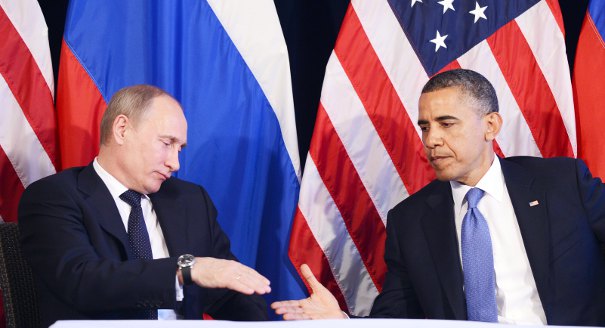
But in the last part of the speech, Obama announced that he was putting off a military response, and asking Congress to postpone its vote authorizing force, in order to pursue a “diplomatic path” with Russia’s Vladimir Putin. “This initiative,” Obama said, “has the potential to remove the threat of chemical weapons without the use of force, particularly because Russia is one of Assad’s strongest allies.” The speech did not have the structure of an argument, but of a television drama in which the viewer’s anxiety is finally relieved by the promise of peaceful resolution.This internal structure reflected the events of the last week or so. Obama’s speech was originally supposed to be a clarion call for a military strike against Bashar al Assad in response to his use of chemical weapons. It was supposed to convince Congress to authorize a strike; and the strike was to follow directly. But the speech concluded on the promise of a deal with Putin that would end the crisis. In this sense, the speech was anti-climactic. It heralded the end of the great debate and the beginning of messy, protracted negotiations that will take Syria off the front pages and allow the administration and Congress to turn their attention to the budget. That’s probably good for Obama’s presidency, and might also have a net positive effect on international relations, but it’s probably not good for Syria’s opposition forces and for the prospect of a negotiated settlement there.
Why is it good for Obama? Up until yesterday, his Syria policy was in a shambles. Three weeks ago, he announced his intention to take military action against Syria in retaliation for its use of chemical weapons. The administration expected that it would be able to create a coalition of European and Arab states, as it had in Libya, to back the action, and to take the onus of responsibility off the United States, which in acting alone would arouse suspicion in the region that it was more interested in oil or in protecting Israel than in punishing Assad for his use of chemical weapons. But Obama failed to win support from Britain and the Arab League, and Obama and Secretary of State John Kerry failed to win support at the G-20 meetings. Even France, the only country to agree to share military responsibilities, began to back off.
Obama’s decision to seek Congress’ approval probably stemmed from his failure to win international support. Bill Clinton had acted in the Balkans and Obama in Libya without explicit congressional approval, but in both cases, they were acting as part of an international coalition. With the United States acting alone, Obama had little choice but to seek congressional approval. That effort, too, was about to fail. The House was almost certainly going to reject Obama’s appeal, and with a filibuster likely, the Senate—at least judging from Majority Leader Harry Reid’s decision to postpone a vote—was also going to deny the administration authorization for a military strike. So it’s not an exaggeration to say that as of this Monday morning, the administration’s foreign policy was about to fall off a cliff.
But Obama was spared an almost certain disaster that would have crippled his foreign policy and also weakened America’s ability to function internationally by what seems to have been a fortuitous series of events: Kerry’s off-hand and not seriously intended proposal that Assad could end the crisis by putting his chemical weapons in international hands, followed by the proposal’s acceptance by Putin and Syria’s Foreign Minister. Obama and White House officials, including National Security Advisor Susan Rice, initially downplayed Putin’s proposal. After a White House visit by former Secretary of State Hillary Clinton, however, Obama abruptly endorsed the proposal and made it a centerpiece of his television interviews that night. That ended the political crisis and for the time being the prospect of a military conflict with Syria’s Assad.
Obama attributed the Russian initiative partly to “the credible threat of U.S. military action.” That’s certainly the case. The Russians and Syrians would not have budged without the threat of American force. And even if the protracted negotiations over the next months don’t result in a clear and firm proposal, Assad will have acknowledged his use of chemical weapons and be far less likely to use them again, as will other dictators who find themselves facing popular rebellions. And if by any chance he does use them, Obama should have less trouble in building an international coalition to punish him. That’s all to the good, and is the result—even with all the bungling diplomacy—of Obama’s initial threat of force.
But Syria’s opposition—and most particularly, the so-called moderate opposition led primarily by former Assad regime officials—may not benefit from the cessation of the crisis. They stood to gain from what would have been a devastating American missile attack on Assad’s facilities and government. In trying to win over Senator John McCain and other hawks, Kerry and other administration officials had promised that the attacks would do more than simply deter Assad from using chemical weapons. These attacks might have also moved the Assad government and its allies closer to negotiating an end to the conflict. In an odd way, the focus on deterring Assad’s use of chemical weapons legitimizes his use of all other kinds of weaponry in Syria’s awful civil war—a civil war in which Assad has shown a willingness to destroy the country in order to preserve his rule.
But as the debate over congressional authorization showed, the American public has lost its taste for unilateral military intervention that cannot be justified by a direct threat to American lives. In his speech, Obama did his best to justify his initial support for a military strike against Syria, but what was most eloquent in that presentation was not his tortuous appeals to national security (“over time, our troops would again face the prospect of chemical warfare on the battlefield…”), but his moral case for upholding international law and responding to the gassing of hundreds of innocent children. These kind of appeals resonate with many Americans, including me, but as the debate over the last week showed, not with enough to throw American might against the Assad government.

Former Visiting Scholar
As a visiting scholar at Carnegie, Judis wrote The Folly of Empire: What George W. Bush Could Learn from Theodore Roosevelt and Woodrow Wilson.
Recent Work
John Judis
John Judis
Carnegie India does not take institutional positions on public policy issues; the views represented herein are those of the author(s) and do not necessarily reflect the views of Carnegie, its staff, or its trustees.

In any defense establishment, change is an ongoing process. However, despite the best of intentions, existing bureaucracies, bound by habit and years of socialization, have their limits in implementing transformative change.

Anit Mukherjee

How is AI reshaping space security, creating governance challenges, and where does international diplomacy stand today?


Tejas Bharadwaj, Almudena Azcárate Ortega

After the chill in ties between 2020 and 2024 that brought India–China relations to their lowest point in several decades, the two countries have engaged each other afresh. This paper argues that there are predominantly four imperatives guiding India’s approach to China, and they exist in an order of priority.

Saheb Singh Chadha

This piece argues that India’s central challenge is not managing a single flashpoint but resolving the underlying tension between expansion and institutional coherency of the BRICS grouping.

Vrinda Sahai

A partnership between India, a country of subcontinental size, and Africa, a continent of fifty-four countries, may seem asymmetric until one notes that both are home to nearly the same number of people—1.4 billion. This essay spells out the existing challenges to the partnership, its optimal potential, and the possible pathways to realize it over the next quarter-century.

Rajiv Bhatia