

Commentary
Dmitri Trenin
{
  "authors": [
    "Dmitri Trenin"
  ],
  "type": "commentary",
  "centerAffiliationAll": "",
  "centers": [
    "Carnegie Endowment for International Peace",
    "Carnegie Russia Eurasia Center"
  ],
  "collections": [
    "Iranian Proliferation"
  ],
  "englishNewsletterAll": "",
  "nonEnglishNewsletterAll": "",
  "primaryCenter": "Carnegie Russia Eurasia Center",
  "programAffiliation": "",
  "programs": [],
  "projects": [],
  "regions": [
    "North America",
    "United States",
    "Middle East",
    "Iran",
    "Russia",
    "Western Europe"
  ],
  "topics": [
    "Foreign Policy",
    "Nuclear Policy",
    "Global Governance"
  ]
}
Source: Getty
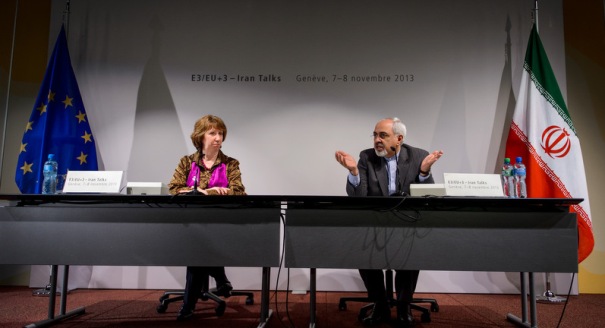
The dramatic developments in Geneva last week demonstrate that the Iranian nuclear issue can be resolved. The details of the future accord are very important, and they may become sticking points for international diplomacy.
The dramatic developments in Geneva last week—substantial progress in the six powers' negotiations with Iran, the urgent gathering of foreign ministers in anticipation of an agreement, and finally the failure in reaching such agreement—demonstrate that the Iranian nuclear issue, one of the most difficult international problems, can be resolved. That France at the last moment came up with objections to the draft on the table postpones the deal, but not necessarily kills it. The crucial fact is that both the leadership in Iran and the Barack Obama administration in the United States definitely want it. The amount of time Secretary of State John Kerry and Iranian Foreign Minister Mohammad Javad Zarif spent together testifies to it.
The details of the future accord are very important, and they may become sticking points for international diplomacy. Even when the agreement is signed, implementing it will not be easy. Trust is still a rare commodity in relations between Iran and its negotiating partners. There are also countries, such as Israel and Saudi Arabia, which are not participating in negotiations, but are taking a much harder line on Iran than the United States. President Obama had to call Prime Minister Benjamin Netanyahu (though not the Saudi king). Lastly, not everyone within Iran and within the United States is applauding the recent progress in negotiations. At this point, anything is still possible.
Yet, one thing is clear. Despite all the talk of Moscow's jealousy over the budding rapprochement between Washington and Tehran, Russia is not about to throw a wrench into the process. In his remarks after the current round of negotiations in Geneva, Foreign Minister Sergey Lavrov publicly singled out John Kerry for his effort in narrowing the differences between Iran and the Six. He hailed the phased and reciprocal approach as the method for moving forward in the talks—something which Moscow had supported and which is now accepted by all. The message Lavrov has been sending is that Russia will not seek to undermine the nuclear negotiations with Iran in order to exploit continued U.S.-Iranian hostility. This is a mature statesmanlike approach. The emerging pattern of U.S.-Russian collaboration on Syria and Iran serves both countries' interests, and aids regional security.
Former Director, Carnegie Moscow Center
Trenin was director of the Carnegie Moscow Center from 2008 to early 2022.
Recent Work
Dmitri Trenin
Dmitri Trenin
Carnegie India does not take institutional positions on public policy issues; the views represented herein are those of the author(s) and do not necessarily reflect the views of Carnegie, its staff, or its trustees.

How is AI reshaping space security, creating governance challenges, and where does international diplomacy stand today?


Tejas Bharadwaj, Almudena Azcárate Ortega

After the chill in ties between 2020 and 2024 that brought India–China relations to their lowest point in several decades, the two countries have engaged each other afresh. This paper argues that there are predominantly four imperatives guiding India’s approach to China, and they exist in an order of priority.

Saheb Singh Chadha

This piece argues that India’s central challenge is not managing a single flashpoint but resolving the underlying tension between expansion and institutional coherency of the BRICS grouping.

Vrinda Sahai

A partnership between India, a country of subcontinental size, and Africa, a continent of fifty-four countries, may seem asymmetric until one notes that both are home to nearly the same number of people—1.4 billion. This essay spells out the existing challenges to the partnership, its optimal potential, and the possible pathways to realize it over the next quarter-century.

Rajiv Bhatia

The U.S.–India semiconductor cooperation story is well-stocked with top-level strategic intent. What remains unresolved, however, are some underlying challenges that will determine whether the cooperation actually functions. Three such friction points stand out.

Shruti Mittal