

Article
Thomas de Waal
{
  "authors": [
    "Thomas de Waal"
  ],
  "type": "commentary",
  "centerAffiliationAll": "",
  "centers": [
    "Carnegie Endowment for International Peace",
    "Carnegie Europe",
    "Carnegie Russia Eurasia Center"
  ],
  "collections": [],
  "englishNewsletterAll": "",
  "nonEnglishNewsletterAll": "",
  "primaryCenter": "Carnegie Europe",
  "programAffiliation": "",
  "programs": [],
  "projects": [
    "Eurasia in Transition"
  ],
  "regions": [
    "Central Asia",
    "Kazakhstan",
    "Caucasus",
    "Russia",
    "Armenia",
    "Eastern Europe",
    "Ukraine",
    "Belarus"
  ],
  "topics": [
    "Economy",
    "Foreign Policy"
  ]
}
Source: Getty
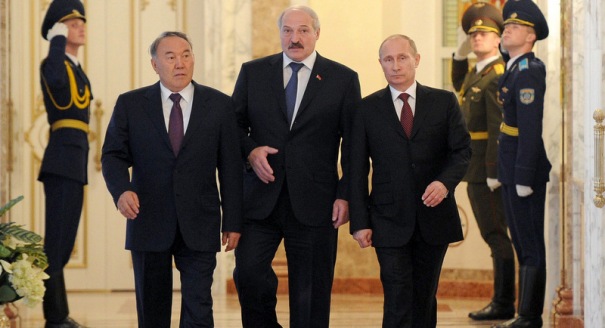
As the focus is all on Putin's effort to reshape his neighborhood this week, a Kazakh and a Belarusian silence is an awkward reminder that the Eurasian Union was supposed to be a collaborative project and that the more Putin grabs the headlines, the less that is the case.
Where are the Kazakhs? This question may sound a little irrelevant as turbulent events continue in Ukraine and after President Vladimir Putin completed his trip to Armenia. We should not be surprised that President Nursultan Nazarbayev has nothing to say about this.
But as the focus is all on Russia this week and on Putin's effort to reshape his neighborhood, a Kazakh (as well as a Belarusian) silence is an awkward reminder that the Eurasian Union was supposed to be a collaborative project and that the more Putin grabs the headlines, the less that is the case.
The first Russian objective has been achieved. That was to stop Ukraine and Armenia from initialing Association Agreements with the European Union at the Vilnius Eastern Partnership summit. (Moldova proved a harder nut to crack and it looks as though Moscow has more or less given up on Georgia). Even now, however, the door is still half-open for Kiev and Yerevan in the future. Three years' work has been done in each capital on those agreements and the train could be restarted quite quickly.
The second part of Putin's agenda, getting these two countries into the Customs Union, is much harder. In the case of Ukraine, President Viktor Yanukovych clearly wants to defer any decision on this for as long as possible—and the events of this week will only have deepened his determination to pursue that "neither-nor" course. Besides, Russia is almost certainly not prepared for the huge challenge of economic reintegration with a country of 45 million people.
In the Armenian case, it is far from clear what the economic rationale is of a customs union with a state which does not share a border with other members. The deal was evidently about security and politics first and trade later. The two governments have set up working groups so as to set Armenia on a fast track to the new union, but all the work so far has basically been done on a Russian-Armenian bilateral basis.
Back in October, both presidents, Nursultan Nazarbayev and Alexander Lukashenko, were much cooler about admitting Armenia than was Putin. Lukashenko publicly doubted if Armenia could join next year. A month later, he visited Baku and told his Azerbaijani hosts that he was much closer to them than to Armenia, saying "we have the same views on the world order." Nazarbayev said, "We are very cautious about admitting new members."
Now, the wily president of Kazakhstan must be looking at the scenes from the Maidan in Kiev and wondering what he has put his name to.

Senior Fellow, Carnegie Europe
Thomas de Waal is a senior fellow at Carnegie Europe, specializing in Eastern Europe and the Caucasus.
Recent Work
Thomas de Waal
Thomas de Waal
Carnegie India does not take institutional positions on public policy issues; the views represented herein are those of the author(s) and do not necessarily reflect the views of Carnegie, its staff, or its trustees.

After the chill in ties between 2020 and 2024 that brought India–China relations to their lowest point in several decades, the two countries have engaged each other afresh. This paper argues that there are predominantly four imperatives guiding India’s approach to China, and they exist in an order of priority.

Saheb Singh Chadha

This piece argues that India’s central challenge is not managing a single flashpoint but resolving the underlying tension between expansion and institutional coherency of the BRICS grouping.

Vrinda Sahai

A partnership between India, a country of subcontinental size, and Africa, a continent of fifty-four countries, may seem asymmetric until one notes that both are home to nearly the same number of people—1.4 billion. This essay spells out the existing challenges to the partnership, its optimal potential, and the possible pathways to realize it over the next quarter-century.

Rajiv Bhatia

The India–EU Free Trade Agreement (FTA) is shaping up to be one of the most consequential trade negotiations, both economically and strategically. But, what’s in the agreement, what’s missing, and what will determine its success in the years ahead
Vrinda Sahai, Nicolas Köhler-Suzuki

On March 10, 2026, India’s Union Cabinet approved amendments to Press Note 3, a regulation that mandated government approval on all foreign direct investment (FDI) from countries sharing a land border with India. This amendment raises questions primarily about whether its stated benefits will materialize and if the risks have been adequately weighed. This piece will address the same.

Konark Bhandari