

Paper
Renée DiResta, Rachel Kleinfeld, Margot Treadwell
{
  "authors": [
    "Rachel Kleinfeld"
  ],
  "type": "legacyinthemedia",
  "centerAffiliationAll": "dc",
  "centers": [
    "Carnegie Endowment for International Peace",
    "Malcolm H. Kerr Carnegie Middle East Center"
  ],
  "collections": [
    "Iranian Proliferation"
  ],
  "englishNewsletterAll": "democracy",
  "nonEnglishNewsletterAll": "",
  "primaryCenter": "Carnegie Endowment for International Peace",
  "programAffiliation": "DCG",
  "programs": [
    "Democracy, Conflict, and Governance",
    "Middle East"
  ],
  "projects": [],
  "regions": [
    "North America",
    "United States",
    "Middle East",
    "Iran"
  ],
  "topics": [
    "Security",
    "Economy",
    "Foreign Policy",
    "Nuclear Policy"
  ]
}
Source: Getty
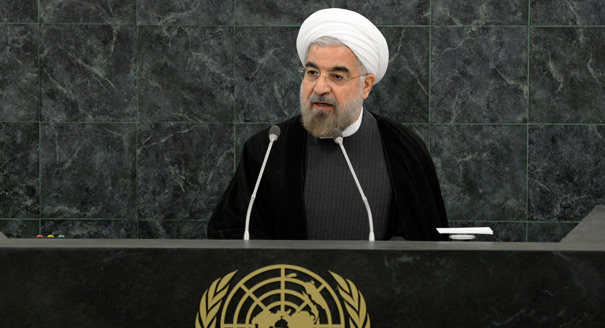
The new government of President Hassan Rouhani may not be moderate, but it is practical. It would like a nuclear weapon, but it wants economic relief more.
Source: San Francisco Chronicle
After the State of the Union address, Sens. Dianne Feinstein and Barbara Boxer won five precious votes. Five more senators stepped back from the brink and joined California's delegation in smart foreign strategy. The issue: one of the only major policies in Obama's otherwise small-ball speech - a nuclear deal that could end Iran's weapons program and stop one of the greatest security threats America faces. It could be one of the most significant acts of this presidency. And the Senate is threatening to destroy it.
The State of the Union revolved around a simple message: It's the economy, stupid. The president needs to focus on jobs and economic strength at home.
Guess what? Iran's president is in exactly the same boat. Since the start of Obama's presidency, his administration and Congress have enacted the toughest sanctions the world has ever known to bring Iran's economy to its knees. The United States has had unilateral sanctions against Iran for decades, but they didn't have much bite. The United States needed to convince more than 50 other countries to create truly global sanctions that froze Iranian assets abroad, denied it access to the international banking system and vastly cut its oil exports.Facing skyrocketing inflation, a collapsing currency and a sudden loss of imported goods, Iranians voted last year to kick out Mahmoud Ahmadinejad and elected a government they thought might jump-start their economy.
The new government of President Hassan Rouhani is not "moderate" - but it is practical. It would like a nuclear weapon, but it wants economic relief more. Rouhani knows his only bargaining chip to end sanctions is to stop the nuclear weapons program.
But the Rouhani government is on a short leash. Iran's supreme leader, Ali Khamenei, holds the ultimate power - and he is skeptical that a deal can be struck. Hardliners in Iran who benefit from sanctions are against it, as are many in the U.S. Congress. Khamenei needs to walk a careful line: If he looks like he's capitulating too much, then he'll face domestic backlash. He knows he has only a few months to deliver.
That is why the congressional threat of more sanctions - even if they take effect only if the deal fails - is so dire. Hardliners and Khamenei will take such legislation as proof that the United States wants regime change, not an end to Iran's nuclear program. Rouhani himself has said that if sanctions legislation passes, negotiations are off.
So why have more than 50 senators signed up as co-sponsors of new sanctions? Some do want regime change. So would we all - Iran is a noxious, terrorist-supporting, human-rights-destroying government. But regime change wouldn't end the security threat. Even the "Green Movement" that marched for democracy a few years ago wanted to obtain a nuclear weapon.
Others think that sanctions got Iran to the negotiating table, so more sanctions will push them even harder. This is a miscalculation. Negotiations have begun. Iran has allowed nuclear inspectors to seal up their nuclear plants. More sanctions will simply seem like bad faith on our part. They also could provide the excuse other countries are looking for to break with the sanctions regime. Bans on oil imports are causing real economic hardship to allies such as Japan who depended on Iran for much of their energy, and export bans are hurting European companies desperate to restart growth. If the United States looks like the bad guy, these governments are likely to give in to domestic pressure and reduce their sanctions against Iran.
Finally, the American Israel Public Affairs Committee is lobbying Congress hard with the message that a vote against sanctions is a vote against Israel. To me, as a Jew and a Zionist, this is not only hogwash: It is allowing an unelected American nongovernmental organization to wrap itself in the Israeli flag while suggesting actions that threaten Israel.
If we cannot end Iran's nuclear program with diplomacy, we will end it through war. Two years ago, the national security organization I founded worked with Pentagon planners on a simulation game to look at what would happen after the United States bombed Iran. In all the possible scenarios, Iran was likely to do one thing: attack Israel to open up a two-front war and further drag America into conflict in the Middle East. A vote for sanctions at this point is a vote for war - and for Iranian missile attacks on Israel.
Luckily, California has two brave senators working to get the votes to stop the slide toward veto-proof sanctions legislation. After the State of the Union address, they got five co-sponsors to punt - for now - in order to make a nonnuclear Iran possible. Sen. Feinstein, chairman of the Senate Intelligence Committee, knows exactly the threat we are up against. She knows, as does Sen. Boxer and the president himself, that negotiating an acceptable deal is going to be difficult, and may not happen. But they also know that the United States is in the strongest position we have ever held in negotiations with Iran. Let's not screw it up.
This article was originally published in the San Francisco Chronicle.

Senior Fellow, Democracy, Conflict, and Governance Program
Rachel Kleinfeld is a senior fellow in Carnegie’s Democracy, Conflict, and Governance Program, where she focuses on issues of rule of law, security, and governance in democracies experiencing polarization, violence, and other governance problems.
Recent Work
Renée DiResta, Rachel Kleinfeld, Margot Treadwell
Political Violence Researchers, Rachel Kleinfeld, ed., Dalya Berkowitz, ed.
Carnegie India does not take institutional positions on public policy issues; the views represented herein are those of the author(s) and do not necessarily reflect the views of Carnegie, its staff, or its trustees.

In any defense establishment, change is an ongoing process. However, despite the best of intentions, existing bureaucracies, bound by habit and years of socialization, have their limits in implementing transformative change.

Anit Mukherjee

How is AI reshaping space security, creating governance challenges, and where does international diplomacy stand today?


Tejas Bharadwaj, Almudena Azcárate Ortega

After the chill in ties between 2020 and 2024 that brought India–China relations to their lowest point in several decades, the two countries have engaged each other afresh. This paper argues that there are predominantly four imperatives guiding India’s approach to China, and they exist in an order of priority.

Saheb Singh Chadha

This piece argues that India’s central challenge is not managing a single flashpoint but resolving the underlying tension between expansion and institutional coherency of the BRICS grouping.

Vrinda Sahai

A partnership between India, a country of subcontinental size, and Africa, a continent of fifty-four countries, may seem asymmetric until one notes that both are home to nearly the same number of people—1.4 billion. This essay spells out the existing challenges to the partnership, its optimal potential, and the possible pathways to realize it over the next quarter-century.

Rajiv Bhatia