

Article
Thomas de Waal
{
  "authors": [
    "Thomas de Waal"
  ],
  "type": "commentary",
  "centerAffiliationAll": "",
  "centers": [
    "Carnegie Endowment for International Peace",
    "Carnegie Europe",
    "Carnegie Russia Eurasia Center"
  ],
  "collections": [],
  "englishNewsletterAll": "",
  "nonEnglishNewsletterAll": "",
  "primaryCenter": "Carnegie Europe",
  "programAffiliation": "",
  "programs": [],
  "projects": [],
  "regions": [
    "Caucasus",
    "Russia",
    "Georgia"
  ],
  "topics": [
    "Security",
    "Foreign Policy"
  ]
}
Source: Getty
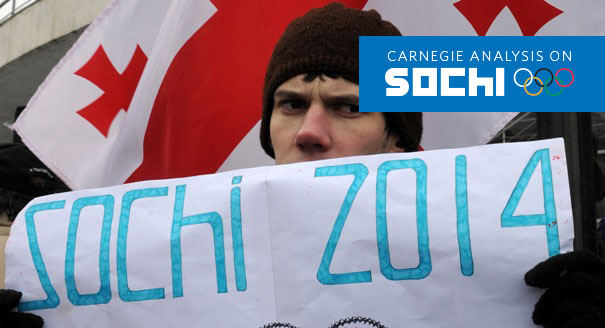
The Sochi Olympics could become the pretext for a real rapprochement between Moscow and Tbilisi. However, conversation between Russia and Georgia about the insurgency in the North Caucasus never started, and in the future this will be remembered as a missed opportunity.
Russia was lucky with the timing. If the vote on the venue of the Winter Olympics had been held in the summer of 2008, rather than a year earlier, the International Olympic Committee would surely not have awarded the 2014 games to a city located right next to a conflict zone.
Since Sochi won the right to host the Olympics in 2007, the region next door has been through war, Russia's recognition of Abkhazia and South Ossetia as independent states and a partial thaw caused by the election of the Georgian Dream government in October 2012.
Had Mikheil Saakashvili's United National Movement won the election in 2012, it is likely that Georgia would have boycotted Sochi and relations between Moscow and Tbilisi would have deteriorated even further.
Instead, for a moment in 2012, it looked as though the Sochi games could become the "peace games," the pretext for a real rapprochement between Moscow and Tbilisi. The new Georgian government announced it would not be boycotting the games. It quietly dropped its politicization of the Circassian issue. The Foreign Minister Maia Panjikidze mused aloud to me that it would be wonderful if she could get in her car and drive across Abkhazia to Sochi.
It was not to be. The Russian-Georgian dialogue established in 2012 has succeeded in restoring trade relations. The Georgian economy has received a boost from getting its wine and agricultural products back on the Russian market. The two sides are discussing visa liberalization.
Georgia is sending four competitors to Sochi and a small delegation from its Olympic Committee. Flights between Tbilisi and Sochi will operate for the duration of the games. The most recent opinion poll says that 66 percent of Georgians approve of their country participating in the games and only 17 percent disapprove.
But one important conversation never started—the one in which Russia and Georgia talk about the never-ending insurgency in the North Caucasus and what the Georgians can do about it. That would have been good for both security and politics. Instead, the Russian government's approach to securing the games has been "Don't talk to the Neighbors." Moscow has actually tightened the borders of Abkhazia and South Ossetia in the past year.
In the future this will surely be remembered as a missed opportunity.

Senior Fellow, Carnegie Europe
Thomas de Waal is a senior fellow at Carnegie Europe, specializing in Eastern Europe and the Caucasus.
Recent Work
Thomas de Waal
Thomas de Waal
Carnegie India does not take institutional positions on public policy issues; the views represented herein are those of the author(s) and do not necessarily reflect the views of Carnegie, its staff, or its trustees.

After the chill in ties between 2020 and 2024 that brought India–China relations to their lowest point in several decades, the two countries have engaged each other afresh. This paper argues that there are predominantly four imperatives guiding India’s approach to China, and they exist in an order of priority.

Saheb Singh Chadha

This piece argues that India’s central challenge is not managing a single flashpoint but resolving the underlying tension between expansion and institutional coherency of the BRICS grouping.

Vrinda Sahai

A partnership between India, a country of subcontinental size, and Africa, a continent of fifty-four countries, may seem asymmetric until one notes that both are home to nearly the same number of people—1.4 billion. This essay spells out the existing challenges to the partnership, its optimal potential, and the possible pathways to realize it over the next quarter-century.

Rajiv Bhatia

The India–EU Free Trade Agreement (FTA) is shaping up to be one of the most consequential trade negotiations, both economically and strategically. But, what’s in the agreement, what’s missing, and what will determine its success in the years ahead
Vrinda Sahai, Nicolas Köhler-Suzuki

This piece argues that the present Indian strategy, based on opportunistic diversification and utilization of limited strategic reserves, remains inadequate when confronting supply disruptions. It evaluates India’s options in the short, medium, and long terms.
Vrinda Sahai