

Commentary
Alexey Malashenko
{
  "authors": [
    "Alexey Malashenko"
  ],
  "type": "commentary",
  "centerAffiliationAll": "",
  "centers": [
    "Carnegie Endowment for International Peace",
    "Carnegie Russia Eurasia Center"
  ],
  "collections": [],
  "englishNewsletterAll": "",
  "nonEnglishNewsletterAll": "",
  "primaryCenter": "Carnegie Russia Eurasia Center",
  "programAffiliation": "",
  "programs": [],
  "projects": [],
  "regions": [
    "Russia",
    "Eastern Europe",
    "Ukraine"
  ],
  "topics": [
    "Security",
    "Foreign Policy",
    "Religion"
  ]
}
Source: Getty
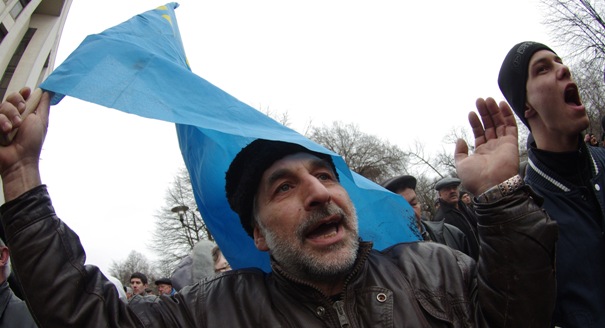
The “Islamic factor” in the Crimean crisis has received relatively little attention so far. However, the complexities of Crimean ethnoreligious realities should not be ignored.
The “Islamic factor” in the Crimean crisis has received relatively little attention so far. It is inconspicuous, especially in light of the fact that the peninsula looks free of interethnic strife and religious conflicts during these troubled times.
However, the complexities of Crimean ethnoreligious realities should not be ignored. While the statistics are quite muddled, 300,000 Muslims, 12-13 percent of the total population, do live in Crimea. We should not forget that political uncertainty may translate into ethnic and religious tensions in no time. The Tatar views on the future of Crimea should also be taken into account. Incidentally, the Tatars are not planning to secede from Crimea and join Russia as of yet.
Radical ideas continue to spread around Crimea. Several Islamic cells have recently sprung up. Evidently, these are the local branches of Muslim Brotherhood and Hizb ut-Tahrir. The latter has already gained a foothold in Russia and is now trying to do the same in Crimea. Hizb-ut Tahrir, which is outlawed in Russia and Central Asian countries, has already tried to organize its conference in Simferopol, receiving some support from the local Tatars.
There were also reports of a few hundred Crimean Muslims fighting alongside the Syrian opposition. Thus, local Islamic radicals have become part of the international extremist community and can count on its support if they feel threatened.
The situation in Crimea is far from stable. In this context, the Muslim community is being wooed by a slew of different political forces, both on the local level, in Kyiv and in Moscow. This is certain to continue well into the future. Naturally, Muslims will exercise their freedom of choice in deciding which side to support.
The Islamic radicals stand to benefit from the instability. First, they will now have an easier time influencing the youth and increasing their ranks. Second, the current power vacuum allows them to strengthen their organizational structure. And, believe me, they will. And who will deal with them later? Who will bear responsibility for the Islamist activities in Crimea? Will it be Moscow? Hasn’t it had enough dealing with the North Caucasus?
And don’t forget Turkey. Ankara will definitely remember Crimea. Actually, it has already remembered it—cautiously, for now.
Former Scholar in Residence, Religion, Society, and Security Program
Malashenko is a former chair of the Carnegie Moscow Center’s Religion, Society, and Security Program.
Recent Work
Alexey Malashenko
Alexey Malashenko
Carnegie India does not take institutional positions on public policy issues; the views represented herein are those of the author(s) and do not necessarily reflect the views of Carnegie, its staff, or its trustees.

In any defense establishment, change is an ongoing process. However, despite the best of intentions, existing bureaucracies, bound by habit and years of socialization, have their limits in implementing transformative change.

Anit Mukherjee

After the chill in ties between 2020 and 2024 that brought India–China relations to their lowest point in several decades, the two countries have engaged each other afresh. This paper argues that there are predominantly four imperatives guiding India’s approach to China, and they exist in an order of priority.

Saheb Singh Chadha

This piece argues that India’s central challenge is not managing a single flashpoint but resolving the underlying tension between expansion and institutional coherency of the BRICS grouping.

Vrinda Sahai

A partnership between India, a country of subcontinental size, and Africa, a continent of fifty-four countries, may seem asymmetric until one notes that both are home to nearly the same number of people—1.4 billion. This essay spells out the existing challenges to the partnership, its optimal potential, and the possible pathways to realize it over the next quarter-century.

Rajiv Bhatia

The India–EU Free Trade Agreement (FTA) is shaping up to be one of the most consequential trade negotiations, both economically and strategically. But, what’s in the agreement, what’s missing, and what will determine its success in the years ahead
Vrinda Sahai, Nicolas Köhler-Suzuki