

In The Media
Lilia Shevtsova
{
  "authors": [
    "Lilia Shevtsova"
  ],
  "type": "commentary",
  "centerAffiliationAll": "",
  "centers": [
    "Carnegie Endowment for International Peace",
    "Carnegie Russia Eurasia Center"
  ],
  "collections": [],
  "englishNewsletterAll": "",
  "nonEnglishNewsletterAll": "",
  "primaryCenter": "Carnegie Russia Eurasia Center",
  "programAffiliation": "",
  "programs": [],
  "projects": [],
  "regions": [
    "North America",
    "United States",
    "Russia",
    "Eastern Europe",
    "Ukraine",
    "Western Europe"
  ],
  "topics": [
    "Political Reform",
    "Democracy",
    "Security",
    "Foreign Policy",
    "Global Governance"
  ]
}
Source: Getty
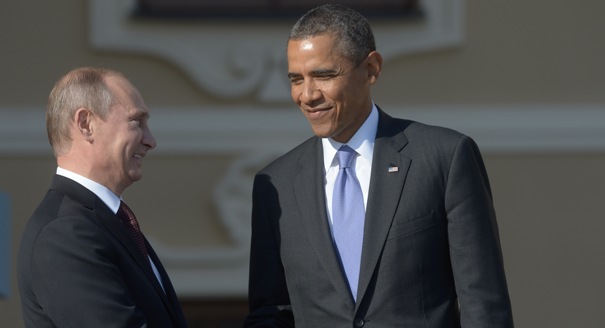
Today’s world is again facing the civilizational choice which was recently expressed in the speeches of Putin and Obama representing two civilizations with starkly different norms.
Apart from turning the global chessboard upside down by annexing Crimea, President Vladimir Putin has done something else—he set the Law of Unintended Consequences in motion, thus awaking the slumbering West, revitalizing the transatlantic ties, and even prompting President Barack Obama to visit Europe. By destroying the post-Cold War order, Putin has forced the world to reflect on this now bygone order as well as on the order that will be more in tune with the contemporary challenges. I will venture a guess that the order that Putin destroyed could not have been stable since it rested on hopes and imitations.
I am referring to Russia and the United States and Putin’s and Obama’s speeches delivered on March 18 and 26 respectively.
For the first time since the collapse of the Soviet Union, the Russian leader so blatantly defined the Russian trajectory—not into the future, but into the past. It is the first time that the Kremlin cast aside its previous attempts to imitate Western principles, announcing its return to the Russian Matrix of the past century. This Matrix is grounded in military force, struggle for territory, containing all alien ideology and moral principles, protecting “Russianness” as the foundation of the empire and the Kremlin’s interpretation of international law.
Putin’s vocabulary lacks the concepts of freedom, dignity, tolerance and diversity. Even his understanding of democracy and constitutional norms proceeds from his understanding of military might and territory. Returning to the sixteenth century values and principles in the twenty-first century apparently does not fluster him.
In stark contrast, President Obama’s address presented an entirely different view of society and the world. True, the American president can be criticized for failing to implement many of his ideas. However, it is all about the principles that he now declared. In fact, he presented an alternative to the Russian Matrix. Obama spoke about society founded on the ideas of freedom, saying that “each of us has the right to live as we chose,” adding that “power is derived from the consent of the governed.” He was talking about the “universal ideas” of freedom, human dignity, rule of law, and individual rights. It was not merely political rhetoric but a different way to conceive of one’s leadership. By saying “We are human, after all, and we face difficult decisions about how to exercise our power,” Obama did not only recognize the limitations imposed on his leadership by the liberal democratic order but also his humanity, hence his right to mistakes and imperfection.
In this respect, Obama is also fundamentally different from Putin, who tried to crush everyone with the royal splendor of his office and a claim to the sanctity of his rhetoric.
We, the experts, can stop arguing on Russia’s trajectory. We just have to read or listen to the speeches of the two presidents to see what they stand for and what abyss separates the two civilizations that they represent.
Former Senior Associate, Russian Domestic Politics and Political Institutions Program, Moscow Center
Shevtsova chaired the Russian Domestic Politics and Political Institutions Program at the Carnegie Moscow Center, dividing her time between Carnegie’s offices in Washington, DC, and Moscow. She had been with Carnegie since 1995.
Recent Work
Lilia Shevtsova
Lilia Shevtsova
Carnegie India does not take institutional positions on public policy issues; the views represented herein are those of the author(s) and do not necessarily reflect the views of Carnegie, its staff, or its trustees.

How is AI reshaping space security, creating governance challenges, and where does international diplomacy stand today?


Tejas Bharadwaj, Almudena Azcárate Ortega

After the chill in ties between 2020 and 2024 that brought India–China relations to their lowest point in several decades, the two countries have engaged each other afresh. This paper argues that there are predominantly four imperatives guiding India’s approach to China, and they exist in an order of priority.

Saheb Singh Chadha

This piece argues that India’s central challenge is not managing a single flashpoint but resolving the underlying tension between expansion and institutional coherency of the BRICS grouping.

Vrinda Sahai

A partnership between India, a country of subcontinental size, and Africa, a continent of fifty-four countries, may seem asymmetric until one notes that both are home to nearly the same number of people—1.4 billion. This essay spells out the existing challenges to the partnership, its optimal potential, and the possible pathways to realize it over the next quarter-century.

Rajiv Bhatia

The U.S.–India semiconductor cooperation story is well-stocked with top-level strategic intent. What remains unresolved, however, are some underlying challenges that will determine whether the cooperation actually functions. Three such friction points stand out.

Shruti Mittal