

Article
C. Raja Mohan, Darshana M. Baruah
{
  "authors": [
    "C. Raja Mohan"
  ],
  "type": "legacyinthemedia",
  "centerAffiliationAll": "dc",
  "centers": [
    "Carnegie Endowment for International Peace",
    "Carnegie India"
  ],
  "collections": [],
  "englishNewsletterAll": "ctw",
  "nonEnglishNewsletterAll": "",
  "primaryCenter": "Carnegie India",
  "programAffiliation": "SAP",
  "programs": [
    "South Asia"
  ],
  "projects": [
    "India Decides 2014"
  ],
  "regions": [
    "South Asia",
    "India",
    "Pakistan"
  ],
  "topics": [
    "Foreign Policy"
  ]
}
Source: Getty
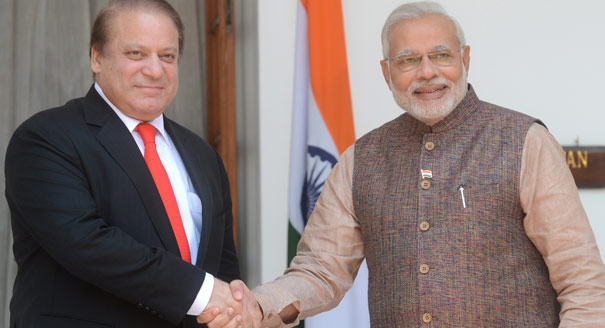
If Narendra Modi is luckier than his predecessors, he might make some progress with Pakistan. However, Modi should be aware that breakthroughs are unlikely amid the country’s current political flux.
Source: Indian Express
Although Pakistan’s Nawaz Sharif will draw most of the media attention at the anointment of Narendra Modi as India’s 14th prime minister at Rashtrapati Bhawan today, there is no underestimating the importance of the seven other regional leaders who will be present at the occasion.
For Modi, Nawaz Sharif’s willingness to show up at the launch of his government is a political bonus. If Modi is luckier than Manmohan Singh and Atal Bihari Vajpayee, he might make some sustainable progress with Pakistan. As a realist, however, Modi should be aware that major breakthroughs are unlikely amid the current political flux within Pakistan and Sharif’s deteriorating relations with the all-powerful army.But it is with the other neighbours that Modi has the opportunity to transact much economic and political business in his five-year tenure as prime minister of India. Modi’s determination to pursue a vigorous regional diplomacy appears to rest on five foundations.
For one, Modi has appreciated the much-neglected fact that foreign policy begins at the nation’s borders. India’s traditional diplomatic discourse is obsessed with grand concepts such as non-alignment and the elusive quest for the leadership of the global South.
It has been rather easy for the Indian strategic community to forget the critical importance of tending one’s own neighbourhood in the subcontinent and the Indian Ocean. Worse still, Delhi has been unwilling to confront and address the reasons for the steady loss of Indian influence in the region over the last many decades. An India that fails to reclaim its primacy in the subcontinent, Modi can now see, can’t really make a lasting impression on the world beyond.
Second, Modi has understood the importance of discarding the diplomatic formalism that has bedevilled India’s engagement with the region. Consider, for example, Manmohan Singh’s legacy on regional diplomacy. In his decade-long tenure as PM, Singh was either unwilling or unable to step across the borders to catch up with the leaders next door. Singh travelled for regional summits once each in Dhaka, Colombo, Thimphu and Male. He travelled twice to Kabul and once each to Dhaka and Thimphu on bilateral business. By any measure, this is a dismal diplomatic record.
In inviting the regional leaders for his inauguration, Modi is suggesting that contacts with the neighbours should be made a matter of routine rather than treated as exceptional occasions. In his interactions with the South Asian leaders after the swearing in, Modi must tell them he is ready to visit all neighbouring countries, including Pakistan, at the earliest and will order his cabinet colleagues to do the same. There is some speculation that Modi might respond positively to the request of Sheikh Hasina, the premier of Bangladesh, to make Dhaka his first foreign destination as India’s prime minister.
Third, at the level of substance, Manmohan Singh had a clear vision that India’s destiny is inextricably linked with that of her neighbours. He articulated the case for regional economic integration and took some important initiatives on trade liberalisation and trans-border connectivity. He was also ready to address long-standing issues with neighbouring countries. He came close to signing agreements with Pakistan on the Siachen and Sir Creek disputes and resolving the land boundary agreement with Bangladesh. He also oversaw the back-channel negotiations with Pakistan that apparently produced a framework accord on Kashmir.
But Manmohan Singh was unable to overcome the political resistance within the Congress party to clinch any of these agreements. The Congress leadership would not let the PM travel to Pakistan even once. It caved to pressures from West Bengal Chief Minister Mamata Banerjee and compelled Manmohan Singh to pull back on the very consequential agreements with Dhaka. Yielding to pressures from Tamil Nadu, the Congress leadership prevented the PM from even travelling to Colombo last year for a multilateral summit.
If the Congress put narrow electoral considerations above India’s national interests in the region, Modi seems ready to uphold the Central government’s responsibility to conduct foreign policy. He can easily follow through by clinching the agreements with neighbours that have already been negotiated and are ready for signature. Modi’s rejection of the protests from the BJP’s allies and others in Chennai against the visit of Sri Lankan President Mahinda Rajapaksa not only underlines India’s new resolve but also improves Delhi’s negotiating leverage with Colombo on the question of Tamil minority rights in Sri Lanka.
Fourth, in inviting the prime minister of Mauritius to the swearing in ceremony, Modi is acknowledging Delhi’s special relationship with the island nation and its Indian diaspora. The new PM is acutely aware of the urgent need to reverse the UPA government’s wanton destruction of this relationship at the very moment when Mauritius was re-emerging as the strategic pivot of the Western Indian Ocean.
Finally, Modi appears to have recognised that India’s ability to deal with great powers like the United States and China will significantly improve only if and when Delhi can reconstitute the geopolitical unity of the subcontinent. For decades, India has complained about US and Chinese strategic partnerships with Pakistan. More recently, India has watched warily as China’s political influence rose rapidly in the subcontinent. Delhi must accept a large portion of the blame for making it easier for outsiders to limit its influence in the region.
Instead of whining about external intervention in the subcontinent, Delhi needs a strategy that builds on India’s natural geographic advantage, economic complementarity, historic role as the regional security provider and a shared cultural inheritance. If Manmohan Singh talked the talk on restoring India’s regional primacy, Modi might have the political will to walk the walk by resolving long-standing political disputes and promoting economic prosperity across the subcontinent.
This article was originally published by the Indian Express.
Former Nonresident Senior Fellow, Carnegie India
A leading analyst of India’s foreign policy, Mohan is also an expert on South Asian security, great-power relations in Asia, and arms control.
Recent Work

C. Raja Mohan, Darshana M. Baruah


Alexander Gabuev, Paul Haenle, C. Raja Mohan, …
Carnegie India does not take institutional positions on public policy issues; the views represented herein are those of the author(s) and do not necessarily reflect the views of Carnegie, its staff, or its trustees.

In any defense establishment, change is an ongoing process. However, despite the best of intentions, existing bureaucracies, bound by habit and years of socialization, have their limits in implementing transformative change.

Anit Mukherjee
As AI grows more sophisticated, as the supply chains that power it become more contested, and as access to frontier models becomes geopolitically charged, India must begin to ask a different set of questions. Not what applications it can build on someone else’s infrastructure but what the world needs.

Konark Bhandari

The Indian Ocean Region hosts one of the densest concentrations of subsea cables in the world. Yet, despite accounting for a significant share of global internet traffic, India’s participation remains limited.

Charukeshi Bhatt

How is AI reshaping space security, creating governance challenges, and where does international diplomacy stand today?


Tejas Bharadwaj, Almudena Azcárate Ortega

After the chill in ties between 2020 and 2024 that brought India–China relations to their lowest point in several decades, the two countries have engaged each other afresh. This paper argues that there are predominantly four imperatives guiding India’s approach to China, and they exist in an order of priority.

Saheb Singh Chadha