

Commentary
Alexey Malashenko
{
  "authors": [
    "Alexey Malashenko"
  ],
  "type": "commentary",
  "centerAffiliationAll": "",
  "centers": [
    "Carnegie Endowment for International Peace",
    "Carnegie Russia Eurasia Center"
  ],
  "collections": [],
  "englishNewsletterAll": "",
  "nonEnglishNewsletterAll": "",
  "primaryCenter": "Carnegie Russia Eurasia Center",
  "programAffiliation": "",
  "programs": [],
  "projects": [],
  "regions": [
    "Russia",
    "Eastern Europe",
    "Ukraine"
  ],
  "topics": [
    "Political Reform",
    "Economy",
    "Foreign Policy"
  ]
}
Source: Getty
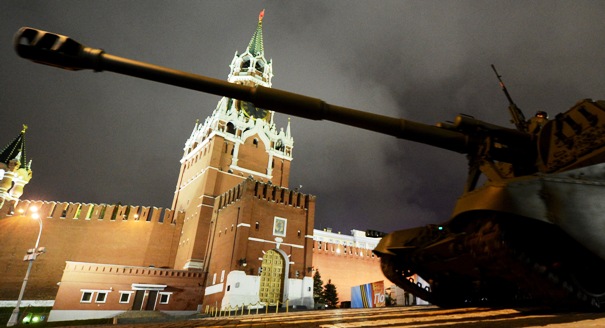
The crisis in Ukraine may lead to unpredictable consequences inside Russia—from another perestroika to complete collapse.
The Ukrainian developments are far from over. The crisis in Ukraine will be a lengthy ordeal which will affect Russia’s foreign policy for quite some time. It will also impact the situation inside the country, which is especially important.
Thanks to his active and successful performance on the Ukrainian stage, President Vladimir Putin has elevated his approval ratings to unprecedented heights. According to a March VCIOM (Russian Public Opinion Research Center) poll, Putin would get 64 percent of the vote if elections were to take place today; 93 percent of the respondents support the annexation of Crimea. Having consolidated most of society around himself, Putin looks like a national hero, the “gatherer of Russian lands,” and is now basking in his glory, believing his charisma will never fade.
The Russian president has appropriated nationalist sentiments, turning them entirely against the West, and primarily against the United States, which has again become public enemy number one, just like in the times of the Cold War. Savoring his victory, Putin probably recalls the Cold War years, when the West swallowed the suppression of the 1956 Hungarian uprising and the 1968 occupation of Czechoslovakia. And he definitely remembers the more recent events of 2008, when Washington and Brussels acquiesced to the “independence” of Abkhazia and South Ossetia.
The Kremlin puts a positive spin on the anti-Russian sanctions. The official propaganda constantly stresses that the sanctions actually contribute to the development of the national economy, particularly its hi-tech segment, and improve the domestic financial system. These statements sound appealing to ordinary Russians, who sincerely believe that their country is indeed completely self-sufficient and capable of functioning, and even progressing, in isolation from the rest of the world.
It may seem that Putin has already secured an optimally long reign. The most impressionable of the analysts and authors are starting to compare his rule to the Soviet times, when only leaders’ deaths could pry them away from power.
However, assertions that Putin can now act as he pleases and that his future is all rosy are debatable. First, sooner or later (most likely, later), the sanctions against Russia, if consistent, will start working and will be felt by the Russian public. Then, people will no longer blame the West, but will take their own government to task. Second, the pragmatic economists, including those at the very top, realize that when economy is held hostage to political ambitions the results can never be positive. While there is no split in the Russian political establishment yet, some dissonance can already be heard. As some Russian politicians exalt the financial infusions into Crimea (13 billion rubles in subsidies) and enthusiastically report on pension increases and seaside vacations there, others are calculating the costs of the new acquisition. They remind us of the deplorable state of the economy—economic growth is expected to fall 0.2 percent this year and is unlikely to exceed one percent. (It is clear that Russia will not be able to financially support the Southeastern Ukraine, where some would dream of repeating the Crimean scenario.)
Third, as Russia’s economic outlook turns grimmer, the conflicts within the ruling class will escalate, and one cannot guarantee that Putin will continue in his role of both patron and mediator. His political resource is directly related to economic indicators, primarily the demand for and the price of hydrocarbons, which will keep falling. It is hard to say when this internal power struggle will take place, but it is clearly unavoidable. This struggle will take on a quintessentially Soviet-Byzantine form of backroom intrigue. Just as 50 years ago, Russia and the rest of the world will learn about it from jokes and rumors.
The conflict’s finale is totally unpredictable—it runs the gamut from another perestroika to complete collapse.
No comparison is perfect, but for what it’s worth… Four years separated the Soviet invasion to Afghanistan (1979) and Gorbachev’s ascension to power (1984). The breakup of the Soviet Union occurred 11 years after the invasion (1991). Shall we start counting?
Former Scholar in Residence, Religion, Society, and Security Program
Malashenko is a former chair of the Carnegie Moscow Center’s Religion, Society, and Security Program.
Recent Work
Alexey Malashenko
Alexey Malashenko
Carnegie India does not take institutional positions on public policy issues; the views represented herein are those of the author(s) and do not necessarily reflect the views of Carnegie, its staff, or its trustees.

After the chill in ties between 2020 and 2024 that brought India–China relations to their lowest point in several decades, the two countries have engaged each other afresh. This paper argues that there are predominantly four imperatives guiding India’s approach to China, and they exist in an order of priority.

Saheb Singh Chadha

This piece argues that India’s central challenge is not managing a single flashpoint but resolving the underlying tension between expansion and institutional coherency of the BRICS grouping.

Vrinda Sahai

A partnership between India, a country of subcontinental size, and Africa, a continent of fifty-four countries, may seem asymmetric until one notes that both are home to nearly the same number of people—1.4 billion. This essay spells out the existing challenges to the partnership, its optimal potential, and the possible pathways to realize it over the next quarter-century.

Rajiv Bhatia

The India–EU Free Trade Agreement (FTA) is shaping up to be one of the most consequential trade negotiations, both economically and strategically. But, what’s in the agreement, what’s missing, and what will determine its success in the years ahead
Vrinda Sahai, Nicolas Köhler-Suzuki

On March 10, 2026, India’s Union Cabinet approved amendments to Press Note 3, a regulation that mandated government approval on all foreign direct investment (FDI) from countries sharing a land border with India. This amendment raises questions primarily about whether its stated benefits will materialize and if the risks have been adequately weighed. This piece will address the same.

Konark Bhandari