

Commentary
Dmitri Trenin
{
  "authors": [
    "Dmitri Trenin"
  ],
  "type": "commentary",
  "centerAffiliationAll": "",
  "centers": [
    "Carnegie Endowment for International Peace",
    "Carnegie Russia Eurasia Center"
  ],
  "collections": [],
  "englishNewsletterAll": "",
  "nonEnglishNewsletterAll": "",
  "primaryCenter": "Carnegie Russia Eurasia Center",
  "programAffiliation": "",
  "programs": [],
  "projects": [],
  "regions": [
    "Russia",
    "Eastern Europe",
    "Ukraine"
  ],
  "topics": [
    "Political Reform",
    "Security",
    "Foreign Policy"
  ]
}
Source: Getty
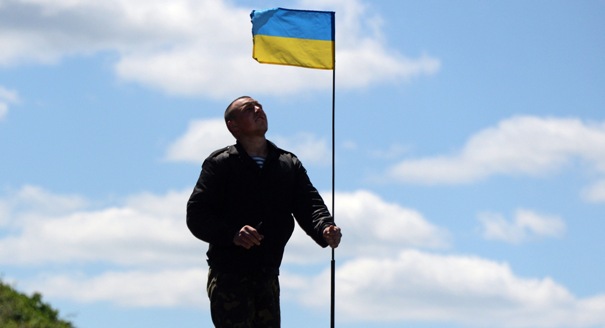
Russia certainly pursues its interests in Ukraine, as does the United States, but the actual forces engaged there are the locals. The victorious Maidan has proven both unwilling and powerless to bridge or stitch together the fault lines which have emerged.
Ten days ago, it was the murderous fire in Odessa. Last Friday, the shooting in Mariupol. Both the actions and the inactions of the interim authorities in Kiev helped to split Ukraine, in the name of saving it. The notion that the prime source of Ukraine’s current troubles lies in the Kremlin and that the Ukrainian military and security forces are facing terrorists in the east is self-delusion. Developments in Ukraine follow their own dynamic, and its pace is quickening. The presidential elections set for May 25 will not bring a magic solution. A point may soon be reached when an internally federalized and internationally neutralized Ukraine—Moscow’s mantra—will not be possible.
One can dismiss the regional referenda as illegal, although it is a weak argument in Ukraine’s post-revolutionary context. One can dismiss the real internal divisions in Ukraine only at one’s own peril. Russia certainly pursues its interests in Ukraine, as does the United States, but the actual forces engaged there are the locals. The victorious Maidan has nudged Ukraine off its post-Soviet immobility, but it has proven both unwilling and powerless to bridge or stitch together the fault lines which have emerged. Ukraine will not die, but it can multiply.
Former Director, Carnegie Moscow Center
Trenin was director of the Carnegie Moscow Center from 2008 to early 2022.
Recent Work
Dmitri Trenin
Dmitri Trenin
Carnegie India does not take institutional positions on public policy issues; the views represented herein are those of the author(s) and do not necessarily reflect the views of Carnegie, its staff, or its trustees.

After the chill in ties between 2020 and 2024 that brought India–China relations to their lowest point in several decades, the two countries have engaged each other afresh. This paper argues that there are predominantly four imperatives guiding India’s approach to China, and they exist in an order of priority.

Saheb Singh Chadha

This piece argues that India’s central challenge is not managing a single flashpoint but resolving the underlying tension between expansion and institutional coherency of the BRICS grouping.

Vrinda Sahai

A partnership between India, a country of subcontinental size, and Africa, a continent of fifty-four countries, may seem asymmetric until one notes that both are home to nearly the same number of people—1.4 billion. This essay spells out the existing challenges to the partnership, its optimal potential, and the possible pathways to realize it over the next quarter-century.

Rajiv Bhatia

The India–EU Free Trade Agreement (FTA) is shaping up to be one of the most consequential trade negotiations, both economically and strategically. But, what’s in the agreement, what’s missing, and what will determine its success in the years ahead
Vrinda Sahai, Nicolas Köhler-Suzuki

This piece argues that the present Indian strategy, based on opportunistic diversification and utilization of limited strategic reserves, remains inadequate when confronting supply disruptions. It evaluates India’s options in the short, medium, and long terms.
Vrinda Sahai