

Article
- +1
Toby Dalton, Mark Hibbs, Nicole Grajewski, …
{
  "authors": [
    "Mark Hibbs"
  ],
  "type": "legacyinthemedia",
  "centerAffiliationAll": "dc",
  "centers": [
    "Carnegie Endowment for International Peace"
  ],
  "collections": [
    "U.S. Nuclear Policy"
  ],
  "englishNewsletterAll": "ctw",
  "nonEnglishNewsletterAll": "",
  "primaryCenter": "Carnegie Endowment for International Peace",
  "programAffiliation": "NPP",
  "programs": [
    "Nuclear Policy"
  ],
  "projects": [],
  "regions": [
    "North America",
    "United States",
    "Middle East",
    "Iran",
    "Israel"
  ],
  "topics": [
    "Nuclear Policy",
    "Arms Control"
  ]
}
Source: Getty
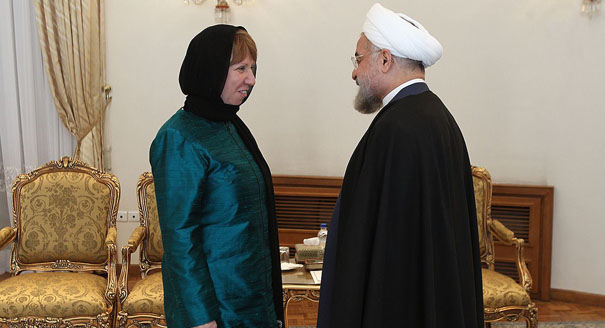
While asserting that Tehran will not surrender its right to nuclear development in upcoming talks with world powers, Iran’s President Rouhani did say that his country would be ‘transparent’ in negotiations over the disputed program.
Source: Voice of Russia
Tehran will not surrender its right to nuclear development in upcoming talks with world powers, Iran’s President said on Sunday. Hassan Rouhani added, however, that his country would be 'transparent' in negotiations over the disputed program.Speaking to a group of medical and nuclear experts, Mr.Rohani appeared to be trying to counter hard-liners in his country, who increasingly criticize the nuclear deal with the world powers for giving too much, while gaining too little from the West.
The Iranian President said that, if the world seeks good relations with Iran, it should - quote – ‘respect the Iranian nation’ and ‘surrender to Iran’s rights’. ‘What we can offer the world is greater transparency’, Mr.Rohani pointed out. Also on Sunday, Iran’s supreme leader Ayatollah Ali Khamenei criticized Western expectations for his country to limit its missile program, describing them as ‘stupid and idiotic’. He accused the West of continuously raising military threats against Iran and added that missiles should be mass-produced. The Voice of Russia talked to Mark Hibbs, Berlin based senior associate in Carnegie’s Nuclear Policy Program.The United States and its allies are worried about its missile program as they fear the weapons could carry nuclear warheads. However, Iran insists that missiles are part of its conventional armed forces and rules out including them on the agenda of the nuclear negotiations.
The talks beginning on Tuesday in Vienna, Austria, are aimed at reaching a comprehensive agreement on Iran’s enrichment program and other nuclear activities in exchange for full sanctions relief. The two sides hope to strike a deal by July 20. Iran has already said it would redesign its Arak heavy water reactor to greatly limit the amount of plutonium it can make. The move is seen as Tehran’s major concession.
There are optimists who feel that a deal could be struck by July 20th+. In the view of others the powers are already taking steps to extend the negotiations beyond July. The narrative that we are hearing suggesting that a deal could be imminent might just be informed by the need to reassure critics in the US and Iran that there is progress being made.
They’ve moved forward but the real problems are yet to come. They have to decide how long the term of the deal would be. The West wants a deal that would 20 years, Iran perhaps wants a deal that would limited to as little as five years. But if we look at the past, we see that the issue of the length of the suspension has been critical.
The suspension is tricky, because while Iran is going to be suspending its uranium enrichment, it wants to continue its R&D activities who would give them a more sophisticated and capable technology during the period of time that they are not actually enriching uranium.
The negotiations address the problem of Iran breaking out. In other words, quickly producing enough enriched uranium to make a nuclear weapon. What is less clear in the architecture of the deal which is being negotiated is how the powers and Iran will address the problems of a potential clandestine activity by Iran. That would require an inspection regime and a transparency mechanism that would have to be set up between Iran, the powers and the IAEA.
This aspect has already led to some differences between, for example, the Russian Federation and the US. An official in the US State Department responsible for these negotiations recently told Congress that the deal with Iran would address this missile program. The officials in Russia countered, by asserting that the missile issue was separate. I don’t know whether the missile program itself would be addressed by the talks. One way out of this dilemma would be to set up a separate but parallel discussion between Iran and the powers about the future of the missile program.
It depends on how the powers and Iran go forward on this. The Iranians claim that this missile program is part of its weapons development for its conventional defense. Others aren’t sharing that view. But the fact is that the missile program is not specifically singled out in the agreement, it is an additional problem.
The Israelis’ statements are to a certain extent informed by the fact that they are not sitting at the table. As far as Iran’s status is concerned, the US for many decades has not had an official bilateral relationship with Tehran and it is in the process of addressing that issue. And I think that the Israelis will understand that the US having a relationship with Iran is in their interest.
My concern here has more to do with how the West will relate to Russia. The Russians do not want to see Iran with nuclear arms, but they also don’t want to see a deal in which the US and the EU emerge with greater leverage and more influence in the Middle East.
This interview was originally published on the Voice of Russia.
Nonresident Senior Fellow, Nuclear Policy Program
Hibbs is a Germany-based nonresident senior fellow in Carnegie’s Nuclear Policy Program. His areas of expertise are nuclear verification and safeguards, multilateral nuclear trade policy, international nuclear cooperation, and nonproliferation arrangements.
Recent Work


Toby Dalton, Mark Hibbs, Nicole Grajewski, …
Mark Hibbs
Carnegie India does not take institutional positions on public policy issues; the views represented herein are those of the author(s) and do not necessarily reflect the views of Carnegie, its staff, or its trustees.

How is AI reshaping space security, creating governance challenges, and where does international diplomacy stand today?


Tejas Bharadwaj, Almudena Azcárate Ortega

The U.S.–India semiconductor cooperation story is well-stocked with top-level strategic intent. What remains unresolved, however, are some underlying challenges that will determine whether the cooperation actually functions. Three such friction points stand out.

Shruti Mittal

India and the United States are close to concluding a Reciprocal Defense Procurement Agreement (RDPA) that will allow firms from the two countries to sell to each other’s defense establishments more easily. While this may not remedy the specific grievances both sides may have regarding larger bilateral issues, an RDPA could restore some momentum, following the trade deal announcement.

Konark Bhandari

On the last day of the India AI Impact Summit, India signed Pax Silica, a U.S.-led declaration seemingly focused on semiconductors. While India’s accession to the same was not entirely unforeseen, becoming a signatory nation this quickly was not on the cards either.
Konark Bhandari

This piece examines India’s response to U.S. sanctions and tariffs, specifically assessing the immediate market consequences, such as alterations in import costs, and the broader strategic implications for India’s energy security and foreign policy orientation.

Vrinda Sahai