

In The Media
Petr Topychkanov
{
  "authors": [
    "Petr Topychkanov"
  ],
  "type": "commentary",
  "centerAffiliationAll": "",
  "centers": [
    "Carnegie Endowment for International Peace",
    "Carnegie Russia Eurasia Center"
  ],
  "collections": [],
  "englishNewsletterAll": "",
  "nonEnglishNewsletterAll": "",
  "primaryCenter": "Carnegie Russia Eurasia Center",
  "programAffiliation": "",
  "programs": [],
  "projects": [],
  "regions": [
    "South Asia",
    "India",
    "Russia"
  ],
  "topics": [
    "Foreign Policy"
  ]
}
Source: Getty
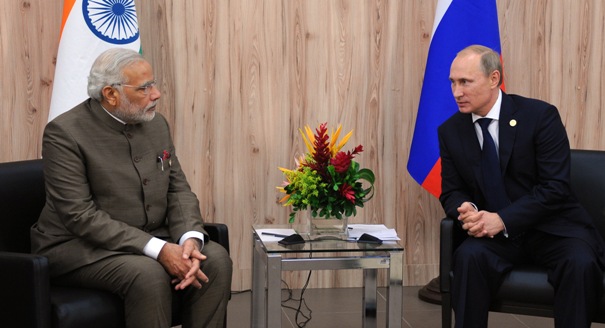
Narendra Modi’s and his associates’ foreign policy experience will guide them toward a balanced policy in which Russia will play one of the key roles.
New figures are at the helm in India. An outside observer might think that some of them have little foreign policy experience. Some may call Narendra Modi’s international relations’ expertise into question.
In reality, Modi and his associates do have foreign policy experience. This experience will guide them toward a balanced policy in which Russia will play one of the key roles.
Narendra Modi has given Russia special attention more than once. Russian Deputy Prime Minister Dmitry Rogozin became only the second foreign politician to be seen by the new Indian prime minister on June 19 (Chinese Foreign Minister Wang Yi was the prime minister’s first guest on June 9).
Meeting the Russian president and deputy prime minister was not Narendra Modi's first exposure to Russia. In fact, back on June 6, 2001, President Putin and then Indian Prime Minister Atal Bihari Vajpayee signed a protocol of cooperation between the Astrakhan Region and the State of Gujarat (Narendra Modi as a member of the Indian delegation at the time). The protocol was renewed in 2006 during the visit of the delegation headed by Narendra Modi to the Astrakhan Region. In recent years, the relations between the Russian region and the Indian state have developed rapidly. Astrakhan and Allahabad became sister cities. In October 2009, Narendra Modi made his third trip to Russia—this time to participate in the International Energy Week.
As for the prime minister’s inner circle, the legendary figure of the National Security Advisor Ajit Kumar Doval looms particularly large. This post cannot fit all of his famous exploits, and many pages of his biography still remain classified. But even the known facts testify to his knowledge of Russia and a long record of cooperation with this country. As a head of the Intelligence Bureau’s operation wing in the 1990’s—the post he had held for ten years, Ajit Doval was involved in organizing the effort to assist Afghanistan’s Northern Alliance, which was supported by Russia, India, and Iran. It is clear that he had numerous contacts with the Russian side in the course of the three country’s cooperation on this issue.
The above examples demonstrate that the new Indian authorities know Russia, understand how to work with it and are willing to develop India-Russia relations.
Former Fellow, Nonproliferation Program, Moscow Center
Topychkanov was a fellow in the Carnegie Moscow Center’s Nonproliferation Program.
Recent Work
Petr Topychkanov
Petr Topychkanov
Carnegie India does not take institutional positions on public policy issues; the views represented herein are those of the author(s) and do not necessarily reflect the views of Carnegie, its staff, or its trustees.

This piece argues that the present Indian strategy, based on opportunistic diversification and utilization of limited strategic reserves, remains inadequate when confronting supply disruptions. It evaluates India’s options in the short, medium, and long terms.

Vrinda Sahai
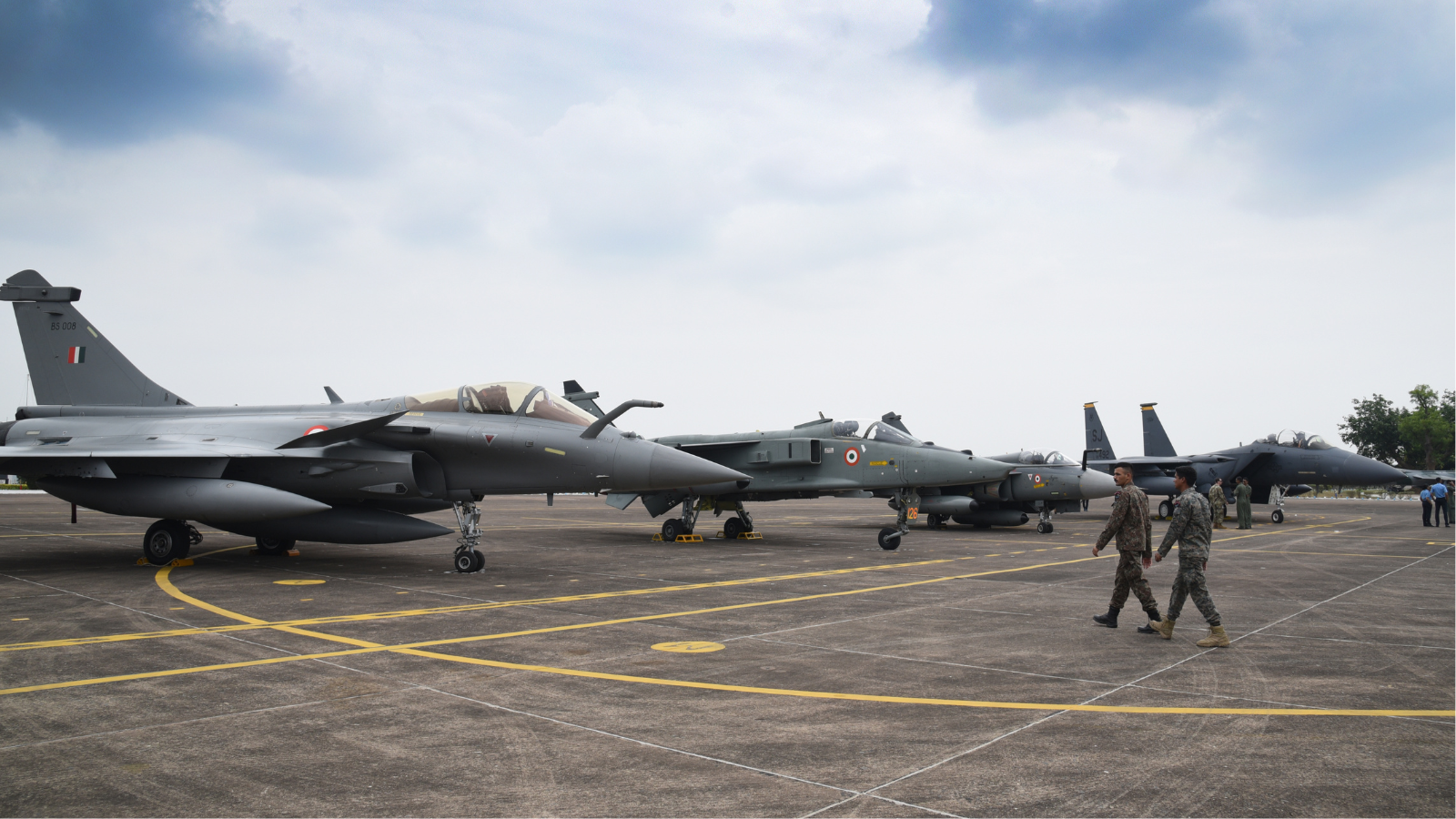
India and the United States are close to concluding a Reciprocal Defense Procurement Agreement (RDPA) that will allow firms from the two countries to sell to each other’s defense establishments more easily. While this may not remedy the specific grievances both sides may have regarding larger bilateral issues, an RDPA could restore some momentum, following the trade deal announcement.

Konark Bhandari

On the last day of the India AI Impact Summit, India signed Pax Silica, a U.S.-led declaration seemingly focused on semiconductors. While India’s accession to the same was not entirely unforeseen, becoming a signatory nation this quickly was not on the cards either.
Konark Bhandari

On January 12, 2026, India's "workhorse," the Polar Satellite Launch Vehicle, experienced a consecutive mission failure for the first time in its history. This commentary explores the implications of this incident on India’s space sector and how India can effectively address issues stemming from the incident.

Tejas Bharadwaj
Connecting real-world AI use cases across sectors such as health, education, agriculture, and livelihoods can help policymakers, innovators, and institutions align around a shared goal. This article looks at a framework ensuring that AI works for everyone.
Shalini Kapoor, Tanvi Lall