

Article
C. Raja Mohan, Darshana M. Baruah
{
  "authors": [
    "C. Raja Mohan"
  ],
  "type": "legacyinthemedia",
  "centerAffiliationAll": "dc",
  "centers": [
    "Carnegie Endowment for International Peace",
    "Carnegie India"
  ],
  "collections": [],
  "englishNewsletterAll": "ctw",
  "nonEnglishNewsletterAll": "",
  "primaryCenter": "Carnegie India",
  "programAffiliation": "SAP",
  "programs": [
    "South Asia"
  ],
  "projects": [],
  "regions": [
    "India",
    "Oceania",
    "South Asia"
  ],
  "topics": [
    "Foreign Policy",
    "Security"
  ]
}
Source: Getty
There is a growing recognition in New Delhi that Australia is a valuable partner in stabilizing Asia.
Source: Indian Express
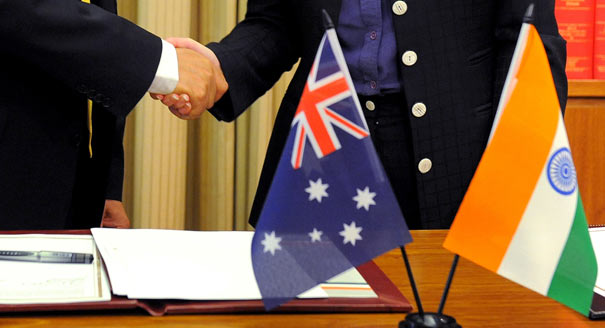
When they meet in New Delhi on Friday, Prime Minister Narendra Modi and his Australian counterpart Tony Abbott should, hopefully, clinch the long-awaited agreement on civil nuclear cooperation that would allow Canberra to export uranium to India. But the two leaders should also look beyond the nuclear issue and lay the foundation for an enduring defence and security cooperation that will contribute to peace and stability in Asia and the Indo-Pacific littoral.
The nuclear deal is indeed an important breakthrough in bilateral relations. It is, in essence, about burying the past when differences over non-proliferation issues constrained the engagement between the two countries. These differences boiled over when Australia reacted sharply to the Indian nuclear tests in May 1998. Canberra found it hard to export uranium even after Delhi concluded a historic civil nuclear initiative with Washington that ended more than three decades of India’s atomic isolation. There were deep divisions within the Australian political class on allowing uranium exports to India.
As part of its strong and unilateral non-proliferation commitments, Australia had decided long years ago that it would not export uranium to countries that did not sign the nuclear non-proliferation treaty. The problem for Australia was that the India-US nuclear initiative was about finding a way to circumvent the question of the NPT. While India was not in a position to sign the NPT, it offered strong assurances to the international community that it would not use material and technology obtained through international cooperation for military purposes. India also reaffirmed its impeccable non-proliferation record and expressed full support for the global non-proliferation regime. The challenge in Australia was to get the political elite to look beyond the NPT, understand the value of India’s integration into the global nuclear order and, above all, appreciate the broader benefits of building a lasting partnership with Delhi.To their credit, Prime Minister Abbott and his predecessors in both Liberal and Labor parties have worked hard to overcome internal political differences and get the country to change its long-standing policy on uranium exports by taking a strategic view of relations with India. Once the deal is through, Australia could become an important source of natural uranium exports.
The real story, however, lies beyond uranium. Australia is rich in mineral resources and is a natural long-term partner for India’s industrial growth. Whichever way Delhi’s strategy for energy security might evolve in the coming years, Australia, with its abundant coal and natural gas resources, will loom large in India’s calculus. With one of the world’s strongest mining sectors, Australia can help India exploit its own natural resources in an environmentally sustainable way and thereby address one of the major current constraints on India’s economic growth.
Contrary to the perception that the country is all about mining, Australia boasts of a strong science and technology base that can feed nicely into India’s plans for economic and industrial advancement. Australia is also home to a prosperous and rapidly growing Indian minority that is emerging as an important bridge between the two countries.
While the natural complementarities in the economic domain are beginning to express themselves, much political work remains to be done on boosting security cooperation between the two countries. For long, Delhi and Canberra have remained far apart in Asia despite shared political values. During the Cold War, Delhi viewed Canberra as merely extending US power in Asia. Canberra, in turn, saw India as aligned with the Soviet Union. The end of the Cold War and the improvement in Indo-US relations set a very different stage for the bilateral relationship.
Canberra’s relentless wooing of Delhi in recent years has begun to change Indian perceptions. There is growing recognition in Delhi today that Australia, which brings so many independent strategic equities to the table, is a valuable partner for India in stabilising Asia and the Indo-Pacific littoral. Asia’s changing geopolitical context — the rise of Chinese power, Beijing’s growing assertiveness on territorial disputes, the uncertainties in the US policy towards the region and the emerging fissures in regional institutions — demands that India and Australia strengthen their bilateral partnership as well as reach out to third parties.
When then Prime Minister Julia Gillard came to India, nearly three years ago, the two sides agreed to initiate a trilateral dialogue with Indonesia. Modi and Abbott must now draw Japan into a similar framework. These expanding circles of engagement among regional powers would help reduce Asia’s vulnerabilities to the twists and turns in the US-China relationship.
Delhi and Canberra must complement this by deepening their own bilateral defence cooperation. Last year, A.K. Antony became the first Indian defence minister to visit Australia. But the MoD’s lack of interest in defence diplomacy under the UPA government means that the two sides are a long way from realising the full potential of bilateral security cooperation.
As Modi outlines a vigorous approach to Asia and Abbott brings great enthusiasm for the India partnership, the two leaders must boldly push for strong defence ties. Besides military exercises that have already been agreed upon, Delhi and Canberra must begin sharing naval intelligence and pool maritime assets dispersed across the Indo-Pacific. They should also initiate joint training and operations with other Asian partners, like Indonesia, Vietnam, Singapore and Japan, who share the objectives of freedom of navigation and security of the sea lines of communication.
This article was originally published in the Indian Express.
Former Nonresident Senior Fellow, Carnegie India
A leading analyst of India’s foreign policy, Mohan is also an expert on South Asian security, great-power relations in Asia, and arms control.
Recent Work

C. Raja Mohan, Darshana M. Baruah


Alexander Gabuev, Paul Haenle, C. Raja Mohan, …
Carnegie India does not take institutional positions on public policy issues; the views represented herein are those of the author(s) and do not necessarily reflect the views of Carnegie, its staff, or its trustees.

In any defense establishment, change is an ongoing process. However, despite the best of intentions, existing bureaucracies, bound by habit and years of socialization, have their limits in implementing transformative change.

Anit Mukherjee

As AI grows more sophisticated, as the supply chains that power it become more contested, and as access to frontier models becomes geopolitically charged, India must begin to ask a different set of questions. Not what applications it can build on someone else’s infrastructure but what the world needs.

Konark Bhandari

The Indian Ocean Region hosts one of the densest concentrations of subsea cables in the world. Yet, despite accounting for a significant share of global internet traffic, India’s participation remains limited.

Charukeshi Bhatt

How is AI reshaping space security, creating governance challenges, and where does international diplomacy stand today?


Tejas Bharadwaj, Almudena Azcárate Ortega

After the chill in ties between 2020 and 2024 that brought India–China relations to their lowest point in several decades, the two countries have engaged each other afresh. This paper argues that there are predominantly four imperatives guiding India’s approach to China, and they exist in an order of priority.

Saheb Singh Chadha