

Commentary
Dmitri Trenin
{
  "authors": [
    "Dmitri Trenin"
  ],
  "type": "commentary",
  "centerAffiliationAll": "",
  "centers": [
    "Carnegie Endowment for International Peace",
    "Carnegie Russia Eurasia Center"
  ],
  "collections": [],
  "englishNewsletterAll": "",
  "nonEnglishNewsletterAll": "",
  "primaryCenter": "Carnegie Russia Eurasia Center",
  "programAffiliation": "",
  "programs": [],
  "projects": [],
  "regions": [
    "North America",
    "United States",
    "Russia"
  ],
  "topics": [
    "Political Reform",
    "Foreign Policy"
  ]
}
Source: Getty
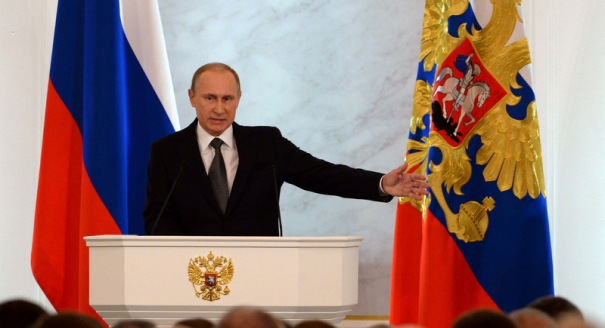
Vladimir Putin’s annual address to parliament on December 4, 2014 has laid down the Kremlin's medium-term strategy. The next four or five years will be very difficult if not critical for Russia, and the Russians, in Putin’s view, absolutely must meet the challenges and win.
Vladimir Putin’s annual address to parliament on December 4, 2014 has laid down the Kremlin's medium-term strategy. It can be summarized as follows:
Putin’s address was directed first and foremost at the Russian people. It has often been assumed that Russians are at their best when things are worst for them, and certainly the economic situation today is very precarious. Putin has decided “not to waste a good crisis,” and wants to use the challenge of Western sanctions and the low oil price as leverage for the country's economic revival. For years, the Russian government only talked about “getting off the oil needle,” but it is only now that it has run out of easier options and has to start doing something about it. Will it be able to do perform that feat?
Vladimir Putin’s most serious and glaring weakness in his 15 years in power has been his failure to come up with a realistic strategy of economic development. He—and Russia—were instead helped by high and rising oil prices, which of course did not create a momentum for reform. Now, the relatively low and falling prices appear to create such a momentum, as Putin’s pro-business initiatives indicate. However, these initiatives will be devalued if not backed up by genuine political will to make the legal system produce justice for all, and by a sustained effort to severely reduce institutionalized corruption. Government transparency and accountability is another indispensable condition.
On the foreign policy front, the Russian president said few new things, but some of the things he had said before were conspicuous for their absence. Thus, he did not mention either the Russian world, Novorossiya, or Donbass. His reference to Crimea’s Khersones, where Grand Duke Vladimir of Kiev was baptized in 988 as a Temple Mount-like sacred place for Russians may suggest that it is Crimea, rather than Kiev, where Vladimir later baptized his subjects and which has long carried the title of the “mother of Russian cities,” is now viewed as the "spiritual fountain" of the Russian people.
The recent moves to bolster the cease-fire agreement in Donbass and some practical economic arrangements and ongoing private dialogue between Moscow and Kiev indicate that Russia is seeking to stabilize its “Ukrainian front” on the basis of a formula: Crimea is ours; Eastern Ukraine is Ukrainian (on certain conditions). True: even a partial accommodation in, with and over Ukraine would push back the danger of an all-out hot war in Europe’s east, but a comprehensive conflict settlement there is at best years away.
To the United States, Putin offered no concessions: the more Moscow backs down, he said, the greater the pressure on it. To Putin, Western powers, now primarily the United States, have always sought to prevent the emergence of a strong Russia, or to contain it when it did emerge. To Putin, parallels between the U.S.-led Western sanctions and Hitler's invasion of Russia is not too far-fetched. Yet, he has pledged to avoid self-isolation and xenophobia, and approved of continuing cooperation against terrorism and the spread of the Ebola virus. He has also refrained from threatening America and its allies with Russia turning its back on them and seeking to build an anti-Western alliance. Expanded ties to non-Western countries were described in the speech as a complement to Russia’s ties to the West. Thus, while Putin's criticism of the United States and its “on-sovereign” allies was as harsh as ever, the actual import of the message was relatively measured.
This promises a long period of Russian-U.S./Western confrontation, which absolutely needs to be ensured against degenerating into an open military clash; which will require reliable channels for dialogue and credible partners to engage in it; and a provisional set of ground rules—until the outcome of the competition becomes clear and a settlement is in sight. Unlike Putin’s medium-term strategy, this will probably be for the long haul.
Former Director, Carnegie Moscow Center
Trenin was director of the Carnegie Moscow Center from 2008 to early 2022.
Recent Work
Dmitri Trenin
Dmitri Trenin
Carnegie India does not take institutional positions on public policy issues; the views represented herein are those of the author(s) and do not necessarily reflect the views of Carnegie, its staff, or its trustees.

How is AI reshaping space security, creating governance challenges, and where does international diplomacy stand today?


Tejas Bharadwaj, Almudena Azcárate Ortega

After the chill in ties between 2020 and 2024 that brought India–China relations to their lowest point in several decades, the two countries have engaged each other afresh. This paper argues that there are predominantly four imperatives guiding India’s approach to China, and they exist in an order of priority.

Saheb Singh Chadha

This piece argues that India’s central challenge is not managing a single flashpoint but resolving the underlying tension between expansion and institutional coherency of the BRICS grouping.

Vrinda Sahai

A partnership between India, a country of subcontinental size, and Africa, a continent of fifty-four countries, may seem asymmetric until one notes that both are home to nearly the same number of people—1.4 billion. This essay spells out the existing challenges to the partnership, its optimal potential, and the possible pathways to realize it over the next quarter-century.

Rajiv Bhatia

The U.S.–India semiconductor cooperation story is well-stocked with top-level strategic intent. What remains unresolved, however, are some underlying challenges that will determine whether the cooperation actually functions. Three such friction points stand out.

Shruti Mittal