

In The Media
Lina Khatib
{
  "authors": [
    "Lina Khatib"
  ],
  "type": "legacyinthemedia",
  "centerAffiliationAll": "dc",
  "centers": [
    "Carnegie Endowment for International Peace",
    "Malcolm H. Kerr Carnegie Middle East Center"
  ],
  "collections": [],
  "englishNewsletterAll": "menaTransitions",
  "nonEnglishNewsletterAll": "",
  "primaryCenter": "Malcolm H. Kerr Carnegie Middle East Center",
  "programAffiliation": "MEP",
  "programs": [
    "Middle East"
  ],
  "projects": [],
  "regions": [
    "Gulf",
    "Saudi Arabia",
    "Yemen",
    "Middle East"
  ],
  "topics": [
    "Political Reform",
    "Security",
    "Military",
    "Foreign Policy"
  ]
}
Source: Getty
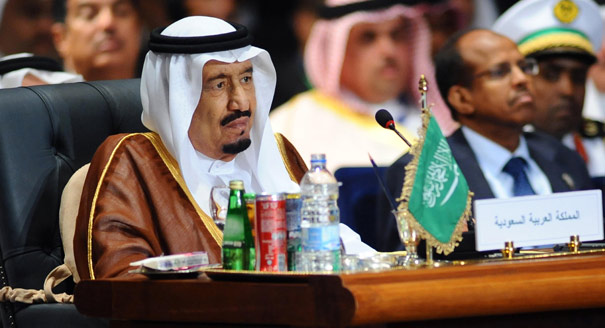
Saudi Arabia is saying that Gulf security is the Arab region’s security and, from now on, Arab states should look to Riyadh for direction to deal with the region’s political and security challenges.
Source: Independent
The Arab League’s declaration of the establishment of a joint Arab military force comes hot on the heels of the escalation of the Yemen conflict, but both Yemen and the league’s declaration are about more than stabilization. They are also about restoring Saudi influence in the Middle East.
Saudi Arabia used to be a major political broker in the region, but its role has declined in recent years largely as a result of internal power struggles within the royal family, which have meant its foreign policy sometimes lacked coherence. Yemen has witnessed the consequences of this.
The Saudis agreed that the 2011 uprising in Yemen against president Ali Abdullah Saleh threatened their interests and consequently led an initiative by the Gulf Cooperation Council to transfer power from Saleh to his deputy Abd Rabbuh Mansur Hadi. But they did not have a unified vision for what to do about Saleh. As a result, he stayed in Yemen and was able to lead his own political party and plan a comeback. Some Saudis also believed in keeping channels open with the Houthis, as they were opposed to the Muslim Brotherhood, while others painted the Houthis as dangerous proxies of Saudi’s nemesis, Iran.The incoherence in Saudi policy encouraged Saleh, the Houthis and Iran to try to increase their influence in Yemen. It also paved the way for extremist groups, namely Al-Qaeda in the Arabian Peninsula (AQAP) and Islamic State (ISIS), to attempt to utilize Yemen as a hotbed of terrorism. The ensuing Houthi rebellion that began last September threatened to pull the country towards not just a civil war but also a regional conflict because of the involvement of transnational groups like AQAP and ISIS. This was a wake-up call for Saudi Arabia.
By leading a multinational force to quell the Houthi rebellion Saudi Arabia is making a show of decisiveness against those escalating threats. This is affirmed by the name given to the operation: “Decisive Storm.” The backing of the West gives Saudi’s position legitimacy. The participation of Sunni-majority countries such as Pakistan is also a strong message to Iran, that it cannot control the Sunni-majority Arab world, especially the Gulf.
The kingdom is saying that Gulf security is the Arab region’s security and, from now on, Arab states should look to Riyadh for direction to deal with the region’s political and security challenges.
Former Director, Middle East Center
Khatib was director of the Carnegie Middle East Center in Beirut. Previously, she was the co-founding head of the Program on Arab Reform and Democracy at Stanford University’s Center on Democracy, Development, and the Rule of Law.
Recent Work
Lina Khatib
Lina Khatib
Carnegie India does not take institutional positions on public policy issues; the views represented herein are those of the author(s) and do not necessarily reflect the views of Carnegie, its staff, or its trustees.

In any defense establishment, change is an ongoing process. However, despite the best of intentions, existing bureaucracies, bound by habit and years of socialization, have their limits in implementing transformative change.

Anit Mukherjee

After the chill in ties between 2020 and 2024 that brought India–China relations to their lowest point in several decades, the two countries have engaged each other afresh. This paper argues that there are predominantly four imperatives guiding India’s approach to China, and they exist in an order of priority.

Saheb Singh Chadha

This piece argues that India’s central challenge is not managing a single flashpoint but resolving the underlying tension between expansion and institutional coherency of the BRICS grouping.

Vrinda Sahai

A partnership between India, a country of subcontinental size, and Africa, a continent of fifty-four countries, may seem asymmetric until one notes that both are home to nearly the same number of people—1.4 billion. This essay spells out the existing challenges to the partnership, its optimal potential, and the possible pathways to realize it over the next quarter-century.

Rajiv Bhatia

The India–EU Free Trade Agreement (FTA) is shaping up to be one of the most consequential trade negotiations, both economically and strategically. But, what’s in the agreement, what’s missing, and what will determine its success in the years ahead
Vrinda Sahai, Nicolas Köhler-Suzuki