Source: McClatchy DC
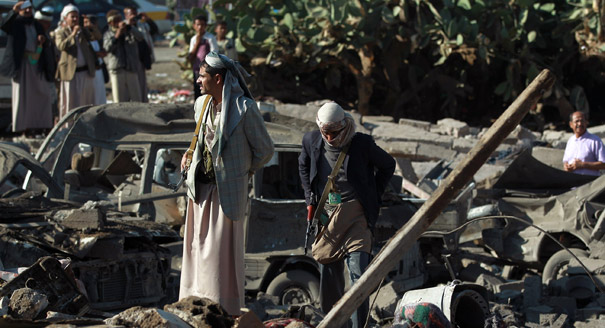
SANAA, Yemen — Saudi warplanes bombed a military airbase at Sanaa’s civilian airport and struck at other strategic locations in a sudden air campaign aimed at halting the advance of Iranian-backed Houthi rebels.
Residents packed their cars and fled the capital by every available route, and local news outlets reported at least 20 people killed and 50 wounded by the air assault, which involved more than 100 aircraft and hundreds of bombs.
Houthi authorities responded to the air raids, which began about 1 a.m., at first with silence and then with a series of moves that seemed unplanned and panicky. Thursday evening, Houthi backers began arresting local and foreign journalists.
Saudi Arabia said it had acted in response to a plea from Yemen’s internationally recognized president, Abed Raboo Mansour Hadi, to the Arab League to “immediately use all means necessary, including military intervention, to protect Yemen and its people.”
Hadi later surfaced in the Saudi capital of Riyadh, saying he would attend an Arab League summit Saturday in Cairo, though many Yemenis thought that was merely an excuse for his having fled the country.
Seven other Arab countries, all ruled by Sunni Muslims, agreed to join the bombing campaign against the Shiite Muslim Houthis – Bahrain, Egypt, Jordan, Kuwait, Morocco, Sudan, Qatar and the United Arab Emirates – and Egypt said it also would send naval forces.
Pakistan, the Islamic world’s only nuclear power, said it would not send troops for now; Turkey said it was considering providing support.
Saudi Arabia said it had mobilized 150,000 troops, but a military spokesman said Thursday night that there was no immediate plan to send in ground forces.
The U.S. responded to the Saudi intervention with low-key statements condemning “ongoing military actions” by the Houthis against Hadi’s government and calling on the rebels to return to negotiations and political dialogue.
Secretary of State John Kerry, speaking with Persian Gulf foreign ministers, “commended the work of the coalition taking military action against the Houthis” and said the U.S. would provide intelligence, targeting assistance and logistical support.
Iran is reported to have provided arms, training, and financial and political support to the Houthis, who like most Iranians are Shiite Muslims. Top officials in Iran’s Revolutionary Guard have boasted in public statements that Yemen is part of an expanding Iranian empire.
But Iran’s initial response to the Saudi intervention also was low key, suggesting that its unelected supreme leader, Ayatollah Ali Khamenei, has no desire to trigger a regional war pitting Sunni Saudi Arabia and its allies against Shiite Iran and its allies.
Iranian Foreign Minister Mohammad Javad Zarif called for an “immediate halt to Saudi Arabia’s military operations in Yemen” and promised that Iran would undertake “all our efforts to control the crisis.” The Iranian Foreign Ministry called the intervention a “dangerous” move that would further complicate the situation in Yemen, which in addition to the government, its Houthi opponents and ever-shifting tribes has a substantial terrorist group affiliated with al Qaida.
The Saudi intervention followed advances by the Houthis in the past week on key military bases and the southern port of Aden.
Many Yemenis were stunned last week when Yemeni airplanes attempted to strafe Hadi’s lodgings in Aden. But the use of the aircraft only served to bolster the belief of many that former President Ali Abdullah Saleh, who was eased from power two years ago but maintains close ties to some parts of the Yemeni military, was siding with the rebels.
Residents of Sanaa were anxious at the course of events and angry that the Houthis had pushed tensions to the point of an outside intervention.
The Saudis announced the intervention – dubbed “Decisive Storm” – in Washington Wednesday night, but top U.S. military officials said they had only limited advance notice before the bombing began.
The Houthis also were caught flat-footed, and it took hours to crank up their publicity machine.
One of the first to post a response – on his Facebook page – was Houthi leader Salah al-Ezi, who warned that Yemenis, “the people of wisdom, will not submit to the rulers of the devil’s horn,” a reference to Saudi Arabia. “Yemen is the cemetery of invaders,” he said. “Tomorrow, you will know what sin you committed when declaring ‘Decisive Storm.’”
Thursday evening, the group’s overall leader, Abdel-Malek al-Houthi, gave a speech on the group’s Al Masirah television station in which he issued a series of vague warnings of unstated consequences if the Saudis send in ground forces. “Yemen is far more powerful than you imagine,” he said.
The only plan that seemed in play Thursday, however, was to close the Saeedah television channel, Yemen’s most independent. So-called popular committees also ransacked news organizations and arrested at least five reporters.
In his TV appearance, Houthi appeared anxious and under pressure. Few analysts thought it likely Iran would come to the Houthis’ defense.
“They are giving them military advice, and financial support, but the commitment is far less than they are making in Syria and Iraq,” said Michael Stephens of the Royal United Services Institute, a London military think tank. “They are capitalizing on regional instability.”
Meanwhile, Pakistan rebuffed a request from Saudi King Salman to Pakistani Prime Minister Nawaz Sharif during a visit to Riyadh earlier this month for troops. The Pakistani military said it could not spare the manpower from its fight with Taliban radicals in the tribal regions near the Afghan border.
The government said in a statement that “any threat to Saudi Arabia’s territorial integrity would evoke a strong response from Pakistan,” but it didn’t extend the pledge to Saudi Arabia’s presence in Yemen.
This article was originally published by McClatchy DC.