

• Research
  • About
  • Experts
Carnegie India logoCarnegie lettermark logo
{
  "authors": [
    "Alexey Arbatov"
  ],
  "type": "legacyinthemedia",
  "centerAffiliationAll": "",
  "centers": [
    "Carnegie Endowment for International Peace",
    "Carnegie Russia Eurasia Center"
  ],
  "collections": [],
  "englishNewsletterAll": "",
  "nonEnglishNewsletterAll": "",
  "primaryCenter": "Carnegie Endowment for International Peace",
  "programAffiliation": "",
  "programs": [],
  "projects": [
    "Eurasia in Transition"
  ],
  "regions": [
    "North America",
    "United States",
    "Russia",
    "Eastern Europe",
    "Ukraine"
  ],
  "topics": [
    "Security",
    "Military",
    "Foreign Policy",
    "Nuclear Policy",
    "Arms Control"
  ]
}

Source: Getty

In The Media

Protecting Nuclear Sanity

Dialogue between Russia and the United States is needed to defuse tension and tone down irresponsible statements on both sides about nuclear weapons.

Link Copied
By Alexey Arbatov
Published on Jun 15, 2015
Project hero Image

Project

Eurasia in Transition

Learn More

Source: Defense News

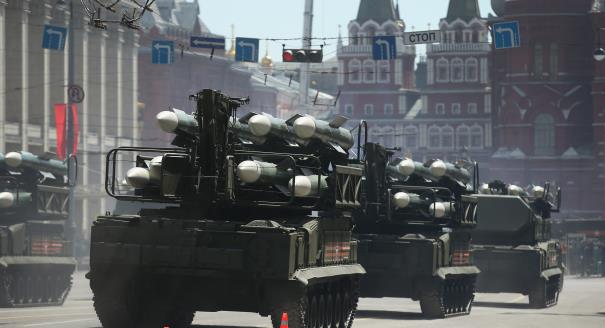
The threat of nuclear war between Russia and the West, long relegated to Cold War history, reappeared last year as the crisis in East-West relations escalated.

Russian strategic bombers now fly long-range patrols near the coast of the US and its NATO allies, while Russian missile tests and military exercises involving simulated use of nuclear weapons raise the specter of nuclear war. The US responds as its defense analysts discuss options for boosting nuclear deterrence in Europe to counter Russian threats.

President Vladimir Putin unambiguously warned the West in August 2014, as the fighting raged in eastern Ukraine, not to forget that "Russia is not to be messed with. I want to remind you that Russia is one of the largest nuclear powers."

All of this has been interpreted in Europe and the US as aggressive posturing intended to intimidate the West. But inside Russia there is a different conversation. In a recent article in the highly regarded Russian defense weekly Voenno-Promyshelnnyi Kuryer (VPK) (Military Industrial Courier), prominent Russian defense expert retired Col. Mikhail Khodarenok draws alarming — for Russia — conclusions about the Russia-NATO military balance and the Russian military's prospects in a hypothetical conflict with the West. ...

Read the full text of this article in Defense News.

About the Author

Alexey Arbatov

Alexey Arbatov is the head of the Center for International Security at the Primakov National Research Institute of World Economy and International Relations.

Alexey Arbatov

Alexey Arbatov is the head of the Center for International Security at the Primakov National Research Institute of World Economy and International Relations.

Alexey Arbatov
SecurityMilitaryForeign PolicyNuclear PolicyArms ControlNorth AmericaUnited StatesRussiaEastern EuropeUkraine

Carnegie India does not take institutional positions on public policy issues; the views represented herein are those of the author(s) and do not necessarily reflect the views of Carnegie, its staff, or its trustees.

More Work from Carnegie India

  • Commentary
    India Signs the Pax Silica—A Counter to Pax Sinica?

    On the last day of the India AI Impact Summit, India signed Pax Silica, a U.S.-led declaration seemingly focused on semiconductors. While India’s accession to the same was not entirely unforeseen, becoming a signatory nation this quickly was not on the cards either.

      Konark Bhandari

  • Commentary
    The Impact of U.S. Sanctions and Tariffs on India’s Russian Oil Imports

    This piece examines India’s response to U.S. sanctions and tariffs, specifically assessing the immediate market consequences, such as alterations in import costs, and the broader strategic implications for India’s energy security and foreign policy orientation.

      Vrinda Sahai

  • Article
    Military Lessons from Operation Sindoor

    The India-Pakistan conflict that played out between May 6 and May 10, 2025, offers several military lessons. This article presents key takeaways from Operation Sindoor and breaks down how India’s preparations shaped the outcome and what more is needed to strengthen future readiness.

      Dinakar Peri

  • Book
    India and the Sovereignty Principle: The Disaggregation Imperative

    This book offers a comprehensive analysis of India's evolving relationship with sovereignty in a complex global order. Moving beyond conventional narratives, it examines how the sovereignty principle shapes India's behavior across four critical domains—from traditional military power to contemporary data governance.

      Rudra Chaudhuri, Nabarun Roy

  • Commentary
    NISAR Soars While India-U.S. Tariff Tensions Simmer

    On July 30, 2025, the United States announced 25 percent tariffs on Indian goods. While diplomatic tensions simmered on the trade front, a cosmic calm prevailed at the Sriharikota launch range. Officials from NASA and ISRO were preparing to launch an engineering marvel into space—the NASA-ISRO Synthetic Aperture Radar (NISAR), marking a significant milestone in the India-U.S. bilateral partnership.

      Tejas Bharadwaj

Get more news and analysis from
Carnegie India
Carnegie India logo, white
Unit C-4, 5, 6, EdenparkShaheed Jeet Singh MargNew Delhi – 110016, IndiaPhone: 011-40078687
  • Research
  • About
  • Experts
  • Projects
  • Events
  • Contact
  • Careers
  • Privacy
  • For Media
Get more news and analysis from
Carnegie India
© 2026 Carnegie Endowment for International Peace. All rights reserved.






