

Article
C. Raja Mohan, Darshana M. Baruah
{
  "authors": [
    "C. Raja Mohan"
  ],
  "type": "legacyinthemedia",
  "centerAffiliationAll": "dc",
  "centers": [
    "Carnegie Endowment for International Peace",
    "Carnegie India"
  ],
  "collections": [],
  "englishNewsletterAll": "ctw",
  "nonEnglishNewsletterAll": "",
  "primaryCenter": "Carnegie India",
  "programAffiliation": "SAP",
  "programs": [
    "South Asia"
  ],
  "projects": [],
  "regions": [
    "South Asia",
    "Pakistan",
    "India"
  ],
  "topics": [
    "Foreign Policy",
    "Economy"
  ]
}
Source: Getty
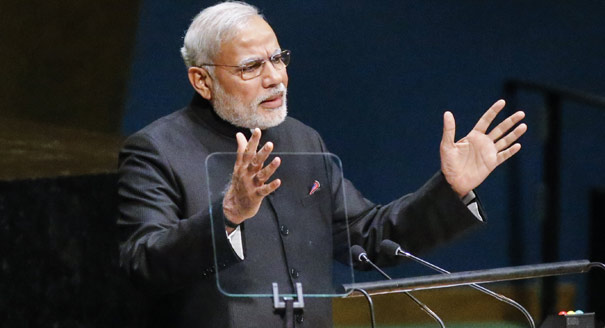
Prime Minister Narendra Modi’s impressive outreach to India's neighbors has seen some unfortunate stumbles, including in the Maldives, Nepal, and Pakistan.
Source: Indian Express
External Affairs Minister Sushma Swaraj’s visit to Maldives over the weekend hopefully signals a much needed course correction in New Delhi’s neighbourhood policy. Prime Minister Narendra Modi’s impressive outreach to the neighbours when he took charge of Indian diplomacy in May 2014 has seen some unfortunate stumbles — in the Maldives, Nepal and Pakistan.
Modi, it might be recalled, had cancelled his scheduled visit to the Maldives at the very last minute earlier this year. The Maldives was part of his Indian Ocean itinerary last March that also included Seychelles, Mauritius and Sri Lanka. Delhi found it difficult to countenance President Abdulla Yameen’s brutalisation of his political opponents, including the former president, Mohamed Nasheed. Delhi’s disapproval did not seem to have much of an impact on Yameen, who responded by warming up to China.
Faced with the options of escalation or engagement, Delhi chose the latter. Foreign Secretary S Jaishankar travelled to the Maldives in August to generate a better understanding of each other’s core interests. Yameen’s positive response appears to have paved the way for Swaraj’s successful visit.
As he resets ties with the Maldives, Modi also has an opportunity to rethink the current Nepal policy. Delhi’s relations with Kathmandu have entered a turbulent phase in the last few weeks amid India’s unhappiness over Nepal’s new constitution. Nepal’s election of a new PM, K.P. Sharma Oli, is a good moment to take a fresh look at the differences between Delhi and Kathmandu.
The situation with Pakistan is a lot more complicated, but the case for renewing Delhi’s stalled dialogue with Islamabad is strong. The lack of any engagement with Pakistan is bound to complicate, sooner than later, India’s other key partnerships in the region and beyond.
The recent troubles with the Maldives, Nepal and Pakistan help remind India of some basic principles in dealing with its South Asian neighbours. For one, good intentions are not enough. All recent Indian PMs have declared a strong commitment to South Asian regionalism. But Delhi has found it hard to translate declarations into concrete results.
As he resets ties with the Maldives, Modi also has an opportunity to rethink the current Nepal policy. Delhi’s relations with Kathmandu have entered a turbulent phase in the last few weeks amid India’s unhappiness over Nepal’s new constitution. Nepal’s election of a new PM, K.P. Sharma Oli, is a good moment to take a fresh look at the differences between Delhi and Kathmandu.
The situation with Pakistan is a lot more complicated, but the case for renewing Delhi’s stalled dialogue with Islamabad is strong. The lack of any engagement with Pakistan is bound to complicate, sooner than later, India’s other key partnerships in the region and beyond.
The recent troubles with the Maldives, Nepal and Pakistan help remind India of some basic principles in dealing with its South Asian neighbours. For one, good intentions are not enough. All recent Indian PMs have declared a strong commitment to South Asian regionalism. But Delhi has found it hard to translate declarations into concrete results.
Sustained political attention at the highest level, more diplomatic boots on the ground, and better domestic coordination between multiple agencies involved are widely seen as critical for a successful tending of the neighbourhood.
Second is the need for uninterrupted dialogue with neighbours. Calling off talks in a fit of pique or setting pre-conditions for a dialogue hurts India more than its neighbours. Given the high stakes, Delhi has had no choice but to climb down after a decent interval. This has happened ever so often in India’s engagement with Pakistan. But the lessons from that experience may not have been fully internalised in Delhi.
Third, contrary to the popular perception, the strategic choice before India is not between intervention and non-intervention in the domestic affairs of its neighbours. Delhi is condemned to intervene, one way or another, because developments next door deeply affect India’s political and security interests. Competing groups in the smaller countries seek Indian intervention on their own behalf and oppose it when Delhi’s moves help rival factions. Even when it chooses to turn its back, Delhi will effectively tilt the balance in favour of one group or another.
The real challenge for Delhi, therefore, is not whether but when and how to intervene. Those decisions are not mechanical but must come out of careful political judgement of each specific case. Besides the merits of the issue at hand, assessing the prospects for success and the consequences of failure should be important factors in deciding the nature and scope of India’s intervention.
Fourth, it is never easy for a big power to compel its smaller neighbours to act in a particular manner. All great powers, including the United States, Russia and China, face this problem and India must learn to live with the limits to its power in the region. Even a massive difference in size and capabilities — such as that between India and the Maldives — or extraordinary geographic interdependence, as between Delhi and Kathmandu, does not guarantee one-sided outcomes in any confrontation.
The power differential between India and Pakistan is a lot less. That precisely is the problem with the NDA government’s current strategy of seeking to unilaterally alter the terms of dialogue with Pakistan — whether it is on substance or process. Coercive diplomacy is a demanding art. Public posturing for domestic constituencies and intemperate rhetoric are enemies of sensible diplomacy in general. The use of blunt instruments makes the attempt at persuading a neighbouring state that much more difficult.
Finally, the margins for error in India’s regional diplomacy are rapidly shrinking, thanks to the rise of China. Beijing, with its growing economic and military clout, is an attractive counter to many of India’s neighbours in dealing with pressures from Delhi. This, in turn, demands big changes in the way we think and act in the neighbourhood.
This article was originally published in the Indian Express.
Former Nonresident Senior Fellow, Carnegie India
A leading analyst of India’s foreign policy, Mohan is also an expert on South Asian security, great-power relations in Asia, and arms control.
Recent Work

C. Raja Mohan, Darshana M. Baruah


Alexander Gabuev, Paul Haenle, C. Raja Mohan, …
Carnegie India does not take institutional positions on public policy issues; the views represented herein are those of the author(s) and do not necessarily reflect the views of Carnegie, its staff, or its trustees.

In any defense establishment, change is an ongoing process. However, despite the best of intentions, existing bureaucracies, bound by habit and years of socialization, have their limits in implementing transformative change.

Anit Mukherjee

As AI grows more sophisticated, as the supply chains that power it become more contested, and as access to frontier models becomes geopolitically charged, India must begin to ask a different set of questions. Not what applications it can build on someone else’s infrastructure but what the world needs.

Konark Bhandari

The Indian Ocean Region hosts one of the densest concentrations of subsea cables in the world. Yet, despite accounting for a significant share of global internet traffic, India’s participation remains limited.

Charukeshi Bhatt

How is AI reshaping space security, creating governance challenges, and where does international diplomacy stand today?


Tejas Bharadwaj, Almudena Azcárate Ortega

After the chill in ties between 2020 and 2024 that brought India–China relations to their lowest point in several decades, the two countries have engaged each other afresh. This paper argues that there are predominantly four imperatives guiding India’s approach to China, and they exist in an order of priority.

Saheb Singh Chadha