Source: Reuters
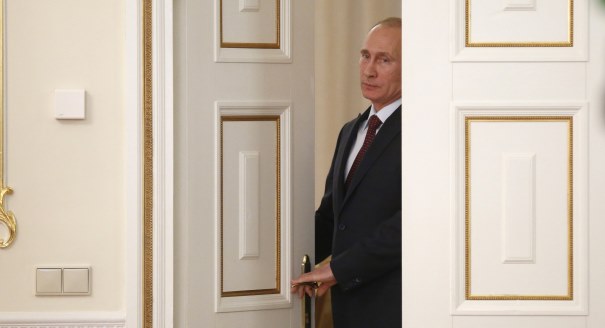
Russia’s rapidly expanding military presence in Syria is viewed by many as an attempt to bolster the regime of President Bashar al-Assad rather than attack Islamic State forces. There are strong indications, however, that Moscow is coming to grips with the idea that a political solution for the region would include a post-Assad Syria.
Russian officials have talked about the need to transform the current Syrian regime into an inclusive government, one built on a power-sharing deal between it and certain opposition elements. The Kremlin has even reconsidered its opposition to allowing anti-Assad Islamic groups to participate in a settlement. To this end, it has raised the possibility of early parliamentary elections.
The real question may turn out to be whether outside players can put aside their anger over Putin’s in-your-face military moves and join forces with Moscow to finally end this tragedy.
Starting in May with his visit to Russian President Vladimir Putin’s residence in Sochi, Secretary of State John Kerry has been at the forefront of a renewed Russian diplomatic push in Syria. Since then, the Obama administration has taken pains to note that the Kremlin’s main intentions there remain unclear.
Mistrust of Putin’s intentions is, of course, pervasive in the West and the Middle East. This could be one reason for the drumbeat of assertions that Moscow really only wants to prop up Assad’s regime by providing him with game-changing military capabilities. Some critics suggest that even Russian authorities do not know which scenario their boss is planning to put into action.
Putin’s Sept. 28 speech and his private meeting with President Barack Obama at the United Nations in New York were expected to reveal more about Moscow’s intentions. Yet in his speech, the Russian president only repeated the general outlines of a plan already previewed by the Kremlin’s foreign-policy worthies.
Putin talked about establishing an international coalition against Islamic State, pursuant to a U.N. Security Council resolution, with the participation of the Syrian army and regional Muslim states. He also discussed the launch of a new negotiation process between the Assad regime and elements of the opposition. Yet he provided few concrete details.
Even in its loosely articulated form, Putin’s plan will hardly find a warm reception. First, though the civil war in Syria is in its fourth year, the warring factions seem far from ready to stop fighting. Plenty of outside actors are ready to battle to the last drop of Syrian blood.
Meanwhile, the Kremlin still strongly resists setting deadlines for Assad’s removal from power as a precondition for beginning a national dialogue. In Russian eyes, Assad is still the only person capable of standing up to Islamic State and keeping the Syrian state from total collapse.
This vision drastically differs from that of the West and many Middle Eastern countries. They consider Assad the source of Syria’s problems, rather than part of any possible solution. Moscow also has a narrow definition of which opposition forces it would accept as legitimate players. The Kremlin continues to grant exaggerated importance to a regime that, at best, controls only a quarter of Syria’s territory.
Beneath the surface, however, Moscow’s vision for the future of Syria is shifting. Both Putin and Russian Foreign Minister Sergey Lavrov, for example, have stopped labelling all opposition forces as “terrorists,” which suggests that some moderate groups on the ground might be recognized by Moscow as legitimate players. The Russian Ministry of Foreign Affairs recently clarified this shift by announcing Moscow’s readiness to deal with Syrians “who are interested in securing their interests in their own country.”
Moscow also no longer excludes the option that Assad be replaced. The Kremlin sees the transformation of his regime as inevitable. The Russian military deployments to Syria can be viewed as a way to ensure that Moscow will have a major voice in any decisions about how the change occurs. The Kremlin is also concerned about protecting long-time Russian interests, such as the fate of Syria’s Christian population.
Even the decision to launch air strikes in Syria is probably part of the broader Russian strategy aimed at resolving the Syrian conflict on Moscow’s terms. Putin continues to insist on a peace settlement based on existing Syrian state structures and institutions.
To persuade the international community, the Kremlin has adopted a two-track approach. On the diplomatic front, Moscow is engaged in active dialogue with the West and Middle Eastern countries, particularly the Gulf States. Militarily, Russia’s support is helping guarantee that the Assad regime can hold out long enough for the Kremlin to achieve a desirable breakthrough on the diplomatic track.
Putin may be able to use Russia’s military actions in Syria as important leverage. The presence of Russian forces in Syria ensures that any decision on Syria’s future cannot be made without Moscow’s participation. It is not a coincidence that in the 48 hours since Russia launched its air raids in Syria, the intensity of diplomatic contacts between Moscow and the West have increased.
Yet if the West soundly rejects Putin’s initiative — paltry though it may be — the outlook for Syria could become even grimmer. There are many interested parties in Moscow who see little upside in cooperation on Syria. They would be perfectly happy to focus on shoring up the Assad regime and increasing Russia’s military support of it.
This may not save Damascus from falling. But it would prolong the conflict and raise the death toll on all sides.
The Russians have already signalled that they can raise the stakes in the Syrian game. The meetings that began in New York are an opportunity to steer them on a more productive path.
This article originally appeared in Reuters.