

Article
C. Raja Mohan, Darshana M. Baruah
{
  "authors": [
    "C. Raja Mohan"
  ],
  "type": "legacyinthemedia",
  "centerAffiliationAll": "dc",
  "centers": [
    "Carnegie Endowment for International Peace",
    "Carnegie India"
  ],
  "collections": [],
  "englishNewsletterAll": "ctw",
  "nonEnglishNewsletterAll": "",
  "primaryCenter": "Carnegie India",
  "programAffiliation": "SAP",
  "programs": [
    "South Asia"
  ],
  "projects": [],
  "regions": [
    "South Asia",
    "India",
    "United Kingdom",
    "Western Europe"
  ],
  "topics": [
    "Foreign Policy",
    "Security",
    "Military",
    "Global Governance"
  ]
}
Source: Getty
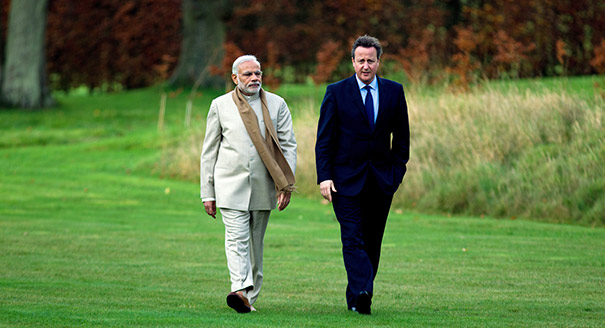
Delhi’s new approach to defense diplomacy came out clearly in the comprehensive joint security agenda set by Modi and Cameron.
Source: Indian Express
India, which clung to non-alignment as its international identity since Independence, had little inclination for defence diplomacy with other nations — big or small. But consider some recent developments that underline New Delhi’s slow but certain movement away from a fastidious avoidance of military partnerships in the past to making security cooperation an important part of India’s foreign relations now.
During his visit to London last week, Prime Minister Narendra Modi unveiled an ambitious framework for international security cooperation with Great Britain. Home Minister Rajnath Singh is heading to China to seek cooperation with Beijing on border management and counter-terrorism.The army chief, General Dalbir Singh Suhag, is in Japan this week after holding talks with the vice chairman of China’s Central Military Commission, General Fan Changlong, in Delhi on Sunday. A team of senior officials from the ministry of defence (MoD) is in Washington, preparing for Defence Minister Manohar Parrikar’s first official visit to the United States next month.
At a gathering of Asian defence ministers in early November, Parrikar got much notice for wading into the territorial disputes between Beijing and its neighbours in the South China Sea. At the Africa Summit in Delhi at October-end, military and security cooperation figured prominently in Modi’s bilateral interaction with the continent’s leaders.
To be sure, it was PM P.V. Narasimha Rao who renewed Delhi’s defence diplomacy as part of restructuring India’s foreign policy after the Cold War. For PM A.B. Vajpayee, who believed in India’s great power potential, defence diplomacy was a priority. But it was PM Manmohan Singh and his first defence minister, Pranab Mukherjee, who shocked the political class and the bureaucratic system with a bold new framework for security cooperation with the US in 2005. Singh and Mukherjee also took the first steps towards purposeful defence engagement with other major powers, including Japan and China, and created the basis for active security partnerships in Asia and the Indian Ocean.
Mukherjee’s successor, A.K. Antony, who served nearly eight long years at the MoD’s helm, pushed the clock back by reviving Delhi’s ambivalence about international security cooperation. Under Antony, the MoD’s civilian bureaucracy reverted to limiting the external reach of the Indian armed forces and blocking attempts by the foreign office to make security cooperation a key element of India’s diplomatic toolbox.
Modi has begun to change all that. He signed a revised framework for defence cooperation with the US and put military diplomacy at the centre of his outreach to major powers as well as important regional partners. The current frenetic pace of security diplomacy is a consequence of Modi’s efforts to plug the gap between the growing international demand for security cooperation with India and Delhi’s ability to respond.
Rajnath Singh’s visit to China is the first in a decade by an Indian home minister. Although the ministry of external affairs has long believed counter-terrorism is a potential arena for cooperation with China, a number of problems seemed to limit Delhi’s enthusiasm for deepening security cooperation with Beijing. These included the PLA’s assertiveness on the long and contested border, Beijing’s all-weather friendship with Rawalpindi, and the Chinese navy’s growing activism in the Indian Ocean. Now, under Modi, there’s a growing recognition that Delhi must cooperate with China where it can and compete where it must.
India’s new approach to defence diplomacy comes out most clearly in the surprising expansiveness of the declaration on international security cooperation between Modi and British PM David Cameron. Although Delhi and London had proclaimed a strategic partnership some years ago, they had found it hard to make it meaningful. Modi and Cameron have now laid out a comprehensive agenda that ranges from defence production to counter-terrorism, cyber security to maritime cooperation. And with it, the two leaders helped India and Britain turn the full circle on security cooperation.
At the dawn of Independence, Delhi, in the name of non-alignment, rejected all British efforts to extend the India-centred Asian security order built in the 19th century into the post-war world. In the decades that followed, Delhi steadily distanced itself from Britain amid deepening differences on regional and global issues.
Modi and Cameron have reversed that by declaring that the “two countries face the same threats and challenges, including the scourge of violent extremism and terror”. “As countries that share a proud tradition of upholding a rules-based international system,” Modi and Cameron asserted, “India and the UK resolve to strengthen the international system and develop a deeper partnership to better combat global threats.”
This is very different from the language of non-alignment. If the colonial past had limited what Delhi and London could do in the defence realm seven decades ago, a rising India and a Britain adapting to decline can now be uninhibited security partners.
Former Nonresident Senior Fellow, Carnegie India
A leading analyst of India’s foreign policy, Mohan is also an expert on South Asian security, great-power relations in Asia, and arms control.
Recent Work

C. Raja Mohan, Darshana M. Baruah


Alexander Gabuev, Paul Haenle, C. Raja Mohan, …
Carnegie India does not take institutional positions on public policy issues; the views represented herein are those of the author(s) and do not necessarily reflect the views of Carnegie, its staff, or its trustees.

In any defense establishment, change is an ongoing process. However, despite the best of intentions, existing bureaucracies, bound by habit and years of socialization, have their limits in implementing transformative change.

Anit Mukherjee
As AI grows more sophisticated, as the supply chains that power it become more contested, and as access to frontier models becomes geopolitically charged, India must begin to ask a different set of questions. Not what applications it can build on someone else’s infrastructure but what the world needs.

Konark Bhandari

The Indian Ocean Region hosts one of the densest concentrations of subsea cables in the world. Yet, despite accounting for a significant share of global internet traffic, India’s participation remains limited.

Charukeshi Bhatt

How is AI reshaping space security, creating governance challenges, and where does international diplomacy stand today?


Tejas Bharadwaj, Almudena Azcárate Ortega

After the chill in ties between 2020 and 2024 that brought India–China relations to their lowest point in several decades, the two countries have engaged each other afresh. This paper argues that there are predominantly four imperatives guiding India’s approach to China, and they exist in an order of priority.

Saheb Singh Chadha