

Article
C. Raja Mohan, Darshana M. Baruah
{
  "authors": [
    "C. Raja Mohan"
  ],
  "type": "legacyinthemedia",
  "centerAffiliationAll": "dc",
  "centers": [
    "Carnegie Endowment for International Peace",
    "Carnegie India"
  ],
  "collections": [],
  "englishNewsletterAll": "ctw",
  "nonEnglishNewsletterAll": "",
  "primaryCenter": "Carnegie India",
  "programAffiliation": "SAP",
  "programs": [
    "South Asia"
  ],
  "projects": [],
  "regions": [
    "South Asia",
    "Pakistan",
    "India"
  ],
  "topics": [
    "Foreign Policy",
    "Security"
  ]
}
Source: Getty
Modi’s surprise trip to Lahore is about lending political energy to the peace process at the highest level.
Source: Indian Express
In for a penny, in for a pound. Having created a diplomatic opening with Pakistan in the last few weeks, Prime Minister Narendra Modi has chosen to accelerate the pace of the engagement with a surprise visit to Lahore today on his way back from Moscow and Kabul.
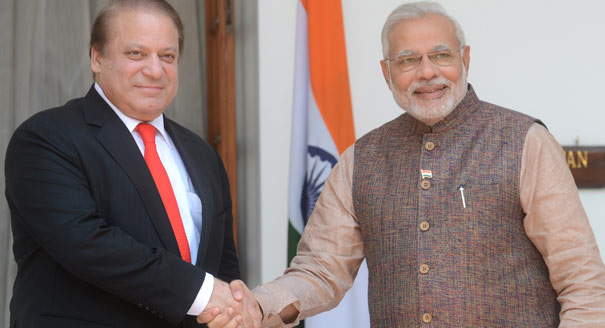
Nawaz Sharif’s birthday provided the happy pretext for the PM’s calculated but rewarding risk in showing up at Lahore. Visits by Indian PM’s to Pakistan are certainly rare. Modi’s is only the eighth in the last seven decades, the first in 11 years.Sharif, who received Modi at the Lahore airport with a big hug, did something similar when he came to the PM’s swearing-in ceremony in May 2014 along with other South Asian leaders.
Despite the twists and turns since then, Modi and Sharif had kept up a conversation, in public and private, despite entrenched skepticism in both capitals.
When the plan they had worked out at Ufa last July derailed quickly, Modi and Sharif waited for the next opportunity in Paris to make the next move.
Their brief but intense 160-second conversation on the margins of the climate change summit set the stage for a productive round of unannounced talks by the two national security advisers in Bangkok earlier this month.
The boldness of Modi’s move is brought into sharp relief by the fact that Prime Minister Manmohan Singh did not, or could not, travel even once in the ten-year long tenure of the UPA government. Although Singh was deeply committed to the peace process with Pakistan, the Congress party was not ready to risk a PM’s visit to Pakistan, let alone sign major agreements. The Congress had long shed the political courage of Rajiv Gandhi, who traveled three times to Pakistan in five years, in search of peace with Islamabad.
The desire to keep safe distance from Pakistan appears to persist in the Congress and is seen in the party’s criticism of Modi’s Lahore visit. Congress, of course, is merely imitating the BJP in opposition, which abandoned Vajpayee’s exploration of reconciliation with Pakistan.
By embracing Vajpayee’s legacy, Modi has, hopefully, created a firewall, for now, against critics on the right, including in his own party, who have revelled demonising Pakistan over the last decade.
In playing diplomatic poker, Modi knows that you don’t always get good cards. You must go for broke when you do. History shows that moments of opportunity in India-Pakistan relations are indeed fleeting.
Vajpayee who, like Modi, had struggled to find an appropriate framework to deal with Pakistan, had finally developed one during his visit to Pak in January 2004. His advisers were hoping to move decisively once they got past the elections that they were confident of winning. Vajpayee, who lost the elections, did not get another chance at peace with Pakistan.
Singh came close to clinching many agreements with Pakistan during 2005-07 and again during 2011-12 but was constrained by his party’s excessive caution. Having learnt from the mistakes of his predecessors, Modi has deliberately chosen to raise the stakes.
Many in Delhi’s political class and the bureaucratic establishment, steeped in a risk- averse strategic culture, find Modi’s rapid maneuvers with Pakistan in the last few weeks and his diplomatic para-drop onto Lahore today disturbing. They would prefer incrementalism through a dialogue between different agencies spread over an extended period of time. Modi, however, knows that the two bureaucracies can choke the peace process by picking nits. His surprise trip to Lahore, then, is about denying that time and space for spoilers on both sides. It is also about lending political energy to the peace process at the highest level.
Many in Delhi worry that Modi may be putting too much of his own political capital on the poker table. But the PM is aware that there is a lot of low-hanging fruit to be harvested in the engagement with Pakistan, thanks entirely to the decade long effort by Singh. Modi has the opportunity and political will to finish many Pakistan projects that Singh could not. This depends, for sure, on Sharif playing ball.
If he does, Modi could easily show some early gains from his gamble. Move a bit, the momentum can always take you a little further, and then some. If Sharif is not in a position to respond, Modi would get some political credit, at home and abroad, for trying. Either way, Modi can only win from his high-stakes political poker with Pakistan.
This article was originally published in the Indian Express.
Former Nonresident Senior Fellow, Carnegie India
A leading analyst of India’s foreign policy, Mohan is also an expert on South Asian security, great-power relations in Asia, and arms control.
Recent Work

C. Raja Mohan, Darshana M. Baruah


Alexander Gabuev, Paul Haenle, C. Raja Mohan, …
Carnegie India does not take institutional positions on public policy issues; the views represented herein are those of the author(s) and do not necessarily reflect the views of Carnegie, its staff, or its trustees.

In any defense establishment, change is an ongoing process. However, despite the best of intentions, existing bureaucracies, bound by habit and years of socialization, have their limits in implementing transformative change.

Anit Mukherjee

As AI grows more sophisticated, as the supply chains that power it become more contested, and as access to frontier models becomes geopolitically charged, India must begin to ask a different set of questions. Not what applications it can build on someone else’s infrastructure but what the world needs.

Konark Bhandari

The Indian Ocean Region hosts one of the densest concentrations of subsea cables in the world. Yet, despite accounting for a significant share of global internet traffic, India’s participation remains limited.

Charukeshi Bhatt

How is AI reshaping space security, creating governance challenges, and where does international diplomacy stand today?


Tejas Bharadwaj, Almudena Azcárate Ortega

After the chill in ties between 2020 and 2024 that brought India–China relations to their lowest point in several decades, the two countries have engaged each other afresh. This paper argues that there are predominantly four imperatives guiding India’s approach to China, and they exist in an order of priority.

Saheb Singh Chadha