

Q&A
Eugene Rumer
{
  "authors": [
    "Eugene Rumer"
  ],
  "type": "legacyinthemedia",
  "centerAffiliationAll": "dc",
  "centers": [
    "Carnegie Endowment for International Peace"
  ],
  "collections": [],
  "englishNewsletterAll": "ctw",
  "nonEnglishNewsletterAll": "",
  "primaryCenter": "Carnegie Endowment for International Peace",
  "programAffiliation": "russia",
  "programs": [
    "Russia and Eurasia"
  ],
  "projects": [],
  "regions": [
    "Russia",
    "East Asia",
    "China",
    "Caucasus"
  ],
  "topics": [
    "Foreign Policy",
    "Economy"
  ]
}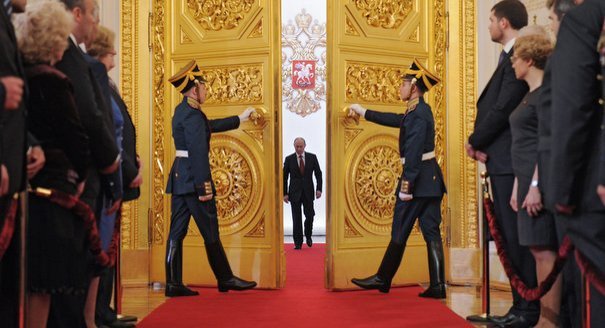
Source: Getty
The image of Russia as weak and withdrawn from the international arena is wrong. Moscow today has broader ambitions, greater resources, and a willingness to push back against challenges.
Source: Financial Times
Moscow is out to change the world order, according to General Philip Breedlove, Nato’s military commander. The entire American military establishment has designated Russia the biggest threat to the US. In response, the Pentagon is beefing up its troops, armour and artillery in eastern Europe, and wants an additional $3.4bn to pay for it.
Meanwhile Barack Obama, the US president, says Russia is “overextended and bleeding” in Syria, and its economy is shrinking “drastically”. The nation is dismissed by others as “a hollow superpower” with no real strategy behind its overseas adventures.
So which picture is accurate? Both. The economy is shrinking. Poverty is on the rise. Without deep, wide-ranging reforms — which few expect on Vladimir Putin’s watch — its prospects are bleak. The president could legally remain in the Kremlin for many years to come, presiding over stagnation at home and, by way of compensation, a confrontational posture abroad.
With an economy and defence budget both a fraction of those of the US, the Russian leader has done rather well. He has held on to power for the best part of two decades. He has held the line against Nato in the former Soviet Union. And he has positioned himself as a dealmaker in the Middle East.
His handling of Syria shows ruthlessness, skill, determination and judgment. Ignoring the brutality of President Bashar al-Assad, and with neither the US nor Europe willing to intervene in the civil war, he stepped into the vacuum and deploying air power changed the course of the conflict. Then he announced he was quitting the scene but left the door open to a return.
Mission accomplished, then. Mr Assad has been saved and all parties to the civil war have been disabused of the idea that a military victory is possible. In a bizarre twist, Mr Putin’s intervention paved the way for the first serious ceasefire in the war and possibly real peace talks — on his own terms.
More broadly, in the Middle East, Russia is back. It is at the centre of a complex web including not only Syria, but all other parties directly and indirectly involved in the larger conflict in the region — including the US and the EU. Moscow cannot solve the region’s problems (who can?) but now they cannot be solved without it either.
Syria shows that Russia, written off in the 1990s as a mere regional power, has a capable military and, given the opportunity, the will to use it. Does it also signal that Moscow has embarked on a new era of military adventurism? No. Mr Putin has walked up to, but not crossed, Nato’s red lines. Wars in Georgia in 2008, and from 2014 in Ukraine, were against nations not covered by Nato’s guarantee; they were fought to prevent them securing that guarantee. In Syria, Russia was confident that the US and its allies would not intervene.
What next? Mr Putin will probably challenge Nato in the Baltics but not militarily. He has a different toolkit, intended to undermine the alliance’s cohesion and confidence in its guarantee without triggering an armed response. Cyber operations, economic boycotts and nuclear threats are at his disposal. Those tools are relatively cheap; he can afford them.
The notion that economic troubles will hinder the Kremlin, that sanctions will force Russia to retreat from Ukraine and adopt a pliant posture, is proving wrong. The image of Russia as weak and withdrawn from the international arena, of its ruling elite focused on economic stability as a means of political survival, is also wrong. That was the 1990s — a period many in Russia remember and few care to recall.
Moscow today has broader ambitions, greater resources and a willingness when challenged to challenge its adversaries in return. That is what Mr Putin has done in Syria and it is only prudent to expect him to do so again.
Director and Senior Fellow, Russia and Eurasia Program
Rumer, a former national intelligence officer for Russia and Eurasia at the U.S. National Intelligence Council, is a senior fellow and the director of Carnegie’s Russia and Eurasia Program.
Recent Work
Eugene Rumer
Eugene Rumer

After the chill in ties between 2020 and 2024 that brought India–China relations to their lowest point in several decades, the two countries have engaged each other afresh. This paper argues that there are predominantly four imperatives guiding India’s approach to China, and they exist in an order of priority.

Saheb Singh Chadha

This piece argues that India’s central challenge is not managing a single flashpoint but resolving the underlying tension between expansion and institutional coherency of the BRICS grouping.

Vrinda Sahai

A partnership between India, a country of subcontinental size, and Africa, a continent of fifty-four countries, may seem asymmetric until one notes that both are home to nearly the same number of people—1.4 billion. This essay spells out the existing challenges to the partnership, its optimal potential, and the possible pathways to realize it over the next quarter-century.

Rajiv Bhatia

The India–EU Free Trade Agreement (FTA) is shaping up to be one of the most consequential trade negotiations, both economically and strategically. But, what’s in the agreement, what’s missing, and what will determine its success in the years ahead
Vrinda Sahai, Nicolas Köhler-Suzuki

On March 10, 2026, India’s Union Cabinet approved amendments to Press Note 3, a regulation that mandated government approval on all foreign direct investment (FDI) from countries sharing a land border with India. This amendment raises questions primarily about whether its stated benefits will materialize and if the risks have been adequately weighed. This piece will address the same.

Konark Bhandari