

Article
C. Raja Mohan, Darshana M. Baruah
{
  "authors": [
    "C. Raja Mohan"
  ],
  "type": "legacyinthemedia",
  "centerAffiliationAll": "dc",
  "centers": [
    "Carnegie Endowment for International Peace",
    "Carnegie India"
  ],
  "collections": [],
  "englishNewsletterAll": "ctw",
  "nonEnglishNewsletterAll": "",
  "primaryCenter": "Carnegie India",
  "programAffiliation": "SAP",
  "programs": [
    "South Asia"
  ],
  "projects": [],
  "regions": [
    "United States",
    "South Asia",
    "India"
  ],
  "topics": [
    "Foreign Policy",
    "Security",
    "Military",
    "Technology"
  ]
}
Source: Getty
Engagement with the U.S. defense establishment is only an important first step towards Delhi’s strategic appreciation of the stakes in the development of artificial intelligence and associated technologies.
Source: Indian Express
This week, in Geneva, Indian diplomats are closely monitoring an international expert review of the legal implications of the so-called “lethal autonomous weapons”. These weapons will have the capability of selecting and engaging targets on their own. Although fully autonomous weapons are yet to register significant presence in the arsenal of any nation, many consider their development and deployment inevitable in the coming years.
Rapid advances in robotics, machine-learning and big-data analytics are at once driving the so-called “fourth industrial revolution” and the transformation of modern warfare. How the leading powers mobilise and deploy these technologies will shape the balance of economic and military power among them in the coming decades.At the centre of it all is the science and engineering of artificial intelligence (AI), or computer algorithms that can perform many functions, such as vision, voice recognition, decision-making and the capacity to process vast quantities of information, which are usually associated with humans.
While autonomous weapons are not going to take humans out of the loop any time soon, AI technologies can augment human ability to handle very complex military tasks more quickly. It’s this man-machine interface that’s likely to be the centre of the new military revolution that’s unfolding.
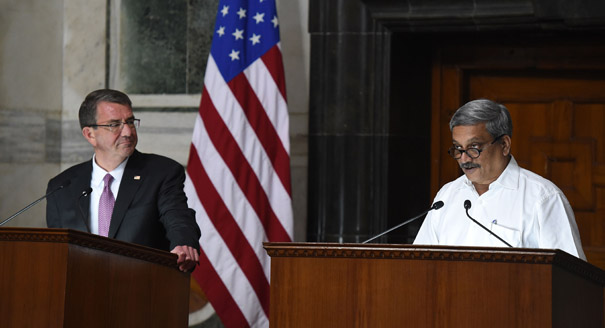
Given its sweeping impact on the civilian and military domains, the fast-paced AI developments should be of concern to not just a handful of Indian diplomats but also all its key economic and national security decision-makers. One way of sensitising the Indian system is to put AI on the agenda for the discussions with visiting US Secretary of Defense Ashton Carter, who has been the strongest champion in the Obama administration for deepening America’s strategic partnership with New Delhi.
Carter, who arrived in Goa over the weekend, is in Delhi today for formal discussions with the Indian leadership, including Prime Minister Narendra Modi. Carter has been driving the Pentagon to leverage AI to America’s strategic advantage over rivals like China and Russia as well as sophisticated terror groups like the Islamic State.
The new approach has been branded the “Third Offset Strategy”. Like the two earlier offsets — tactical nuclear weapons and precision-guided conventional munitions — the US hopes that AI and associated technologies will help America counter the quantitative superiority its rivals Russia and China enjoy in Eurasia and the Western Pacific.
For India too, AI might be critical in coping with the growing gap in conventional military capabilities that has opened up with China. The Chinese defence budget is now more than four times that of India and Beijing has devoted considerable intellectual and policy energies to transform the organisation and doctrine of its armed forces.
AI is also likely to play an important role in countering Pakistan’s low-intensity conflict against India through such proxies as the Lashkar-e-Taiba. India has indeed invested some resources in the military research on AI and robotics. But the changes in its security environment and the technological advances around the world demand a strong high-level political commitment to the development of AI.
This, in turn, would necessarily involve the development of long-term partnerships, especially with the US. In Geneva, both India and the US have not supported calls for an outright pre-emptive ban on the development and deployment of autonomous weapons. Both have called for a prudent approach to the regulation of autonomous weapons. Delhi and Washington are also committed to a stable Asian balance of power and in combating violent extremism. Both these objectives will involve the development and deployment of AI technologies.
But the greatest imperative for Indo-US cooperation comes from the expansive role of the private sector in the development of AI and associated technologies in both countries. Carter has returned the Pentagon to a more active collaboration with Silicon Valley in shaping the Third Offset Strategy. He has recently appointed Google’s Eric Schmidt as the chairman of a new Defence Innovation Advisory Board.
As it turns out, India’s own computer industry is deeply tied to Silicon valley and both sides can build on this connection to strengthen their development and utilisation of AI. Unlike in the earlier military revolutions, India has some capabilities and knowledge in the emerging AI sector.
Engagement with the US defense establishment can only be an important first step towards Delhi’s strategic appreciation of the stakes in the development of AI and associated technologies. In the end, success depends on India’s ability and will to create a domestic policy framework for the promotion of AI applications for civilian and military uses.
Effective use of these will help India accelerate its own economic growth, address its national security challenges and gain an effective voice in the international regulation of autonomous weapons and robotic warfare. Delhi was rather slow in waking up to the impact of the cyber revolution; it can’t afford to make the same error in relation to the AI transformation.
Former Nonresident Senior Fellow, Carnegie India
A leading analyst of India’s foreign policy, Mohan is also an expert on South Asian security, great-power relations in Asia, and arms control.
Recent Work

C. Raja Mohan, Darshana M. Baruah


Alexander Gabuev, Paul Haenle, C. Raja Mohan, …
Carnegie India does not take institutional positions on public policy issues; the views represented herein are those of the author(s) and do not necessarily reflect the views of Carnegie, its staff, or its trustees.
In any defense establishment, change is an ongoing process. However, despite the best of intentions, existing bureaucracies, bound by habit and years of socialization, have their limits in implementing transformative change.
Anit Mukherjee
As AI grows more sophisticated, as the supply chains that power it become more contested, and as access to frontier models becomes geopolitically charged, India must begin to ask a different set of questions. Not what applications it can build on someone else’s infrastructure but what the world needs.
Konark Bhandari

The Indian Ocean Region hosts one of the densest concentrations of subsea cables in the world. Yet, despite accounting for a significant share of global internet traffic, India’s participation remains limited.

Charukeshi Bhatt

How is AI reshaping space security, creating governance challenges, and where does international diplomacy stand today?


Tejas Bharadwaj, Almudena Azcárate Ortega
After the chill in ties between 2020 and 2024 that brought India–China relations to their lowest point in several decades, the two countries have engaged each other afresh. This paper argues that there are predominantly four imperatives guiding India’s approach to China, and they exist in an order of priority.
Saheb Singh Chadha