

Article
C. Raja Mohan, Darshana M. Baruah
{
  "authors": [
    "C. Raja Mohan"
  ],
  "type": "legacyinthemedia",
  "centerAffiliationAll": "dc",
  "centers": [
    "Carnegie Endowment for International Peace",
    "Carnegie India"
  ],
  "collections": [],
  "englishNewsletterAll": "ctw",
  "nonEnglishNewsletterAll": "",
  "primaryCenter": "Carnegie India",
  "programAffiliation": "SAP",
  "programs": [
    "South Asia"
  ],
  "projects": [],
  "regions": [
    "South Asia",
    "India"
  ],
  "topics": [
    "Foreign Policy"
  ]
}
Source: Getty
An interfaith symposium in Ujjain highlights one of the unique features of the NDA government’s international relations—putting religion at the heart of India’s cultural diplomacy.
Source: Indian Express
The city of Ujjain in central India would seem an unlikely place for the conduct of Indian diplomacy. Madhya Pradesh (MP) is, in fact, among the few states of India that neither has a coast nor an international border.
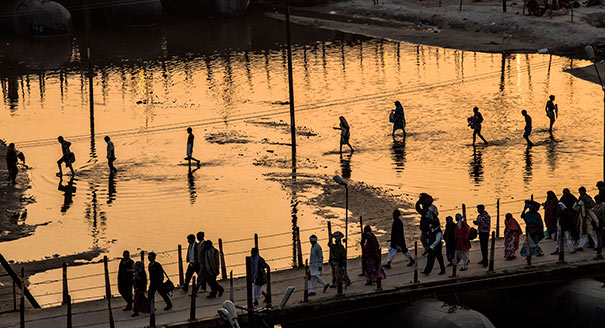
But the state’s rich heritage has always made it an important location on the world’s cultural map. Delhi has now chosen to lend a diplomatic dimension to the ancient city of Ujjain, by internationalising this year’s month-long Simhasth Maha Kumbh festival that began in April on the banks of the Kshipra river.Ujjain is among the four cities where the Maha Kumbh is celebrated every 12 years, drawing millions of pilgrims for a holy dip. The other three are Haridwar, Allahabad and Nashik. The BJP government in MP and the NDA government in Delhi have decided to host a “spiritual maha kumbh” of religious leaders from across India and the world this week in Ujjain.
Prime Minister Narendra Modi will participate in the concluding session of the inter-faith symposium on Saturday. Many foreign envoys in Delhi are expected to join. The president of Nepal, Bidhya Devi Bhandari, pulled out last week amidst political turbulence in Kathmandu. Sri Lankan President Maithripala Sirisena will be present and lend the occasion some diplomatic gravitas.
Coming at the end of the NDA government’s second year in power, the Ujjain event highlights one of the unique features of the NDA government’s international relations — putting religion at the heart of India’s cultural diplomacy.
It was India’s first prime minister, Jawaharlal Nehru, and his education minister, Abul Kalam Azad, who founded the Indian Council of Cultural Relations in 1950. Nehru and Azad understood the subcontinent’s vast cultural inheritance must necessarily play a role in modern India’s international engagement. Nehru, however, was clear in his mind that religion must be kept out of India’s diplomacy. This unwritten norm laid down by Nehru was followed largely by his successors, including Atal Bihari Vajpayee, the first BJP prime minister.
The one exception to the secular approach to foreign policy occurred when India sought to join the Organisation of the Islamic Conference when it was founded in 1969. (The OIC has since been renamed as the Organisation of Islamic Cooperation). The rebuff from the OIC, at the behest of Pakistan, in fact, seemed to reinforce the taboo in Delhi against mixing religion with foreign policy. Not any longer.
While the governments in Delhi sought to separate faith and foreign policy, India’s religion and philosophy had begun to acquire a special niche in the global market for spiritualism in the 1960s. The famous seekers who came to India included the Beatles, who spent time at Maharishi Mahesh Yogi’s ashram in Rishikesh in 1968. That tradition continues as ordinary men and women, celebrities, and world leaders make the passage to India.
Mark Zuckerberg of Facebook revealed last year that he had visited the Kainchi Dham in Uttarakhand at the suggestion of Steve Jobs, the founder of Apple, who had visited the ashram in the 1970s. Meanwhile, the Indian godmen and gurus responded to a growing market in the world, especially in the West. Yoga and meditation gained large followings around the world, including in the East.
Delhi and its diplomatic establishment took a somewhat bemused and detached view of this growing spiritual engagement between India and the world. Prime Minister Modi, however, appears to have taken a conscious decision to integrate religion into India’s diplomacy.
In the last two years, he has taken a number of steps in this direction. His worship at the Pashupatinath temple in Kathmandu and prayers at a Buddhist temple in Kyoto during 2014 were, at once, acts of personal religiosity and part of a conscious strategy to deepen the links with the people of these countries. His decision to invite the visiting Japanese Prime Minister Shinzo Abe to the Ganga worship in Varanasi last year and the invitations to the presidents of Nepal and Sri Lanka to join the Maha Kumbh celebrations in Ujjain this week are one part of the unfolding story of religion and the new Indian diplomacy. The diplomatic campaign to get the United Nations to declare June 21 as the International Yoga Day is another.
Even more significant has been Modi’s conscious strategy to build on the Hindu-Buddhist links between India and a large number of Asian countries. Last year, he also joined the participants of a Hindu-Buddhist conference in Delhi and Bodh Gaya. Earlier this year, the PM had convened a World Sufi Forum that brought Islamic scholars from around the world to Delhi as part of Modi’s conviction that mobilising the religious and spiritual traditions is critical to combating violent extremism and building a harmonious society.
The Maha Kumbh in Ujjain suggests Modi’s religious diplomacy is here to stay. While traditionalists would demur, the PM seems quite convinced that religion, as an integral part of India’s culture, must also be an important component of Indian diplomacy.
Former Nonresident Senior Fellow, Carnegie India
A leading analyst of India’s foreign policy, Mohan is also an expert on South Asian security, great-power relations in Asia, and arms control.
Recent Work

C. Raja Mohan, Darshana M. Baruah


Alexander Gabuev, Paul Haenle, C. Raja Mohan, …
Carnegie India does not take institutional positions on public policy issues; the views represented herein are those of the author(s) and do not necessarily reflect the views of Carnegie, its staff, or its trustees.

In any defense establishment, change is an ongoing process. However, despite the best of intentions, existing bureaucracies, bound by habit and years of socialization, have their limits in implementing transformative change.

Anit Mukherjee
As AI grows more sophisticated, as the supply chains that power it become more contested, and as access to frontier models becomes geopolitically charged, India must begin to ask a different set of questions. Not what applications it can build on someone else’s infrastructure but what the world needs.

Konark Bhandari

The Indian Ocean Region hosts one of the densest concentrations of subsea cables in the world. Yet, despite accounting for a significant share of global internet traffic, India’s participation remains limited.

Charukeshi Bhatt

How is AI reshaping space security, creating governance challenges, and where does international diplomacy stand today?


Tejas Bharadwaj, Almudena Azcárate Ortega

After the chill in ties between 2020 and 2024 that brought India–China relations to their lowest point in several decades, the two countries have engaged each other afresh. This paper argues that there are predominantly four imperatives guiding India’s approach to China, and they exist in an order of priority.

Saheb Singh Chadha