

Article
C. Raja Mohan, Darshana M. Baruah
{
  "authors": [
    "C. Raja Mohan"
  ],
  "type": "legacyinthemedia",
  "centerAffiliationAll": "dc",
  "centers": [
    "Carnegie Endowment for International Peace",
    "Carnegie India"
  ],
  "collections": [],
  "englishNewsletterAll": "ctw",
  "nonEnglishNewsletterAll": "",
  "primaryCenter": "Carnegie India",
  "programAffiliation": "SAP",
  "programs": [
    "South Asia"
  ],
  "projects": [],
  "regions": [
    "United States",
    "South Asia",
    "India",
    "North America"
  ],
  "topics": [
    "Foreign Policy",
    "Security"
  ]
}
Source: Getty
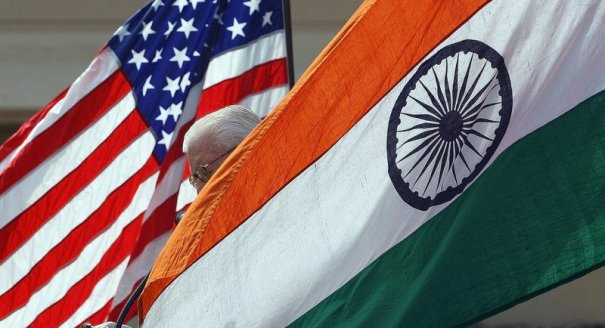
Modi used his Congress address to present India as a credible and reliable partner for America in these uncertain times.
Source: Indian Express
Narendra Modi is not the first Indian prime minister to address a joint session of the US Congress. But he took the podium on the Capitol Hill at a paradoxical moment in India’s bilateral relations with the United States.
The partnership between the two countries has never had the kind of depth and breadth that it has today. Modi is aware of the special role the Congress played in getting the two nations to this point.
This happy moment, however, coincides with a very difficult moment in US political evolution. Washington today is passing through a momentary loss of self-confidence that generates some uncertainty about its future direction.
American politics have never been as polarised as they are today. Both parties are also seeing deep internal divisions. Many of these divisions relate to the domestic consequences of economic globalisation and the growing wariness with foreign military interventions after Iraq and Afghanistan.
As the strong leader of the world’s fastest growing economy, Modi sought to use the moment to present India as a credible and reliable partner for America in these uncertain times. Modi was also presenting an India that was no longer defensive about engaging America.
Modi offered fulsome praise for America’s international role, including the sacrifices of its armed forces in defending freedom and liberty. On the economic front, Modi presented India as an opportunity that could address some of American concerns.
Modi emphasised the value of the strategic partnership for both countries. He recalled Vajpayee’s slogan on the two countries being “natural allies”. He underlined his own conviction that the US is an indispensable partner for India. He also pointed to the possibilities for joint efforts in favour of peace and stability in the vast Indo-Pacific region.
Modi made it quite clear that under his leadership, Delhi’s past hesitations on partnering Washington are now over. The PM insisted that the bilateral partnership is ‘primed for a momentous future’. All this is music to American ears and reinforces those in Washington who have long bet on India’s rise but have felt frustrated at the slow progress and Delhi’s seeming reluctance for productive engagement.
Unlike most Indian speakers, Modi has figured that a bit of humour goes a long way in connecting to the Americans. The PM pushed in a few jokes to lighten the mood of the Congressional gathering.
No Indian speech in America is complete without a reference to shared democratic values. Modi went beyond the boiler plate in praising America for ‘empowering’ other democracies. Modi also referred to the ideological and philosophical threads linking the two great democracies, by referring to Mahatma Gandhi and Martin Luther King.
It was not all sombre. Modi made light of the political grid lock in the US Congress and compared to the difficulties he was having in the Rajya Sabha to approve the government’s bills. “As you can see, we have many shared practices”, Modi cracked.
Modi is aware of the current grim economic mood in America. It was but natural that Modi, through his visit to Washington, was highlighting India’s role in driving the world economy. In the Congress, he recapitulated all his major economic initiatives and underlined the opportunities it provides for the US investors.
The essence of the proposition from the PM was that partnership with Delhi could address, in part, some of America’s current economic challenges while facilitating India’s own development.
Modi put a special emphasis on renewable energy, a field in which the US has considerable lead. Partnership in renewal energy has been at the centre of Modi’s effort to find common ground with the US.
Modi is also acutely conscious of the growing discomfiture in the US at the growing religious intolerance in India. He underlined the essential strengths of Indian democracy, the ‘freedom from fear’ that Indian citizens exercise ‘every day’ and his commitment to constitutionalism.
Given his government’s extraordinary focus on terrorism, Modi spent some time emphasising the shared interests with the US combating violent religious extremism. Modi thanked America for the support Delhi received in dealing with the cross border terror attacks on Mumbai in 2008.
In a veiled reference to Pakistan, Modi emphasised the importance of ‘isolating’ those who sponsor terrorism. ‘Refusing to reward’ the sponsors of terror is critical, Modi said in a reference to the recent move in the US Congress to block F-16 sales to Pakistan. It was a way of saying ‘thank you’ to the Congress that might be at the cusp of changing the traditional American approach to the sources of terrorism in the Subcontinent.
Finally, no diplomatic manoeuvre for Modi is complete without a reference to the Indian diaspora. This is specially true of America, where the Indian communities have played a strong role in mobilising Congressional support for India. In his address, Modi returned to the theme of the diaspora as a bridge between India and America.
This article was originally published in the Indian Express.
Former Nonresident Senior Fellow, Carnegie India
A leading analyst of India’s foreign policy, Mohan is also an expert on South Asian security, great-power relations in Asia, and arms control.
Recent Work

C. Raja Mohan, Darshana M. Baruah


Alexander Gabuev, Paul Haenle, C. Raja Mohan, …
Carnegie India does not take institutional positions on public policy issues; the views represented herein are those of the author(s) and do not necessarily reflect the views of Carnegie, its staff, or its trustees.

In any defense establishment, change is an ongoing process. However, despite the best of intentions, existing bureaucracies, bound by habit and years of socialization, have their limits in implementing transformative change.

Anit Mukherjee
As AI grows more sophisticated, as the supply chains that power it become more contested, and as access to frontier models becomes geopolitically charged, India must begin to ask a different set of questions. Not what applications it can build on someone else’s infrastructure but what the world needs.

Konark Bhandari

The Indian Ocean Region hosts one of the densest concentrations of subsea cables in the world. Yet, despite accounting for a significant share of global internet traffic, India’s participation remains limited.

Charukeshi Bhatt

How is AI reshaping space security, creating governance challenges, and where does international diplomacy stand today?


Tejas Bharadwaj, Almudena Azcárate Ortega

After the chill in ties between 2020 and 2024 that brought India–China relations to their lowest point in several decades, the two countries have engaged each other afresh. This paper argues that there are predominantly four imperatives guiding India’s approach to China, and they exist in an order of priority.

Saheb Singh Chadha