

Article
C. Raja Mohan, Darshana M. Baruah
{
  "authors": [
    "C. Raja Mohan"
  ],
  "type": "legacyinthemedia",
  "centerAffiliationAll": "dc",
  "centers": [
    "Carnegie Endowment for International Peace",
    "Carnegie India"
  ],
  "collections": [],
  "englishNewsletterAll": "ctw",
  "nonEnglishNewsletterAll": "",
  "primaryCenter": "Carnegie India",
  "programAffiliation": "SAP",
  "programs": [
    "South Asia"
  ],
  "projects": [],
  "regions": [
    "United States",
    "South Asia",
    "India",
    "North America"
  ],
  "topics": [
    "Foreign Policy"
  ]
}
Source: Getty
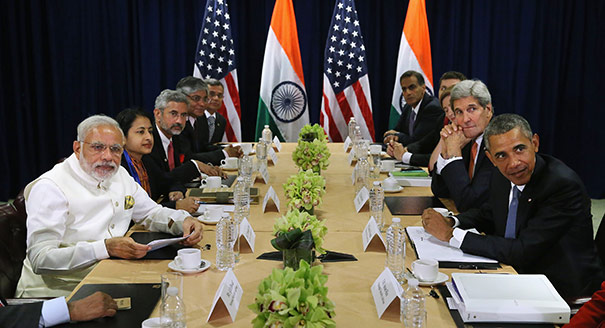
The partnership between India and the United States has advanced significantly during the Obama administration. Now, Modi and Obama should push agreements forward before the next U.S. administration starts.
Source: Indian Express
This week’s diplomatic activity between India and the US signals the consolidation of a partnership that has advanced significantly over the last two years as a result of the efforts of President Barack Obama and Prime Minister Narendra Modi. Back in 2008, during his campaign for the presidency and immediately after winning the election, Obama gave some sleepless nights to Indian diplomats. The future of the civilian nuclear deal as well as the place of Pakistan and China in the relationship between India and the US seemed up in the air after the change of guard in Washington.
Obama eventually dispelled much of this scepticism. Modi, on his part, injected fresh energy into India’s ties with the US when he took charge in 2014. Modi and Obama would want to wrap up the expansive agenda they outlined two years ago, and insulate India and America against potential political and geopolitical turbulence.
But first, an evaluation of Obama’s record with India. Obama’s ambivalence towards the historic nuclear deal launched by his predecessor, George W. Bush — with former prime minister Manmohan Singh — raised serious concerns in Delhi. Would Obama help tie-up the loose ends in the nuclear deal or create fresh problems?
Obama’s view on India’s neighbourhood too raised some apprehensions in the South Block. Obama seemed to believe that resolving the Kashmir issue was the key to securing Pakistan’s cooperation in ending the war in Afghanistan. He also appeared to believe that a solid partnership with China should be the top US priority in Asia.
These would have implied a reversal of three elements of Bush’s policy: Making an exception for India in matters of nuclear energy, the de-hyphenation of American policy towards India and Pakistan and recognising India’s salience in promoting a stable balance of power in Asia. Obama dispelled these fears by embracing Bush’s approach to Delhi: Supporting the rise of India is in Washington’s self-interest.
Obama was determined not only to complete the nuclear deal but take it to the logical conclusion — supporting India’s full membership of the global nuclear order. He resisted the traditional temptation of the members of the Democratic Party to mediate on matters related to Kashmir and took a more aggressive approach to the sources of terrorism in Pakistan. Having burnt his hands with a “China First” policy, Obama made India an important part of his approach towards Asia.
Ironically, as Obama warmed up to India, Delhi developed cold feet. Manmohan Singh, who had set a bold new course with America during the UPA’s first term, found little support from the Congress leadership. Delhi’s lack of enthusiasm slowed the momentum down during the UPA’s second term.
Modi, however, offered a big surprise. Despite his personal problems with the US in the past — being denied a visa when he was the Gujarat chief minister — and little interest in the BJP, Modi put America at the centre of his endeavour to revive India’s foreign policy.
Obama, in turn, understood the significance of the 2014 Lok Sabha elections and extended a hand to Modi. Unexpected political chemistry between the two leaders saw the wrapping up of the civilian nuclear deal, renewal of the defence partnership, construction of a new framework for security cooperation in the Indo-Pacific, expansion of economic engagement, and turning climate change from an arena of confrontation to a field of cooperation.
Delhi must prepare itself for potential uncertainty in its relations with the US after the change of guard in Washington. Some in Delhi worry that after 16 productive years under Bush and Obama, India might face some headwinds in Washington. They will heave a sigh of relief if Hillary Clinton, a known champion of Indo-US ties, is elected president. Her Republican rival, Donald Trump, however, promises anything but continuity. Although his chances of winning may have diminished considerably in the last few weeks, it would be unwise to write Trump off. With more than two months to go before the polls, a big reversal in political fortunes is not impossible.
Some of Trump’s policies on immigration, trade, alliances and Asian security will have resounding effects on much of the world, including India. Meanwhile the rise of China, it’s deepening alliance with Pakistan, the assertiveness of Russia, the temptations for strategic retrenchment in America, the second thoughts on globalisation in the West, and the turmoil in the western and eastern parts of Asia point to inevitable changes in the geopolitical context that brought Delhi and Washington closer in the last decade-and-a-half.
In the uncertain world ahead, Delhi and Washington will need each other even more. That is precisely why Modi and Obama should push their foreign, commerce and defence ministers, who are meeting this week, to try and conclude as many agreements as possible — these should include making a fresh bid for India’s membership to the Nuclear Suppliers Group, negotiating a bilateral investment treaty and signing an agreement on defence logistics.
This article was originally published in the Indian Express.
Former Nonresident Senior Fellow, Carnegie India
A leading analyst of India’s foreign policy, Mohan is also an expert on South Asian security, great-power relations in Asia, and arms control.
Recent Work

C. Raja Mohan, Darshana M. Baruah


Alexander Gabuev, Paul Haenle, C. Raja Mohan, …
Carnegie India does not take institutional positions on public policy issues; the views represented herein are those of the author(s) and do not necessarily reflect the views of Carnegie, its staff, or its trustees.

In any defense establishment, change is an ongoing process. However, despite the best of intentions, existing bureaucracies, bound by habit and years of socialization, have their limits in implementing transformative change.

Anit Mukherjee

As AI grows more sophisticated, as the supply chains that power it become more contested, and as access to frontier models becomes geopolitically charged, India must begin to ask a different set of questions. Not what applications it can build on someone else’s infrastructure but what the world needs.

Konark Bhandari

The Indian Ocean Region hosts one of the densest concentrations of subsea cables in the world. Yet, despite accounting for a significant share of global internet traffic, India’s participation remains limited.

Charukeshi Bhatt

How is AI reshaping space security, creating governance challenges, and where does international diplomacy stand today?


Tejas Bharadwaj, Almudena Azcárate Ortega

After the chill in ties between 2020 and 2024 that brought India–China relations to their lowest point in several decades, the two countries have engaged each other afresh. This paper argues that there are predominantly four imperatives guiding India’s approach to China, and they exist in an order of priority.

Saheb Singh Chadha