

Article
C. Raja Mohan, Darshana M. Baruah
{
  "authors": [
    "C. Raja Mohan"
  ],
  "type": "legacyinthemedia",
  "centerAffiliationAll": "dc",
  "centers": [
    "Carnegie Endowment for International Peace",
    "Carnegie India"
  ],
  "collections": [],
  "englishNewsletterAll": "ctw",
  "nonEnglishNewsletterAll": "",
  "primaryCenter": "Carnegie India",
  "programAffiliation": "SAP",
  "programs": [
    "South Asia"
  ],
  "projects": [],
  "regions": [
    "Asia",
    "South Asia",
    "India",
    "East Asia",
    "Southeast Asia"
  ],
  "topics": [
    "Foreign Policy"
  ]
}
Source: Getty
There is a nice fit between a growing Asia’s demand for economic and military balance in the region and Modi’s Act East policy.
Source: Indian Express
When he took charge two and a half years ago, Prime Minister Narendra Modi declared that his government will do more than “Look East”. It will “Act East”. Sceptics in Delhi saw it as a mere slogan. The PM, who had traveled extensively in the region as the chief minister of Gujarat, however, was committed to bringing new energy and a fresh perspective to India’s eastern strategy.
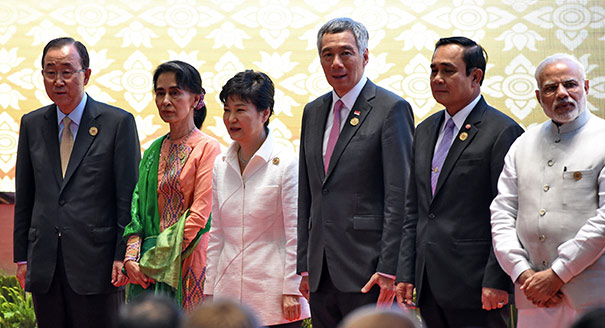
As he sits down this week with leaders of the Association of South East Asian Nations (ASEAN) and joins the broader East Asia Summit that brings the 10 member-states of the ASEAN with leaders of Australia, India, Japan, New Zealand, Japan and the United States, Modi has an opportunity review the progress in India’s Act East policy.
At the dawn of independence, uniting Asia was the first big idea that animated Prime Minister Jawaharlal Nehru. This focus on Asia arose naturally out of the movements for solidarity with other Asian nations during the struggle for independence in the first half of the 20th century. If Nehru believed that India was bound to lead Asia, the idea ran headlong into the complex realities of post-colonial Asia.
Not everyone in the region liked the idea of India “leading Asia”. The continent was deeply divided on issues ranging from the approach to Cold War blocs to the choice of economic strategy for national development. Although there is much retrospective romanticisation of the Asian Relations Conference held in Delhi in March 1947, any perusal of its proceedings would reveal how divergent the views of the participants about the future of Asia were.
If the Delhi conclave could not paper over differences, the conference a decade later at Bandung, Indonesia, revealed deep cleavages in Asia. A deeply disappointed Nehru would turn his back on Asia. Thus began the second phase — “leaving Asia” — in India’s engagement with the East. As it drew closer to the Soviet Union, India became distant from its historical partners in the region. India’s inward economic orientation resulted in active commercial dissociation from Asian markets. So self-possessed was India that it had a hard time figuring out how rapidly its weight and influence was declining in Asia during the 1970s and 1980s.
The economic reforms of the 1990s pushed India back into Asia. After the ambition of the first phase and condescension of the second, a chastened India was “returning to Asia” in the third phase. When they accepted India as a partner in the early 1990s, the ASEAN leaders advised India to lie low and adapt. Although the growth in India’s ties with the region was impressive the pace and intensity of Delhi’s engagement with the region left many Asian leaders disappointed. If the ASEAN was talking of an “India fever” in the early 1990s, it seemed reconciled by the mid 2000s to Delhi being the laggard on Asian regionalism.
Modi’s arrival in Delhi coincided with an uncertain moment in East Asia’s evolution. China’s rise made it the most important economic partner for the region, but it also tested the internal coherence of the ASEAN as Beijing began to assert its power in pursuit of expansive territorial claims in the South China Sea. Nearly four decades of harmonious relations among the US, China and Japan came to a close in the 2010s. Russia’s strategic embrace of China amid Moscow’s deteriorating relations with the West and growing concerns about America’s staying power added to the nervousness in the region.
India’s expanding economy and growing defence capabilities have made India an even more attractive partner for Asian nations. The ASEAN which warned India not to overreach in the early 1990s was now complaining that India was too passive. Modi’s domestic political strength, diplomatic activism and the affirmation of the Act East policy generated much enthusiasm in the region.
Two and a half years later, there is no doubt that Modi’s India has begun to overcome Delhi’s tentativeness on defence and security cooperation under the Look East policy. Delhi has begun to discard the historic hesitations on security partnership with America and Japan. Modi’s recent decision to extend a defence credit line of $500 million to Vietnam is part of this policy.
Connectivity has been a major theme of India’s Look East policy; but its implementation has been deeply disappointing in the third phase. Modi has promised to change this by revamping India’s approach to overland and maritime connectivity. At a time when China is pushing ahead with its Belt and Road initiative, Modi needs to get at least a couple of major connectivity projects off the ground to demonstrate the credibility of the “Act East” policy.
It is on trade and economic engagement that the PM has not been able to break from the past. If the Look East policy did not live up to the commercial possibilities between India and Asia, the NDA government appears to have reinforced the reluctance with its anti-free trade thinking. One hopes the PM can signal much-needed change in Delhi’s approach in Vientiane this week.
Seven decades ago, India’s ambition to lead Asia turned out to be utterly unrealistic. Neither India nor Asia were ready for it. Today there is a nice fit between a growing Asia’s demand for economic and military balance in the region and Modi’s Act East policy. Realising at least parts of it under the present government would launch the long overdue fourth phase — “balancing Asia” — in India’s contemporary engagement with the East.
This article was originally published in the Indian Express.
Former Nonresident Senior Fellow, Carnegie India
A leading analyst of India’s foreign policy, Mohan is also an expert on South Asian security, great-power relations in Asia, and arms control.
Recent Work

C. Raja Mohan, Darshana M. Baruah


Alexander Gabuev, Paul Haenle, C. Raja Mohan, …
Carnegie India does not take institutional positions on public policy issues; the views represented herein are those of the author(s) and do not necessarily reflect the views of Carnegie, its staff, or its trustees.

This piece argues that the present Indian strategy, based on opportunistic diversification and utilization of limited strategic reserves, remains inadequate when confronting supply disruptions. It evaluates India’s options in the short, medium, and long terms.

Vrinda Sahai
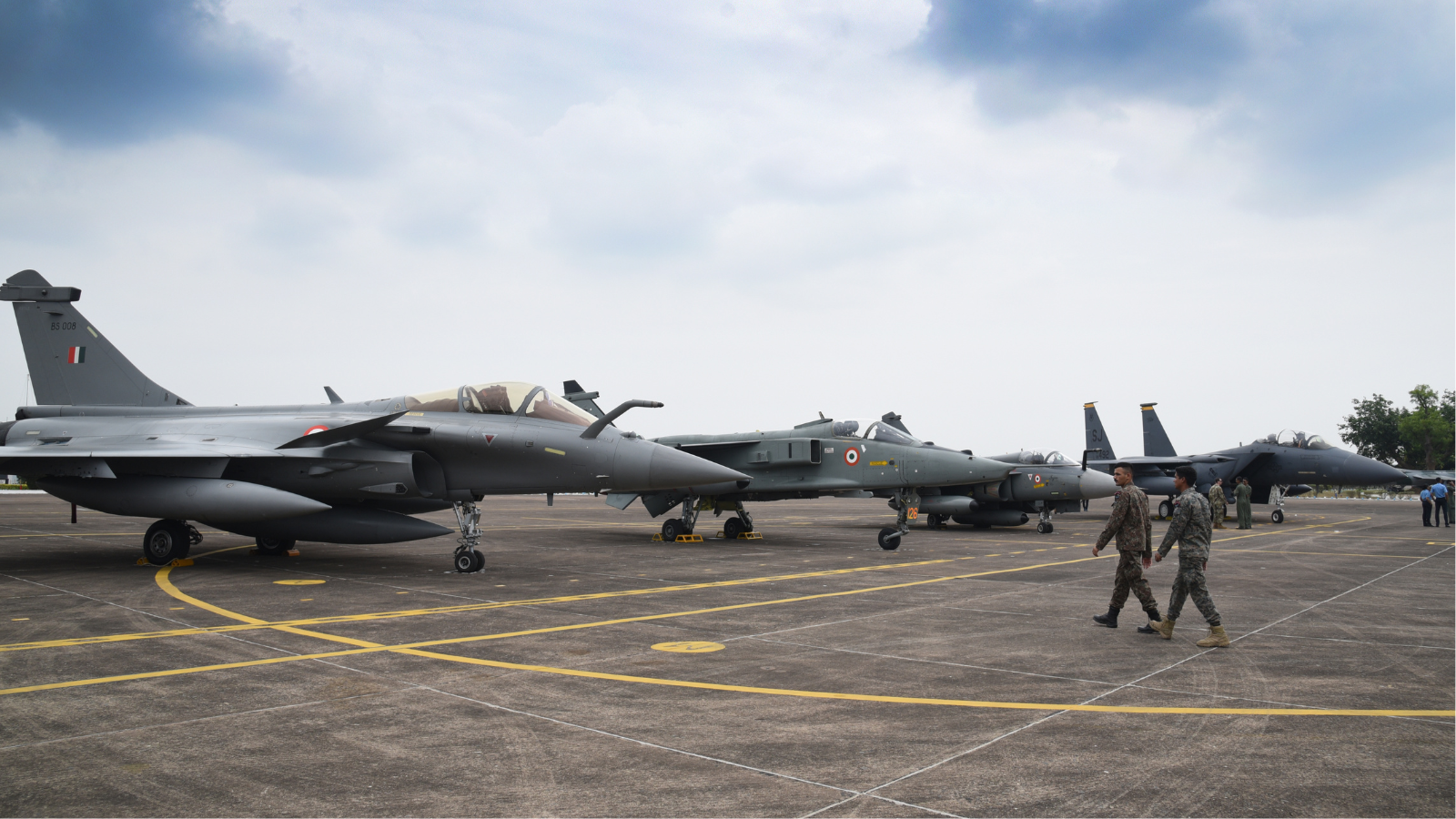
India and the United States are close to concluding a Reciprocal Defense Procurement Agreement (RDPA) that will allow firms from the two countries to sell to each other’s defense establishments more easily. While this may not remedy the specific grievances both sides may have regarding larger bilateral issues, an RDPA could restore some momentum, following the trade deal announcement.

Konark Bhandari

On the last day of the India AI Impact Summit, India signed Pax Silica, a U.S.-led declaration seemingly focused on semiconductors. While India’s accession to the same was not entirely unforeseen, becoming a signatory nation this quickly was not on the cards either.
Konark Bhandari

On January 12, 2026, India's "workhorse," the Polar Satellite Launch Vehicle, experienced a consecutive mission failure for the first time in its history. This commentary explores the implications of this incident on India’s space sector and how India can effectively address issues stemming from the incident.

Tejas Bharadwaj
Connecting real-world AI use cases across sectors such as health, education, agriculture, and livelihoods can help policymakers, innovators, and institutions align around a shared goal. This article looks at a framework ensuring that AI works for everyone.
Shalini Kapoor, Tanvi Lall