

Paper
George Perkovich
{
  "authors": [
    "George Perkovich"
  ],
  "type": "other",
  "centerAffiliationAll": "dc",
  "centers": [
    "Carnegie Endowment for International Peace"
  ],
  "collections": [],
  "englishNewsletterAll": "ctw",
  "nonEnglishNewsletterAll": "",
  "primaryCenter": "Carnegie Endowment for International Peace",
  "programAffiliation": "NPP",
  "programs": [
    "Nuclear Policy"
  ],
  "projects": [],
  "regions": [
    "South Asia",
    "India",
    "Pakistan"
  ],
  "topics": []
}
Source: Getty
If India chooses to respond with extensive force, and if Pakistan moves to counter, Washington inevitably will be impelled to intervene diplomatically to stabilize the situation. This might work temporarily, but the wheel of conflict will turn again.
Source: Foreign Affairs
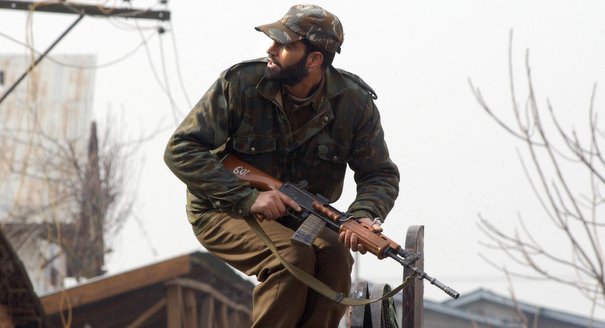
Over the weekend, terrorists attacked an army base in Kashmir, killing 18 Indian soldiers. Soon after, the Indian army announced that it believed that the terrorists had ties to Pakistan. With India apparently preparing to respond to the strike—Prime Minister Narendra Modi proclaimed that “those behind the attack will not go unpunished” and Defense Minister Manohar Parrikar said Wednesday that this “will not remain a mere statement”—U.S. officials could soon find themselves scrambling to manage a nuclear-shadowed crisis.
This would not be the first time. In December 2001, terrorists attacked the Indian parliament complex in New Delhi, prompting the Indian government to mobilize roughly 500,000 troops toward the border with Pakistan. U.S. officials spent months shuttling and phoning back and forth between the leaders of the two countries urging a non-military resolution. India, understandably, sought clear assurances from the Pakistani president, General Pervez Musharraf, that the country would end its support for cross-border terrorism and work to eradicate the groups that perpetrate it. In the end, the combination of U.S. pressure, accommodating gestures from Musharraf, and the lack of viable Indian military options defused the crisis.
Frustrated by this anti-climax, the Indian security establishment and political elite have since sought to develop viable military capabilities to compel the Pakistani security establishment to stop enabling terrorism and to punish the establishment for doing so. In campaigning for election in 2014, Prime Minister Narendra Modi vowed that India would act forcefully on his watch.
Yet, India still lacks military options that could satisfy its strategic objectives, the first of which is to get the Pakistani army to demobilize the most potent anti-India militant groups. After all, army and air force actions robust enough to really harm the Pakistani military could also leave that military unwilling and unable to demobilize the most potent anti-India militants in Pakistan. And even if Indian forces had the ability to move into Pakistani territory to inflict major damage on the army, Pakistan could use its nuclear weapons to stave off defeat. India would be pushed to retaliate in kind.
India could instead consider limited air and special forces strikes on known terrorist facilities and Pakistani military installations in the part of Kashmir that Pakistan controls. The campaign would surely produce television images of destruction that could satisfy (temporarily) the Indian desire for revenge. But a restrained use of force could signal lack of Indian resolve, thereby emboldening the Pakistani military and providing it with little incentive to crack down on anti-Indian groups.
More daringly, Modi could send planes through Pakistani air defenses to bomb militant groups’ facilities in the heartland of Punjab—assuming that India had credible evidence to link Sunday’s attack to those groups. But such an action would likely prompt Pakistan to mount counterattacks on India, again risking escalation whose potential destructiveness would be out of proportion to the injury India has suffered.
India could, and probably will, increase the intensity of covert operations to foment disorder in Pakistan, particularly in the restive province of Balochistan. Such activities would certainly harm the interests of the Pakistani military. But they would also bolster Pakistan’s effort to portray India as morally and politically equivalent to Pakistan in the use of terrorism, a label India has long sought to avoid.
India will also justifiably seek to mobilize the world against Pakistan as a state-sponsor of terrorism, which is increasingly difficult to deny. But the long history of Kashmiri resistance to Indian rule and the fact that the target of this weekend’s attack was a military installation—not civilians—complicates the Indian narrative.
Further, many Indians and outside observers acknowledge that, when it comes to unrest in Kashmir, the lack of economic opportunities, heavy-handed security measures, and denial of political voice and power are more important than the Pakistani hand is. For more than a year, Muslims in Indian-controlled Kashmir have been agitating over inadequate development and repression by Indian security forces. The agitation erupted into a so-called intifada when Indian personnel killed a charismatic young militant named Burhan Wani in July. Nearly 200,000 Kashmiris reportedly attended his funeral prayers. Since then, battles between protestors and Indian security forces have been nearly constant in the Kashmir Valley, leaving 82 dead and thousands wounded.
The Indian government has acted as if economic development schemes should be sufficient. It has rejected negotiations with Kashmiri groups over autonomy and refuses to cede any role to Pakistan in talks. But experience in Kashmir since 1989 (and in Pakistan’s Balochistan) gives little reason to think that people who see themselves as a national community will give up their struggle and accept the government’s writ without negotiated accommodations. This is all the more true so long as Pakistan can help sustain them.
Beyond small-scale tit-for-tat action against targets in Pakistan-controlled Kashmir, India’s best recourse is to persuade the rest of the world to exert sufficient political and economic pressure to punish Pakistan for its toleration—if not outright support—of violence against India. To do that, however, New Delhi must recognize the largely indigenous cause of the Kashmir uprising and end its refusal to negotiate with relevant parties, including, maddeningly, Pakistan.
If India chooses to respond with extensive force, and if Pakistan moves to counter, Washington inevitably will be impelled to intervene diplomatically to stabilize the situation. This might work temporarily, but the wheel of conflict will turn again.

Japan Chair for a World Without Nuclear Weapons, Senior Fellow
George Perkovich is the Japan Chair for a World Without Nuclear Weapons and a senior fellow in the Carnegie Endowment for International Peace’s Nuclear Policy Program. He works primarily on nuclear deterrence, nonproliferation, and disarmament issues.
Recent Work
George Perkovich
George Perkovich
Carnegie India does not take institutional positions on public policy issues; the views represented herein are those of the author(s) and do not necessarily reflect the views of Carnegie, its staff, or its trustees.

In any defense establishment, change is an ongoing process. However, despite the best of intentions, existing bureaucracies, bound by habit and years of socialization, have their limits in implementing transformative change.

Anit Mukherjee
As AI grows more sophisticated, as the supply chains that power it become more contested, and as access to frontier models becomes geopolitically charged, India must begin to ask a different set of questions. Not what applications it can build on someone else’s infrastructure but what the world needs.

Konark Bhandari

The Indian Ocean Region hosts one of the densest concentrations of subsea cables in the world. Yet, despite accounting for a significant share of global internet traffic, India’s participation remains limited.

Charukeshi Bhatt

How is AI reshaping space security, creating governance challenges, and where does international diplomacy stand today?


Tejas Bharadwaj, Almudena Azcárate Ortega

After the chill in ties between 2020 and 2024 that brought India–China relations to their lowest point in several decades, the two countries have engaged each other afresh. This paper argues that there are predominantly four imperatives guiding India’s approach to China, and they exist in an order of priority.

Saheb Singh Chadha