

Paper
Ashley J. Tellis
{
  "authors": [
    "Ashley J. Tellis"
  ],
  "type": "other",
  "centerAffiliationAll": "dc",
  "centers": [
    "Carnegie Endowment for International Peace",
    "Carnegie India"
  ],
  "collections": [],
  "englishNewsletterAll": "ctw",
  "nonEnglishNewsletterAll": "",
  "primaryCenter": "Carnegie Endowment for International Peace",
  "programAffiliation": "SAP",
  "programs": [
    "South Asia"
  ],
  "projects": [],
  "regions": [
    "North America",
    "United States",
    "South Asia",
    "India"
  ],
  "topics": [
    "Foreign Policy"
  ]
}
Source: Getty
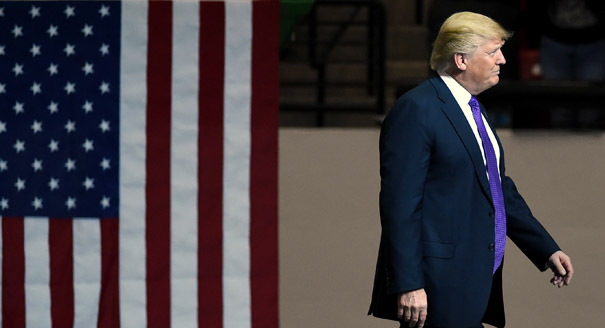
Trump’s “America First” strategy has the potential to damage the U.S.-India relationship. Trump should instead strengthen the India alliance to cope with the challenges posed by China.
Source: Asia Policy 23
For close to two decades now, the transformation of U.S.-India relations has been a bipartisan project in Washington. It has also been uniquely successful, as alternating Republican and Democratic administrations have worked with governments led by both the Bharatiya Janata Party and the Congress Party to exorcise the ghosts of old corrosive Cold War disagreements. As a result, the United States and India, once sharply divided by the issues of alliances and alignment, today routinely declare their commitment to a durable strategic partnership.
Former Indian prime minister Atal Bihari Vajpayee, arguably the progenitor of the new collaboration, once boldly declared the United States and India to be “natural allies.”1 At that moment in 1998, the vision of fraternity seemed like fatuous rhetoric. But to the credit of Vajpayee’s successors (Manmohan Singh and Narendra Modi) and their U.S. counterparts (George W. Bush, in particular), his ambition was brought to fruition rapidly and productively enough for Barack Obama to assert that U.S.-India ties could become the “defining partnership” of the century ahead.
The first section of this essay discusses the potential implications of the “America first” agenda that Donald Trump outlined during his presidential campaign for U.S.-India relations and regional security more broadly. The second section then assesses several challenges facing the bilateral relationship...
This article was originally published in Asia Policy by the National Bureau of Asian Research.
Former Senior Fellow
Ashley J. Tellis was a senior fellow at the Carnegie Endowment for International Peace.
Recent Work
Ashley J. Tellis
Ashley J. Tellis
Carnegie India does not take institutional positions on public policy issues; the views represented herein are those of the author(s) and do not necessarily reflect the views of Carnegie, its staff, or its trustees.
The final report by the Group of Governmental Experts is a key milestone toward a potential instrument regulating Lethal Autonomous Weapons Systems and has garnered both accolades and criticism.

Charukeshi Bhatt
In any defense establishment, change is an ongoing process. However, despite the best of intentions, existing bureaucracies, bound by habit and years of socialization, have their limits in implementing transformative change.
Anit Mukherjee
As AI grows more sophisticated, as the supply chains that power it become more contested, and as access to frontier models becomes geopolitically charged, India must begin to ask a different set of questions. Not what applications it can build on someone else’s infrastructure but what the world needs.
Konark Bhandari

The Indian Ocean Region hosts one of the densest concentrations of subsea cables in the world. Yet, despite accounting for a significant share of global internet traffic, India’s participation remains limited.
Charukeshi Bhatt

How is AI reshaping space security, creating governance challenges, and where does international diplomacy stand today?
Tejas Bharadwaj, Almudena Azcárate Ortega