

Article
C. Raja Mohan, Darshana M. Baruah
{
  "authors": [
    "C. Raja Mohan"
  ],
  "type": "legacyinthemedia",
  "centerAffiliationAll": "dc",
  "centers": [
    "Carnegie Endowment for International Peace",
    "Carnegie India"
  ],
  "collections": [],
  "englishNewsletterAll": "ctw",
  "nonEnglishNewsletterAll": "",
  "primaryCenter": "Carnegie India",
  "programAffiliation": "SAP",
  "programs": [
    "South Asia"
  ],
  "projects": [],
  "regions": [
    "Asia",
    "South Asia",
    "India",
    "East Asia",
    "China"
  ],
  "topics": [
    "Foreign Policy"
  ]
}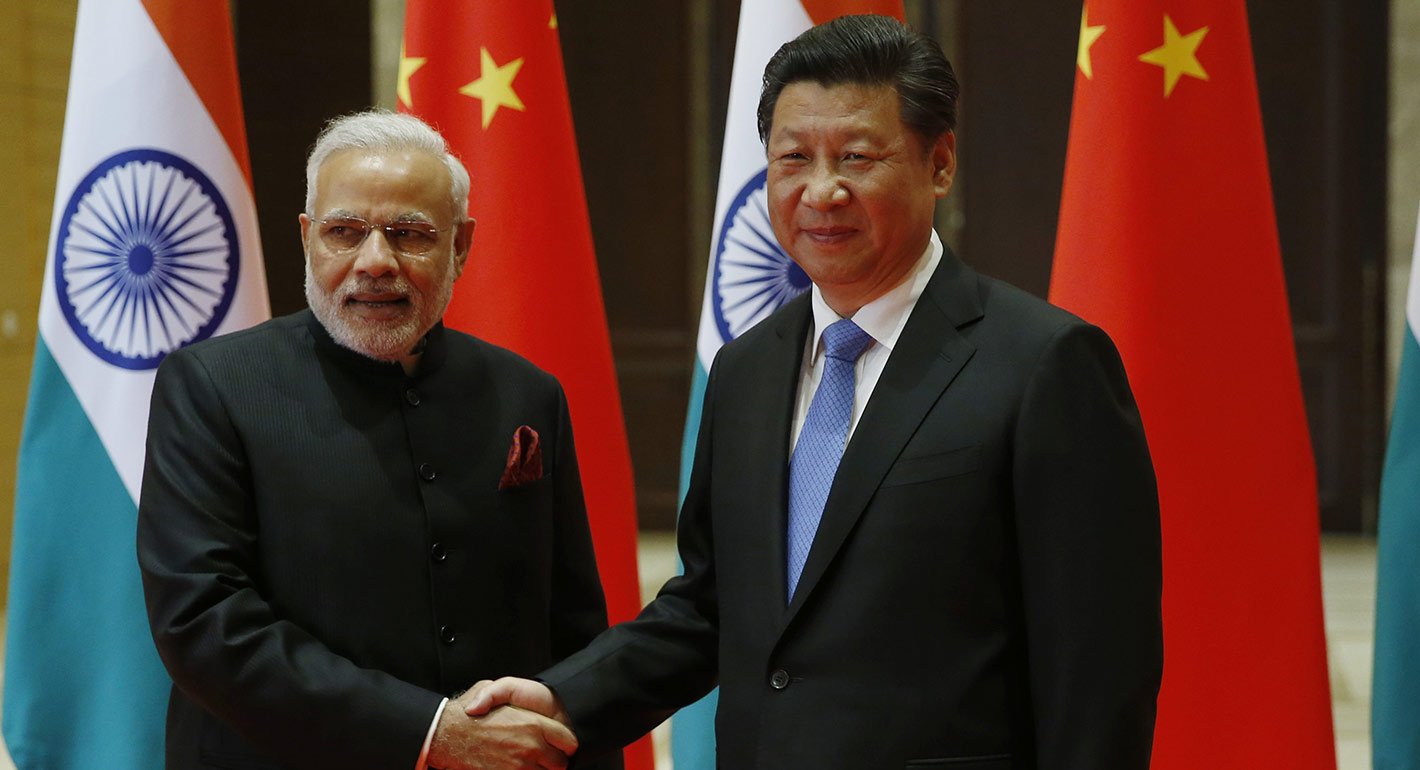
Source: Getty
India and China need a lot of wisdom to limit their differences and carefully manage them.
Source: Global Times
China and India seem to be at loggerheads on a number of bilateral, regional and international issues now. What are the fundamental differences between the two? As China rises and the Asian dynamics keeps changing, where is the Sino-India relationship headed in the future? Global Times (GT) reporter Wang Wenwen talked to Raja Mohan (Mohan), director of Carnegie India based in New Delhi, on these issues.
Mohan: The China-India relations have gone through a number of phases. Before WWII, the two nations worked against the imperial domination and tried to build a new world order. There were a lot of shared aspirations that seemed bind China and India together. But when WWII came, they could not agree on how to coordinate their positions as China was fighting Japan and India was fighting Britain.
After independence, we hoped China and India could shape the post-colonial world. But again, it was not possible because of the Sino-Soviet differences and then the differences between India and China. The international circumstances created the condition in which we could not work together.
More recently, there is the question of Pakistan. China's relationship with Pakistan and it's perception of India's neighborhood has become a problem for New Delhi. Similarly, Beijing perceives India interfering in China's neighborhood as a problem.
The territorial integrity of India and China is another cause of tension. Then, we have an even more direct bilateral dispute on defining the current disposition of the long and contested boundary. When the two sides want to put it aside and do other things, the territorial problem keeps coming back to the front burner. How could we deal with it?
Another stress factor is the regional dynamic. India's conflict with Pakistan is growing, while China has an all-weather partnership with Pakistan. And China's problems with India relate to Vietnam and Japan. China is becoming a large power in South Asia, and India is expanding its influence in East Asia.
Lastly, we have problems at the global level. China does not support India's membership in the UN Security Council and in the Nuclear Suppliers Group. The US does support India and Beijing believes Washington is drawing New Delhi into its orbit.
In addition, we believed expanding economic relations can create a favorable political environment to resolve all the problems. But the trade deficit between India and China is massive and has become a problem in itself.
All of these issues have grown bigger. It is a difficult period we are passing through. India and China need a lot of wisdom to limit the differences and carefully manage these differences.
Mohan: Connectivity is very important for New Delhi because India needs to integrate with itself, the neighborhood and the world. On the surface of it, Beijing's initiative is a perfect opportunity for New Delhi. India is also among the first countries to join the China-led Asian Infrastructure Investment Bank. From the point of view of connectivity and infrastructure, India should be enthusiastic about China's proposal. But unfortunately, political differences around the question of territorial sovereignty have intruded again to trump development.
There is no territorial dispute along the Bangladesh-China-India-Myanmar economic corridor and we should be able to make some progress. The China-Pakistan economic corridor is running through the territory claimed by India and therefore, New Delhi is hesitant to cooperate. If China can assure India that this is not about sovereignty and that China treats India and Pakistan equally on the Kashmir question, then we might find a way forward.
On the military side, China and India need more dialogues. I believe China has real interests in the Indian Ocean and is bound to pursue those. India, too, will seek to build on its interests in the Pacific Ocean. As the maritime footprints of the two nations overlap, there is natural friction. New Delhi and Beijing must find ways to mitigate this friction and find areas for cooperation.
Mohan: India is not joining anybody's alliance system. In the 1960s, India got closer to the Soviet Union and China got closer to the Americans as China thought that relations with the US were important to counter the Soviet power. Similarly, if India becomes increasingly afraid of China's power, then it should think about how it could balance China's power.
China played geopolitics with Russia and the US in the 1960s, so India will do the same. China balances India by building ties with Pakistan, so India will balance China by developing relations with the US and Japan.
Both China and India can play geopolitics. There is a growing imbalance between China and India. China's GDP is six times that of India's and China's defense spending is three times bigger than India's.
How can we fill that gap? When one side feels the dominance of the other, people would think they need a balancing factor.
But at the same time, China is negotiating with America. They are talking about a new type of great power relations or a political accommodation in the form of a "G-2." In fact, the US-China relationship is much bigger and stronger than India-China relations or India-US relations.
Mohan: China has a legitimate right to cooperate with countries in South Asia. Similarly, India has a legitimate right to cooperate with Japan and Vietnam. Problems come when smaller countries become military partners.
What is causing concerns are not economic relations or normal diplomatic relations, but strategic relations.
If somebody comes to my neighborhood, I would feel I'm being undermined. If relationships between a great power and neighbors of another country cross a certain line, then there will be tension.
What happened in Ukraine is that Russia felt the US was using Ukraine to destabilize Russia or that China feels the US was promoting color revolutions in Central Asia.
If India crosses a certain line in its relations with Vietnam, China will have a problem. Similarly, if China does something in Nepal or Sri Lanka, India will be anxious. Because we are big countries with a lot of small neighbors, we should understand where the red lines are and should not cross them.
This interview was originally published in the Global Times.
Former Nonresident Senior Fellow, Carnegie India
A leading analyst of India’s foreign policy, Mohan is also an expert on South Asian security, great-power relations in Asia, and arms control.
Recent Work

C. Raja Mohan, Darshana M. Baruah


Alexander Gabuev, Paul Haenle, C. Raja Mohan, …
Carnegie India does not take institutional positions on public policy issues; the views represented herein are those of the author(s) and do not necessarily reflect the views of Carnegie, its staff, or its trustees.

The Indian Ocean Region hosts one of the densest concentrations of subsea cables in the world. Yet, despite accounting for a significant share of global internet traffic, India’s participation remains limited.

Charukeshi Bhatt

How is AI reshaping space security, creating governance challenges, and where does international diplomacy stand today?


Tejas Bharadwaj, Almudena Azcárate Ortega

After the chill in ties between 2020 and 2024 that brought India–China relations to their lowest point in several decades, the two countries have engaged each other afresh. This paper argues that there are predominantly four imperatives guiding India’s approach to China, and they exist in an order of priority.

Saheb Singh Chadha

This piece argues that India’s central challenge is not managing a single flashpoint but resolving the underlying tension between expansion and institutional coherency of the BRICS grouping.

Vrinda Sahai

The ASML MoU with Tata Electronics is an indicator of how far the Indian semiconductor ecosystem has come. This ecosystem has been years in the making and represents real commercial logic.

Konark Bhandari