

Paper
Constantino Xavier
{
  "authors": [
    "Constantino Xavier"
  ],
  "type": "legacyinthemedia",
  "centerAffiliationAll": "dc",
  "centers": [
    "Carnegie Endowment for International Peace",
    "Carnegie India"
  ],
  "collections": [],
  "englishNewsletterAll": "ctw",
  "nonEnglishNewsletterAll": "",
  "primaryCenter": "Carnegie India",
  "programAffiliation": "SAP",
  "programs": [
    "South Asia"
  ],
  "projects": [],
  "regions": [
    "South Asia",
    "India"
  ],
  "topics": [
    "Foreign Policy"
  ]
}
Source: Getty
While India’s current approach is focused on connectivity and friendly delivery, one should not forget that its geostrategic and democratic concerns about Sri Lanka can often induct a sudden policy shift.
Source: Indian Express
Exactly 30 years ago today, on July 29, 1987, prime minister Rajiv Gandhi flew into Colombo to sign the “Indo-Sri Lanka Agreement to Establish Peace and Normalcy in Sri Lanka,” creating an Indian military mission to enforce a cease-fire, disarm Tamil insurgents and implement constitutional amendments to end the island’s conflict.
Dismissing charges of interference, Rajiv Gandhi argued that India’s involvement was “in response to a specific and formal request of the Government of Sri Lanka,” lauded President Jayawardene for his “courage and statesmanship,” and emphasized both countries’ “faith in the great values of Maitri, Karuna and Samanvaya.”
In practice, however, beyond nice intentions and speeches, July 29 marked the end of a long strategy of Indian coercion that conditioned Sri Lankan sovereignty. This had become apparent to Colombo when, two months earlier, the Indian Air Force violated the island’s air space to drop 23 tonnes of humanitarian relief on Jaffna, where Tamil insurgents resisted a Sri Lankan Army offensive.
Looking up at the nine Indian planes making a provocative fly-by after the drop, Sri Lankan Army Commander Cyril Ranatunga then promised to himself: “I will never forget and will not forgive India to my dying day.” While Sri Lanka expressed “outrage” at the mission as an “unwarranted assault on our sovereignty and territorial integrity,” Delhi’s message was understood loud and clear and led to the July 29 agreement and the deployment of the Indian Peace Keeping Force.
Such past demonstrations of hegemonic power are in stark contrast with India’s current approach to Sri Lanka, focusing on cooperation rather than coercion. For example, in late May, exactly 30 years after the Sri Lankan Navy impeded an Indian flotilla with humanitarian assistance for the beleaguered Tamils, Colombo welcomed three Indian Navy vessels (INS Shardul, Kirch and Jalashwa) as first responders to assist in relief operations after the island’s devastating floods.
Last month Indian Navy Dornier aircrafts also began flying for the first time dedicated sorties to assist the Sri Lankan Navy and Air Force in expanding maritime domain awareness in the Bay of Bengal. Bilateral defence cooperation has flourished in recent years, with an annual defence dialogue, regular joint exercises and technical exchanges.
The positive momentum is the result of a shift in India’s strategy towards its smaller neighbouring states. While, in the past, New Delhi insisted on prerogatives such as the right of first refusal, it is now focused on expanding its capacity of first delivery. Denial and exclusivity are no longer options for India in the region. In a world of greater economic interdependence, and where China offers an attractive alternative, New Delhi realizes that it must step up its game and focus on developing resources to deliver first, more and better. This is the cardinal objective of Prime Minister Modi’s “neighbourhood first” policy and is nowhere more apparent than in Sri Lanka.
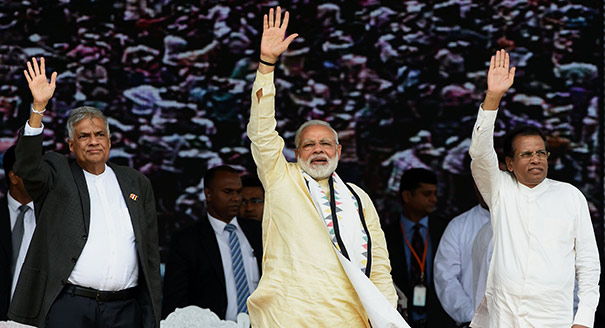
In 2015, Modi paid the first bilateral visit to Sri Lanka since Rajiv Gandhi, in 1987. Earlier this year, he visited again, as chief guest at the International Vesak Day celebrations. India’s focus is now on connectivity, whether it is the plans for a new bridge between both countries, upgrading the Trincomalee oil farms and deep port infrastructure, or speeding up negotiations to conclude the Economic and Technical Cooperation Agreement (ETCA).
To monitor the implementation of an unprecedented number of new agreements and MoUs signed since 2014, a joint working group now meets every three months, followed by a biannual ministerial meeting. As India’s High Commissioner to Sri Lanka, Taranjeet Sandhu, underlined recently, India is “ready to sail with Sri Lanka in its journey towards a more secure, prosperous and fulfilling future” and for this to be achieved both countries must “act now.”
All this bonhomie should not, however, occult continuing bilateral tensions and India’s natural concerns as South Asia’s regional power. Such preoccupations will keep manifesting at two levels.
First, at the geostrategic level, New Delhi will continue to expect Colombo to informally follow an “India first” policy on all crucial security matters. The recently renegotiated Hambantota port agreement with China signals that the Sirisena regime understands such concerns – especially in regard to PLA submarine-basing rights – rather than seeking to contradict geography by pursuing a policy of “equidistance” between Delhi and Beijing.
However, Sri Lanka’s geostrategic DNA will keep driving it to play a balancing game with China and therefore lead to inevitable tensions. President Sirisena and his cabinet must find a fine balance between competing political imperatives as elections loom on the horizon. Getting too close to China will annoy India and possibly activate New Delhi’s interventionist mode, as in late 2014, when it allegedly facilitated a regime change. On the other hand, kowtowing to India will embolden former president Rajapaksa’s and other opposition factions to rally around anti-India cries.
Second, at the domestic political level, India will also expect Colombo to deliver on political devolution to address the lingering roots of the island’s ethnic conflict. New Delhi’s mantra of “13A” – referring to one of the key clauses of the 1987 agreement – has become less audible in recent years but Colombo should not assume it can therefore keep delaying decentralization.
In May, Modi became the first Indian Prime Minister to visit the Indian Origin Tamils in the island’s central hills, and underlined that “there is no better sight than a multilingual society living in peace and harmony.” His words echo those of Rajiv Gandhi, back in 1987: “Where there is discrimination and discord, a nation’s security becomes fragile. Unity cannot be imposed. … Democracy is both the rule of the majority and the security of the minorities.”
While India’s current approach is focused on connectivity and friendly delivery, one should not forget that its geostrategic and democratic concerns about Sri Lanka can often induct a sudden policy shift. Cooperation across the Palk Straits may be the flavour of the day, but coercion is still a tool in New Delhi’s regional toolkit.
This article was originally published in the Indian Express.
Former Fellow, Carnegie India
Constantino Xavier was a fellow at Carnegie India, based in New Delhi. His research focus is on India’s foreign policy, with emphasis on relations with its neighboring countries and South Asian regional security.
Recent Work
Constantino Xavier
Constantino Xavier
Carnegie India does not take institutional positions on public policy issues; the views represented herein are those of the author(s) and do not necessarily reflect the views of Carnegie, its staff, or its trustees.

In any defense establishment, change is an ongoing process. However, despite the best of intentions, existing bureaucracies, bound by habit and years of socialization, have their limits in implementing transformative change.

Anit Mukherjee

As AI grows more sophisticated, as the supply chains that power it become more contested, and as access to frontier models becomes geopolitically charged, India must begin to ask a different set of questions. Not what applications it can build on someone else’s infrastructure but what the world needs.

Konark Bhandari

The Indian Ocean Region hosts one of the densest concentrations of subsea cables in the world. Yet, despite accounting for a significant share of global internet traffic, India’s participation remains limited.

Charukeshi Bhatt

How is AI reshaping space security, creating governance challenges, and where does international diplomacy stand today?


Tejas Bharadwaj, Almudena Azcárate Ortega

After the chill in ties between 2020 and 2024 that brought India–China relations to their lowest point in several decades, the two countries have engaged each other afresh. This paper argues that there are predominantly four imperatives guiding India’s approach to China, and they exist in an order of priority.

Saheb Singh Chadha