

Article
C. Raja Mohan, Darshana M. Baruah
{
  "authors": [
    "C. Raja Mohan"
  ],
  "type": "legacyinthemedia",
  "centerAffiliationAll": "dc",
  "centers": [
    "Carnegie Endowment for International Peace",
    "Carnegie India"
  ],
  "collections": [],
  "englishNewsletterAll": "ctw",
  "nonEnglishNewsletterAll": "",
  "primaryCenter": "Carnegie India",
  "programAffiliation": "SAP",
  "programs": [
    "South Asia"
  ],
  "projects": [],
  "regions": [
    "South Asia",
    "Pakistan",
    "India"
  ],
  "topics": [
    "Economy",
    "Foreign Policy",
    "Trade",
    "Security"
  ]
}
Source: Getty
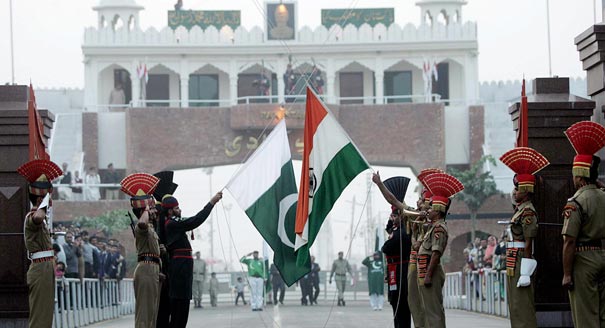
The tragedy of partition was compounded by the economic division of South Asia, an outcome that did not need to accompany the political separation. India’s efforts at regional economic integration will have implications for both peace and development.
Source: Indian Express
Seven decades after Independence, transcending the tragedy of Partition remains the single biggest national challenge for India. The structural religious tension, engendered by Partition has been aggravated by the unending conflict between India and Pakistan, the successor states of the undivided Subcontinent. Few had expected the conflict to last so long. Nor did the second partition in 1971, that seemed to decisively shift the balance of power in favour of India, create the conditions for enduring peace.
In fact, the vivisection of Pakistan in 1971 set the stage for the politics of revenge in Rawalpindi, the headquarters of the Pakistan army. It acquired nuclear weapons to restore a measure of balance with India. As nuclear weapons gave it a credible assurance that Delhi will no longer be able to embark on a major military adventure, Rawalpindi saw a new opportunity for permanent destabilisation of India through low intensity conflict.
Three decades and more of cross-border terror has not forced India to yield, but only help congeal the conflict. Despite the on-again off-again peace process of the last few decades, there is no hope of any early resolution of any issues involved. Pessimists have begun branding the India-Pakistan conflict as a “Hundred Years War”. Extremists may say it might be too optimistic to expect India and Pakistan will find peace in the next 30 years.
The messy consequences of dividing the Subcontinent — included the hurried drawing of boundaries between India and Pakistan in the Punjab and Bengal by the departing colonial power, the complex inheritance in the state of Jammu and Kashmir, and the steady militarisation of these borders — were not going to be easily overcome under any circumstances. But coping with the division was made a lot more difficult by one factor that is not usually discussed in relation to the Partition of the Subcontinent — economics.
It was by no means pre-ordained that the political division of the Subcontinent should be followed by economic partition. The political division did not demand that the new states should stop trade and commerce between them or shut down their frontiers or limit people to people contact. In fact, the borders remained relatively open in the first two decades after Independence. The 1965 war, followed by the 1971 conflict, saw the closing of post Partition frontiers and with it the sundering of coherent economic spaces like the Punjab and Bengal.
This drift was accelerated by the new Indian emphasis on economic self-reliance and a deliberate disconnection from the global markets in the immediate aftermath of Independence.
The grand strategy of “socialism in one country”, whatever its ideological sources and economic merits, did not at all understand the long-term consequences of that policy for the natural economic interdependence of the state system in the Subcontinent. Not all frontiers shut down like those between India and Pakistan. Some remained open, as in the case of Nepal and Bhutan, but India’s deepening protectionism and the perception of neighbours as aliens, made it harder to sustain the regional interdependencies.
The great regional junctions and trading centres like Lahore and Amritsar turned into terminals at closed frontiers. India and Pakistan made it ever harder for movement of goods and people between the two countries. Entrepôts like Calcutta steadily began to lose their centrality in the vast hinterland in the eastern Subcontinent and beyond. Economic partition of the subcontinent made regions like the Northeast “land locked”.
India’s smaller neighbours tried different ways to cope with India’s deregionalisation. Sri Lanka, in the late 1970s, turned to the ASEAN and the West. Businessmen in Nepal sought arbitrage between the tariff levels of Delhi and Kathmandu. The political liberation of Bangladesh in 1971 had little economic consequence, thanks to shared commitment to state socialism between Congress and the Awami League. When Dhaka tried to promote regionalism and SAARC in the 1980s, Delhi viewed the initiative with great suspicion.
It was only after 1991 that India put regionalism back on the policy radar. India’s new commercial interest in the neighbourhood was very much a consequence of the turn towards globalisation. But it has not been easy to translate India’s new commitment to regional economic integration into effective policies. Internally the resistance to regionalism in India’s economic ministries remains strong. If India has belatedly returned to regionalism, the Subcontinent was not ready to celebrate and embrace Delhi. For much water had flown down the Indus and the Ganges. Pakistan is just not interested in putting economic cooperation as priority in bilateral relations. Worse still, it is determined to block India’s effort to promote regionalism under the SAARC banner. In smaller countries like Nepal and Sri Lanka, the politicisation of economic cooperation with India means knee jerk opposition to all projects involving India.
The smaller neighbours had also long discovered the joys of non-alignment and “strategic autonomy” from India now find an economically powerful and outward-oriented China as a valuable partner. While economic geography might still favour India, China operates with larger financial resources and greater purposefulness.
Overcoming the economic partition of the Subcontinent has become at once urgent and more difficult to achieve. Yet, the problem is not about the lack of ideas or resources. It is about mobilising all of Delhi’s political will to force the pace and raise the intensity of India’s regional economic engagement. Delhi’s decisions to look beyond SAARC, modernise border infrastructure, promote connectivity, open up its markets are all important steps forward. The challenge now is to get a few specific projects off the ground to demonstrate India’s new credibility as a champion of South Asian regionalism.
This article was originally published in the Indian Express.
Former Nonresident Senior Fellow, Carnegie India
A leading analyst of India’s foreign policy, Mohan is also an expert on South Asian security, great-power relations in Asia, and arms control.
Recent Work

C. Raja Mohan, Darshana M. Baruah


Alexander Gabuev, Paul Haenle, C. Raja Mohan, …
Carnegie India does not take institutional positions on public policy issues; the views represented herein are those of the author(s) and do not necessarily reflect the views of Carnegie, its staff, or its trustees.

In any defense establishment, change is an ongoing process. However, despite the best of intentions, existing bureaucracies, bound by habit and years of socialization, have their limits in implementing transformative change.

Anit Mukherjee
As AI grows more sophisticated, as the supply chains that power it become more contested, and as access to frontier models becomes geopolitically charged, India must begin to ask a different set of questions. Not what applications it can build on someone else’s infrastructure but what the world needs.

Konark Bhandari

The Indian Ocean Region hosts one of the densest concentrations of subsea cables in the world. Yet, despite accounting for a significant share of global internet traffic, India’s participation remains limited.

Charukeshi Bhatt

How is AI reshaping space security, creating governance challenges, and where does international diplomacy stand today?


Tejas Bharadwaj, Almudena Azcárate Ortega

After the chill in ties between 2020 and 2024 that brought India–China relations to their lowest point in several decades, the two countries have engaged each other afresh. This paper argues that there are predominantly four imperatives guiding India’s approach to China, and they exist in an order of priority.

Saheb Singh Chadha