

Commentary
John Kerry
{
  "authors": [
    "John Kerry"
  ],
  "type": "legacyinthemedia",
  "centerAffiliationAll": "",
  "centers": [
    "Carnegie Endowment for International Peace",
    "Carnegie Russia Eurasia Center"
  ],
  "collections": [],
  "englishNewsletterAll": "",
  "nonEnglishNewsletterAll": "",
  "primaryCenter": "Carnegie Endowment for International Peace",
  "programAffiliation": "",
  "programs": [],
  "projects": [],
  "regions": [
    "North America",
    "United States",
    "Russia"
  ],
  "topics": [
    "Security",
    "Military",
    "Foreign Policy",
    "Nuclear Policy",
    "Arms Control",
    "Global Governance"
  ]
}
Source: Getty
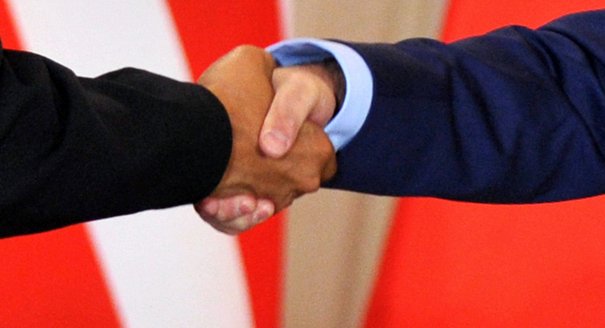
America’s record of nuclear accords with the former Soviet Union remains a remarkable example of the ways that the world can address formerly intractable issues, step by step.
Source: Boston Globe
In a world where North Korea’s nuclear threats roil the Korean Peninsula, and the president of the United States threatens to unravel a nuclear agreement with Iran that the rest of the world agrees is working, there’s at least one good news story about nonproliferation. Today, in a milestone marked by an absence of headlines, the two biggest nuclear powers on the planet met their core obligations under the New START nuclear arms reduction treaty. An agreement that was once jeopardized by the polarized politics of Washington is working to make the United States safer. As a Cold War kid who grew up in the era of nuclear drills at school and watched the Cuban Missile Crisis unfold on a black-and-white television set, I see this as a moment worth mentioning, and a model of how we can really move the world even further away from the danger of nuclear disaster: through diplomacy and verification, not fire and fury.
America’s record of nuclear accords with the former Soviet Union remains a remarkable example of the ways we can address formerly intractable issues, step by step. The original START treaty, negotiated under President Reagan, allowed both countries no more than 6,000 accountable weapons under stringent verification, many more than today, but down from the Cold War peaks. The George W. Bush administration embraced unilaterally announced cuts in the Treaty of Moscow. That agreement, however, had no verification mechanisms of its own and was poorly suited to modern times.
That’s why New START (Strategic Arms Reduction Treaty), approved in 2010, is so important: Both sides can deploy no more than 1,550 warheads on no more than 700 total deployed intercontinental missiles, submarine-launched ballistic missiles, and heavy bombers; each side is permitted to have no more than 800 total deployed and non-deployed ICBM and SLBM launchers and heavy bombers; and the verification regime is strict, and modern, in ways that create confidence.
Building on President Reagan’s maxim “trust but verify,” American inspectors can visit sensitive Russian sites with little notice, and they do the same in the United States. So far, US inspectors have gone to Russian nuclear bases more than 125 times in seven years. More than once a month on average, teams of well-trained, well-prepared inspectors have — on short notice — brought radiation scanners to highly sensitive Russian nuclear installations of our choosing.
We use these short-notice inspections to verify that Russia has been telling us the truth. Each side transmits hundreds of pages of data about its own nuclear forces to the other country each year. Within the first six years, the two sides exchanged some 12,500 notifications — five a day on average. That means we get more up-to-date information on each Russian missile, each launcher, and each bomber than we had ever before. Instead of exchanging threats or insults, our diplomats also meet multiple times each year in a Bilateral Consultative Commission to work out any challenges with implementation, and resolve disagreements over interpretation.
These are the facts of what’s happened under New START. But the most important thing is what hasn’t happened: We do not have to waste taxpayers dollars chasing phantoms or building up new systems because of the uncertainty about Russian nuclear capabilities.
As for New START, we should all stay vigilant. The treaty now in force expires in three years. The Senate approved a provision enabling both the US and Russian presidents to extend the pact without further congressional action for up to five more years. Even in this environment, as long as Russia complies, extension is critical. To let one of the last elements of constructive engagement expire with no follow-on process would ignore the hard-fought lessons of the Cold War. It would court nuclear competition that brings neither stability nor security.
In an era when America’s relationship with Russia has reached its lowest and least constructive phase, this treaty is all the more important. It means that even as we confront Russian aggression in Crimea and Ukraine, and oppose their brazen interference in our democracy and those of other countries, on the existential issue of nuclear war, at least, we have certainty, stability, and transparency between two countries that together hold more than 90 percent of the world’s nuclear weapons.
In foreign policy, there are no crystal balls. On Russia, the United States has attempted to make policy based on varying, even contradictory expectations about Moscow: George W. Bush once said he looked Vladimir Putin “in the eye’’ and found him to be “very straightforward and trustworthy.’’ The Obama administration hoped for a “reset” of relations. By the time I served as secretary of state, the best we could do is compartmentalize issues with Russia, from those where we could act in concert constructively to those where we were absolute adversaries. The world is still trying to make sense of the Trump administration’s approach.
But there’s a bigger lesson as well: We’re better off sticking with nuclear accords that work. In the case of New START, common sense almost died a victim of Washington’s partisan politics. Past treaties were easily approved, with 90, 95, or upwards of 97 votes. I managed the legislative process that led to New START’s successful vote of 71, barely clearing the needed threshold for an agreement endorsed by every living secretary of state, Democrat or Republican.
In this hyperpartisan Washington, 71 might be the old 95, but what if it hadn’t won the day? In this current low point with Moscow, would retaining more nuclear weapons than our military advisers say we need, and having less insight into Russia’s strategic nuclear arsenal, have made us safer?
We should all think hard about the lessons of that moment, and apply them to decisions ahead. We play politics with nuclear Armageddon at our peril, and today more than ever, whether on North Korea, Iran, and the next steps on Russia, we desperately need statesmanship, not partisan brinkmanship. On issues like these, you don’t get second chances.
Nonresident Scholar, Sustainability, Climate, and Geopolitics Program
John Kerry is a nonresident scholar the Carnegie Endowment for International Peace.
Recent Work
John Kerry
Carnegie India does not take institutional positions on public policy issues; the views represented herein are those of the author(s) and do not necessarily reflect the views of Carnegie, its staff, or its trustees.

In any defense establishment, change is an ongoing process. However, despite the best of intentions, existing bureaucracies, bound by habit and years of socialization, have their limits in implementing transformative change.

Anit Mukherjee

How is AI reshaping space security, creating governance challenges, and where does international diplomacy stand today?


Tejas Bharadwaj, Almudena Azcárate Ortega

After the chill in ties between 2020 and 2024 that brought India–China relations to their lowest point in several decades, the two countries have engaged each other afresh. This paper argues that there are predominantly four imperatives guiding India’s approach to China, and they exist in an order of priority.

Saheb Singh Chadha

This piece argues that India’s central challenge is not managing a single flashpoint but resolving the underlying tension between expansion and institutional coherency of the BRICS grouping.

Vrinda Sahai

A partnership between India, a country of subcontinental size, and Africa, a continent of fifty-four countries, may seem asymmetric until one notes that both are home to nearly the same number of people—1.4 billion. This essay spells out the existing challenges to the partnership, its optimal potential, and the possible pathways to realize it over the next quarter-century.

Rajiv Bhatia