Source: Hill
President Trump has denounced the latest reported chemical attack in Syria. However, it is unclear whether this will affect his intent to limit U.S involvement in Syria. He has reluctantly agreed to keep U.S. forces in Syria to defeat ISIS, but his comments cast doubt over how long they will stay. Further, he has said he expects other countries in the region to step in to directly manage and finance the civilian stabilization effort and has frozen U.S. funds for these programs. This is a mistake.
Absent steps to shore up areas previously held by ISIS with credible local governance, essential services and basic security, profound risks will reemerge. Already, there are signs of trouble, as ISIS looks for opportunities to exploit disaffected Arab Sunnis and rebuild its ranks in Syria and neighboring Iraq. If the United States pulls out of Syria now and leaves the fragments of the stabilization task undone, then the next version of ISIS may well rear its head in 2019.
Previous administrations have made this mistake. U.S. history in Iraq and Afghanistan has shown us what happens when we do not finish the job and allow extremist groups to regroup. U.S. military leaders continue to emphasize the need for civilian investment to win the day after so that it is not fighting perpetual wars in distant lands. Hopefully President Trump is listening to his generals.
Failing at stabilization would greatly undermine other U.S. objectives, including deterring further Iranian involvement in Syria and Iraq, competing with Russia for influence and access, mitigating further Turkish incursions into northern Syria, seeking the return of Syrian refugees to stabilized and safe areas, and reinforcing stability for neighboring partners such as Israel, Iraq and Jordan. There is also the basic problem of leverage. Without continued U.S. military and civilian engagement, we will not have a relevant voice on any possible political solution.
Thanks to hard experiences in Iraq and Afghanistan, the United States has learned important lessons about effective civilian stabilization. In fact, the Trump administration is finalizing the first multiagency examination of past stabilization assistance, which as USAID Administrator Mark Green said lays out “quantifiable objectives, rather than open-ended good intentions.” U.S. stabilization programs in Syria are less costly than previous overly ambitious attempts elsewhere. Eastern Syria also has more promising conditions for stabilization because it offers capable partners and better security in many parts of regime-held territory.
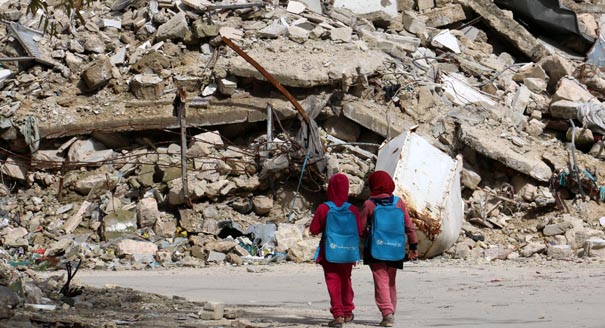
President Trump often talks about the “seven trillion” that the United States has “wasted in the Middle East.” But U.S. programs in Syria are focused on critical tasks of demining, clearing rubble, restoring essential services, and providing training and advising for local security and governance partners. This money is an investment to ensure the enduring defeat of ISIS. Such efforts prevent the need for costly U.S. military reengagement in the future.
Stabilizing ISIS-cleared Syria is not a U.S. task alone, nor should it be. Syrians have paid the highest price with nearly 500,000 dead and millions displaced through the combined effects of the Syrian civil war and the counter-ISIS fight. Multinational donors should step up to assist, as President Trump noted. But in order for this burden-sharing to occur, the United States will have to lead, and not abdicate or depart.
The United States must convene the broadest range of allies and partners, working together to fundraise and stabilize toward shared objectives under a common strategy. Assistance from Middle East regional partners could be crucial but illustrates the need for U.S. involvement. American leadership will be key to ensure a broader framework for stabilization that guarantees credible local governance and security actors receive assistance and not just certain ethnic or sectarian actors.
President Trump has agreed to keep U.S. forces in Syria to defeat ISIS. But the United States needs to stay involved in stabilization, too, to ensure lasting defeat of ISIS. President Trump understands the importance of a good investment. Most immediately, he should unfreeze the funds for civilian stabilization. Further, he should task his diplomats, development experts, and defense leaders to develop and publicly communicate a stabilization framework under which multinational donors could commit resourcing, personnel, and technical expertise to achieve common objectives. The time has come to make a smarter investment in Syria.
This article was originally published in the Hill.