

Research
- +11
Frances Z. Brown, Nate Reynolds, Priyal Singh, …
{
  "authors": [
    "Frances Z. Brown"
  ],
  "type": "legacyinthemedia",
  "centerAffiliationAll": "dc",
  "centers": [
    "Carnegie Endowment for International Peace"
  ],
  "collections": [],
  "englishNewsletterAll": "democracy",
  "nonEnglishNewsletterAll": "",
  "primaryCenter": "Carnegie Endowment for International Peace",
  "programAffiliation": "DCG",
  "programs": [
    "Democracy, Conflict, and Governance"
  ],
  "projects": [],
  "regions": [
    "North America",
    "United States",
    "South Asia",
    "Afghanistan"
  ],
  "topics": [
    "Democracy",
    "Security"
  ]
}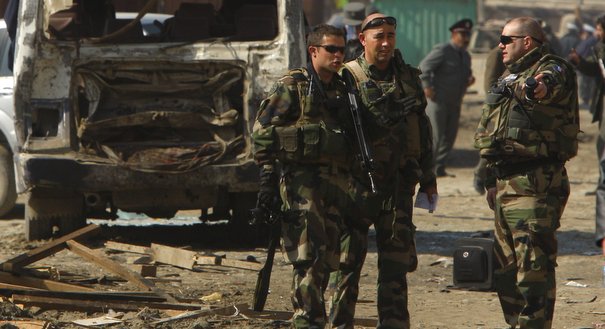
Source: Getty
The latest attacks by the self-proclaimed Islamic State may destabilize the upcoming Afghan elections, even as U.S. President Donald Trump questions the U.S. commitment to the country.
Source: Axios
Two suicide bombings in Afghanistan's capital, Kabul, on Monday morning killed at least 25 people, including journalists, police officers and emergency responders. The Islamic State has claimed responsibility.
Why it matters: Over the past year, Kabul has faced a surge of large-scale attacks, and Afghanistan’s National Unity Government has struggled to improve security throughout the country. Although President Ashraf Ghani has offered to enter peace negotiations with the Taliban, these bombings underscore that the Islamic State poses its own grave challenge to the country's stability, just as President Trump has reportedly called U.S. support into question.
Monday's attacks appear to have been designed to specifically target journalists and emergency personnel. At least nine journalists are confirmed dead, as well as at least four police officers. The blow to Afghan journalism is noteworthy, as the burgeoning independent media is now the country's second-most trusted institution (behind only religious leaders).
The attacks come before two milestones in Afghanistan’s democratic development: parliamentary elections, slated for October, and next spring's presidential election. They also follow another Islamic State–claimed attack last week at a voter registration center that killed at least 60 — an apparent effort to discredit the electoral process and sow ethnic violence.
What to watch: First, whether Afghanistan's deteriorating security will have a further chilling effect on the upcoming elections. Second, whether Trump’s new national security team will shift positions on Afghanistan. U.S. leadership has emphasized enduring American support for the Afghan government consistent with the administration’s new South Asia Strategy, but reports broke on Monday that Trump wants to “get the hell out of ” Afghanistan. The only certainty is that Afghan journalists will continue to risk their lives to report the news.

Vice President for Studies
Dr. Frances Z. Brown is a vice president for studies at the Carnegie Endowment for International Peace. Brown served on the White House National Security Council (NSC) staff over the past three presidential administrations. Her research focuses on U.S. foreign policy, Africa, the Middle East, and governance.
Recent Work

Frances Z. Brown, Nate Reynolds, Priyal Singh, …
Saskia Brechenmacher, Frances Z. Brown
Carnegie India does not take institutional positions on public policy issues; the views represented herein are those of the author(s) and do not necessarily reflect the views of Carnegie, its staff, or its trustees.

In any defense establishment, change is an ongoing process. However, despite the best of intentions, existing bureaucracies, bound by habit and years of socialization, have their limits in implementing transformative change.

Anit Mukherjee

How is AI reshaping space security, creating governance challenges, and where does international diplomacy stand today?


Tejas Bharadwaj, Almudena Azcárate Ortega

After the chill in ties between 2020 and 2024 that brought India–China relations to their lowest point in several decades, the two countries have engaged each other afresh. This paper argues that there are predominantly four imperatives guiding India’s approach to China, and they exist in an order of priority.

Saheb Singh Chadha

The U.S.–India semiconductor cooperation story is well-stocked with top-level strategic intent. What remains unresolved, however, are some underlying challenges that will determine whether the cooperation actually functions. Three such friction points stand out.

Shruti Mittal

This piece argues that the present Indian strategy, based on opportunistic diversification and utilization of limited strategic reserves, remains inadequate when confronting supply disruptions. It evaluates India’s options in the short, medium, and long terms.

Vrinda Sahai