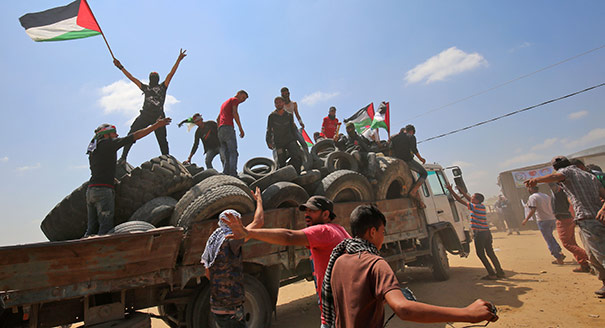
With hundreds of Palestinian casualties and many acres of burned Israeli wheat fields, the week of May 15 is witnessing the predictably tragic climax of several weeks of Palestinian protests along the Gaza border fence in confrontation with the Israel Defense Forces (IDF). These events have pitted the IDF against tens of thousands of protesting Gaza residents, inspired and organized by Hamas, who have managed to set fire to Israeli fields and have aimed to topple the fence and cross into Israel while some are engaging in acts of terrorism under the cover of mass nonviolent protest. Much attention has been given to these events from a current affairs perspective; this short piece offers a more fundamental explanation of the dynamics and their policy implications.
An inevitable point of departure is to acknowledge the heartbreaking human tragedy on the Palestinian side ensuing from the encounter with the IDF and on the desperation driving Gazans to embark on this form of protest. But, to really comprehend the unfolding events, and to conceive of more effective and palatable responses, requires going well beyond a discussion of the tragedy and the changing tactics of Hamas in fomenting and channeling this protest, and Israel’s attempts to dissuade the Gazans from the confrontation and respond to its manifestations. Hamas is engaged in a new variant of an old phenomenon: social warfare strategy. Importantly, this has become the most prevalent approach to warfare worldwide, a strategy commonly chosen by all challengers to the United States and its Western allies, from Hezbollah and the so-called Islamic State to Russia and China. As such it warrants focused attention.
Those applying this strategy seek to prevail not through classical military confrontation with their militarily superior Western rivals—but rather by directly taking on adversarial societies, manipulating international public opinion, and mobilizing their own societies. Though particular tactics differ, all of these approaches channel conflict to occur among and between people, placing noncombatants on both the physical and psychological fronts. To succeed, they creatively subject to such societal logic the employment of a broad array of weapons—traditional (such as tanks and missiles) alongside newly weaponized ones. The latter include social networks, demographic transfers, digital currency, legal methods, and human shields (even corpses). Naturally, media coverage and the internet play a critical role in such campaigns.
This is playing out right now in Gaza. Militarily inferior, Hamas eschews the traditional goal of military victory, adopting instead its own variant of long-term social warfare strategy. Employing judo-like tactics, Hamas cynically twists largely passive-resistance-like tactics employed by past heroes to leverage the superior power’s response to their own advantage. Its core strategy is purposeful provocation of Israel to engage in what the global public deems disproportionate response against noncombatants. In the current round of protests, this is achieved by Hamas cynically enticing desperate Gazans to provoke the IDF along and across the fence. In the larger conflagrations, Hamas has employed a strategy of putting its weaponry and fighters within the civilian population, including in schools, mosques, and hospitals, not to protect them but with the express purpose of having them targeted by Israeli forces to create powerful narratives about IDF cruelty in targeting civilian targets. These events and their attendant images are then widely disseminated through traditional and new media, aimed at Palestinian, Arab, European, U.S., and even Israeli audiences, in order to engender broad public sympathy for its cause (including within Gaza), to create opprobrium of Israel, to fuel the BDS movement, and to generate internal dissent within the IDF and Israeli society writ large. Thus, unwittingly, in its present policy Israel does much to “cooperate” with Hamas’s strategy and to enhance its effectiveness.
Given the unwillingness to wage total savage war against a society, as Syrian President Basher al-Assad and his allies have done in Syria and as the Russians practiced in Chechnya, an effective response to this kind of challenge demands a befitting strategy. Such a strategy should be guided by the logic of social impact, but the precise nature and specific mix of measures and the manner of application must be tailored to the unique circumstances of each case. Here is an illustration of what such an approach would suggest for how Israel should contend successfully with Hamas’s social warfare strategy.
First, notwithstanding Hamas’s provocations, Israel’s leadership should continue to resist the temptation to respond to the Hamas challenge by launching an aggressive military campaign in Gaza aimed at a short-term military victory. Such a campaign would surely result in operational success and a quick conquest of parts or all of the Gaza Strip. But inevitably, it would exact a huge toll from Gazan noncombatants as well as from the IDF that would pay dearly for operating discriminately in a highly militarized, treacherous, mostly urban environment. Israeli victory in such a campaign would amount to a perfect Pyrrhic debacle because of the political ramifications from the humanitarian toll, playing right into the trap of Hamas’s social warfare strategy.
Worse still, it would leave Israel “owning” the Gaza Strip and its hostile population of some 2 million persons who live in extreme poverty amid crumbling infrastructure.
Second, Israel would need to accept a certain “irreducible minimum” level of violent friction from Gaza for the foreseeable future. Which, in turn, would require it to invest even more in defensive capacity against rockets, mortars, and offensive tunnels from Gaza.
Third, in confronting Hamas-incited human waves threatening to topple the security fence separating Gaza from Israel, the IDF should rely predominantly on an arsenal of non- and less-than-lethal weapons. While the use of such weapons is typically legally contentious (hence their employment to date has been relatively modest in scope and efficacy), they nonetheless constitute a proportionate response to the threat faced here and are certainly infinitely preferable to deadly firearms. The latter should be reserved for targeted Hamas warriors and otherwise remain an absolute last resort.
Fourth, in parallel with these coercive tools, Israel should engage in creative social warfare tactics of its own. It needs to enhance its application of the tools and art of media- and internet-based psychological and cognitive impact on Gazan society. Most importantly, it must deploy and leverage outright positive measures. The IDF and its civilian counterparts should redouble their current efforts to transform the Gaza Strip into a more hospitable living environment. Ironically, the key element is to mobilize the international community for a concerted endeavor, not just to raise the required funds and to effectively channel them but also to pressure Hamas to surrender its resistance to a massive development effort, resistance that emanates from its anxiety about losing command of the population by depleting the strategic reservoir of desperation and hatred toward Israel.
Finally, Israeli leadership would be well advised to intensify its exploration of political accommodation options with Hamas that could at least reduce the flames while simultaneously actively seeking buy-in from its own population for all contours of a dual strategy geared toward both conflict and coexistence. Public understanding for the rationale, goals, means, and time frame guiding this complex strategy is indispensable for gaining political elbow room to carry it out while also harmonizing the civil-military relations necessary to implement it effectively.
Examining the dynamics of the confrontation in Gaza through the lens of social warfare strategy is thus instructive for thinking through a successful response. But its relevance is far broader because Gaza presently is merely one of many battlegrounds across the globe in which Western states are challenged by large and small, state and nonstate adversaries employing social warfare strategies. The social-centric paradigm can stimulate development of more effective, humane responses for these other cases as well.
Jonathan (Yoni) Shimshoni is a research affiliate at the MIT Security Studies Program.