

Commentary
Ulrich Kühn
{
  "authors": [
    "Ulrich Kühn"
  ],
  "type": "other",
  "centerAffiliationAll": "dc",
  "centers": [
    "Carnegie Endowment for International Peace"
  ],
  "collections": [
    "U.S. Nuclear Policy"
  ],
  "englishNewsletterAll": "ctw",
  "nonEnglishNewsletterAll": "",
  "primaryCenter": "Carnegie Endowment for International Peace",
  "programAffiliation": "NPP",
  "programs": [
    "Nuclear Policy"
  ],
  "projects": [],
  "regions": [
    "North America",
    "United States"
  ],
  "topics": [
    "Security",
    "Nuclear Policy"
  ]
}
Source: Getty
Why the United States does not currently have a long-term strategy for dealing with its most fundamental foreign policy challenges and why it needs one.
Source: Bulletin of the Atomic Scientists
What might Sigmund Freud, the father of psychoanalysis, have found, had he lived long enough to study the 2018 US Nuclear Posture Review and its drafters? Anxiety about failure and death, fear of impotence, and an obsession with deterrence that obscures the ultimate question: “What is it that the United States wants in this world?” In this essay, the author uses psychoanalytic metaphors to explain why the United States does not currently have a long-term strategy for dealing with its most fundamental foreign policy challenges – and why it needs one, particularly as regards the global nuclear dilemma.
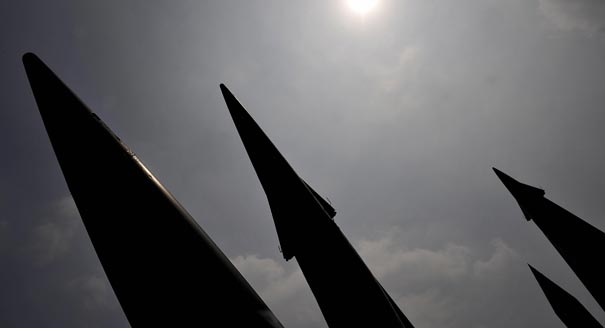
Imagine for a second that Sigmund Freud were to analyze the 2018 US Nuclear Posture Review (NPR). He would quickly encounter strong feelings of anxiety and unhappiness that the drafters of the NPR seem to express when writing about nuclear deterrence. Anxiety about failure, and ultimately death, is omnipresent in the document and is met by prescriptions for more nuclear capabilities. Fear of impotence – in the form of unhappiness with the restraints that nuclear deterrence puts on the natural instinct of aggression – is answered in the NPR by the lowering of the threshold to nuclear use. But ultimately, when digging deeper into the document, Freud would come across an obsession with deterrence, one that saves and prevents the “American patient” from asking the ultimate question: “What is it that I want in this world?”
This article was originally published in the Bulletin of the Atomic Scientists.

Former Nonresident Scholar, Nuclear Policy Program
Ulrich Kühn was a nonresident scholar at the Carnegie Endowment for International Peace, and the head of the arms control and emerging technologies program at the Institute for Peace Research and Security Policy at the University of Hamburg.
Recent Work
Ulrich Kühn
Ulrich Kühn
Carnegie India does not take institutional positions on public policy issues; the views represented herein are those of the author(s) and do not necessarily reflect the views of Carnegie, its staff, or its trustees.

In any defense establishment, change is an ongoing process. However, despite the best of intentions, existing bureaucracies, bound by habit and years of socialization, have their limits in implementing transformative change.

Anit Mukherjee

How is AI reshaping space security, creating governance challenges, and where does international diplomacy stand today?


Tejas Bharadwaj, Almudena Azcárate Ortega

After the chill in ties between 2020 and 2024 that brought India–China relations to their lowest point in several decades, the two countries have engaged each other afresh. This paper argues that there are predominantly four imperatives guiding India’s approach to China, and they exist in an order of priority.

Saheb Singh Chadha

The U.S.–India semiconductor cooperation story is well-stocked with top-level strategic intent. What remains unresolved, however, are some underlying challenges that will determine whether the cooperation actually functions. Three such friction points stand out.

Shruti Mittal

This piece argues that the present Indian strategy, based on opportunistic diversification and utilization of limited strategic reserves, remains inadequate when confronting supply disruptions. It evaluates India’s options in the short, medium, and long terms.

Vrinda Sahai