

Commentary
Ulrich Kühn
{
  "authors": [
    "Ulrich Kühn"
  ],
  "type": "legacyinthemedia",
  "centerAffiliationAll": "dc",
  "centers": [
    "Carnegie Endowment for International Peace"
  ],
  "collections": [
    "U.S. Nuclear Policy"
  ],
  "englishNewsletterAll": "ctw",
  "nonEnglishNewsletterAll": "",
  "primaryCenter": "Carnegie Endowment for International Peace",
  "programAffiliation": "NPP",
  "programs": [
    "Nuclear Policy"
  ],
  "projects": [],
  "regions": [
    "North America",
    "United States",
    "Russia",
    "Western Europe"
  ],
  "topics": [
    "Nuclear Policy",
    "Arms Control"
  ]
}
Source: Getty
With the likely end of the Intermediate-range Nuclear Forces (INF) Treaty approaching, NATO allies have started to debate what reaction the alliance should take in response to the Russian violations.
Source: Valdai Club
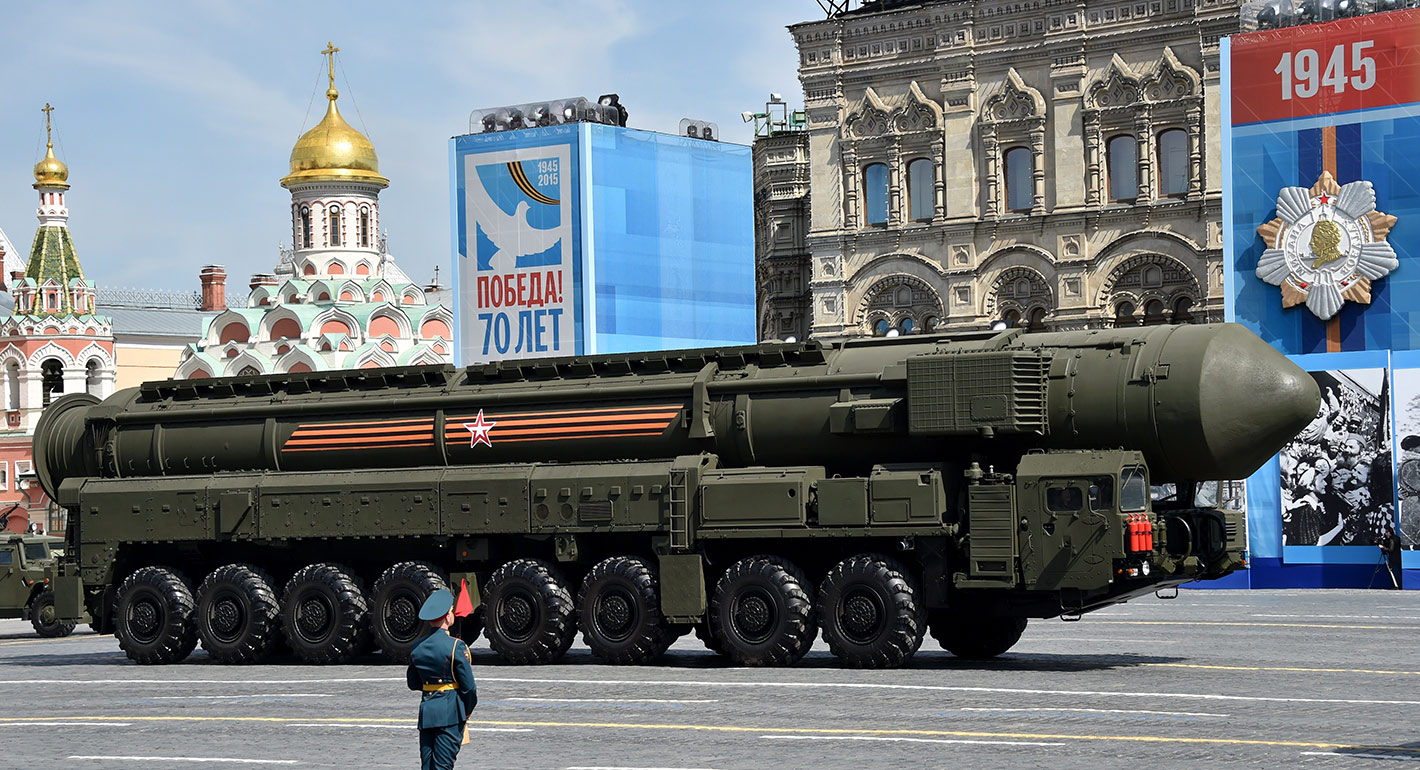
Time is running out on the Intermediate-range Nuclear Forces (INF) Treaty. In early August, the Trump administration will legally pull out of the accord with Russia banning ground-launched missiles with ranges between 500 and 5,500 kilometers. While it is not too late for a diplomatic solution and potential arms control measures to salvage INF’s legacy (see my last column here), it becomes increasingly clear that neither the likely perpetrator, Russia, nor the accuser, the United States, is willing to compromise. Meanwhile, the Pentagon is moving forward with a research and development program for its own future INF-range systems. At the same time, NATO allies have started to debate what reaction the alliance should take in response to the Russian violations. As Russia is expected to deploy more and more SSC-8 missiles, a punitive reaction by NATO members becomes increasingly likely. A number of options are possible.
NATO allies could respond asymmetrically, targeting Russian economic and financial institutions instead of responding with military countermeasures. A new round of sanctions involving all allies could signal that NATO members will not let Russia off the hook. Particularly Europe’s major economies, first and foremost the German, could tighten the screws on Russia, including by cancelling large economic cooperative projects such as the disputed Nord Stream II pipeline. The downsides of this approach are obvious. Most importantly, Chancellor Merkel has made it very clear that Germany will continue to pursue its national interest with regards Nord Stream II. The pipeline so loathed by East Europeans will be built no matter what. Second, as the Minsk process has demonstrated, even orchestrated and sustained sanctions have not resulted in the Kremlin changing course. Third, some allies such as Italy or Greece are unlikely to agree to sanctions in order not to provoke Moscow. Thus, it seems unlikely that Europeans will support another round of even stricter sanctions against Russia.
Because economic sanctions seem unlikely and insufficient, military countermeasures come into play. As Germany’s Minister of Defense, Ursula von der Leyen, confirmed, a number of options are being discussed in Brussels. One option would be strengthening missile defense throughout Europe. In order to deny Russia escalation dominance via its new missiles, point defense installations could help protecting NATO’s critical reinforcement nodes. The downsides to this approach are considerable. First of all, systems like Patriot equipped with PAC-3 interceptors are not very reliable in defending against low-flying cruise missiles. They might be sufficient for protecting certain military installations but certainly cannot close off entire areas or even countries. In addition, more defense could be misperceived in Russia as an invitation for more offense, thereby increasing chances that Europe will experience another missiles arms race. Also, in times of Trumpian transactionalism, European allies should be well aware that costly missile defenses would, quite likely, have to be paid by Europeans themselves.
NATO allies could still strengthen their offensive capabilities well below the threshold of new US INF-range missiles. Here, one option that NATO has already exercised in the recent past would be the rotational deployment of US long-range bombers to Western Europe. Equipped with long-range conventional standoff weapons targeting Russian installations, these bombers could well signal allied resolve to the Kremlin. But some of the unintended signaling effects might turn out to be problematic in an acute crisis. Were Washington to send its bombers in such a crisis, Moscow might well misinterpret the move as preparations for a preventive strike, thereby forcing Moscow’s hand to strike first.
Instead, NATO members could ask America to increase its naval presence in European waters with additional conventional firepower on board US submarines and Arleigh Burke class destroyers. The problem is that the latest revision of America’s nuclear strategy envisions the development of a new class of low-yield nuclear warheads mounted on sea-launched ballistic missiles and a new generation of nuclear-tipped sea-launched cruise missiles (SLCM). But how on earth should the Russian military distinguish between an incoming conventional SLCM and its nuclear twin? Wouldn’t the detection of any kind of SLCM employment risk immediate nuclear escalation by Russia? Responsible politicians and the military would need to answer these questions in a convincing manner.
Finally, allies could opt for a tit-for-tat in ground-launched cruise and ballistic missiles. Latest news about America’s post-INF posture report the development of a new conventional tipped GLCM, which might be ready for deployment in early 2021, and a Pershing III-like ballistic missile, only ready in a couple of years. Even though high-ranking NATO officials such as Jens Stoltenberg have downplayed this option, Europeans might soon be confronted with another deployment debate. No doubt, while perhaps be welcomed by governments such as the current one in Warsaw, a number of Western European allies might view such a decision as highly problematic for domestic reasons. Even though, large-scale protests akin to the early 1980s are rather unlikely today, still, a renewed deployment debate could plunge a number of governments into despair, thereby rendering NATO ineffective. All in all, the political cost of a new deployment debate would most likely be very high.
Whatever the decision by NATO allies with regards measures to counter Russia’s INF violations, it does not take much imaginative power to envision some sort of mix of the options discussed above. The bigger question is whether NATO allies will manage to stay unified when it comes to US pressure for deploying future INF-range systems further down the road and whether they will be able to convince Washington of the salience of arms control.

Nonresident Scholar, Nuclear Policy Program
Ulrich Kühn is a nonresident scholar at the Carnegie Endowment for International Peace, and the head of the arms control and emerging technologies program at the Institute for Peace Research and Security Policy at the University of Hamburg.
Recent Work
Ulrich Kühn
Ulrich Kühn
Carnegie India does not take institutional positions on public policy issues; the views represented herein are those of the author(s) and do not necessarily reflect the views of Carnegie, its staff, or its trustees.

This piece argues that India’s central challenge is not managing a single flashpoint but resolving the underlying tension between expansion and institutional coherency of the BRICS grouping.

Vrinda Sahai

The U.S.–India semiconductor cooperation story is well-stocked with top-level strategic intent. What remains unresolved, however, are some underlying challenges that will determine whether the cooperation actually functions. Three such friction points stand out.

Shruti Mittal

India and the United States are close to concluding a Reciprocal Defense Procurement Agreement (RDPA) that will allow firms from the two countries to sell to each other’s defense establishments more easily. While this may not remedy the specific grievances both sides may have regarding larger bilateral issues, an RDPA could restore some momentum, following the trade deal announcement.

Konark Bhandari

On the last day of the India AI Impact Summit, India signed Pax Silica, a U.S.-led declaration seemingly focused on semiconductors. While India’s accession to the same was not entirely unforeseen, becoming a signatory nation this quickly was not on the cards either.
Konark Bhandari

This piece examines India’s response to U.S. sanctions and tariffs, specifically assessing the immediate market consequences, such as alterations in import costs, and the broader strategic implications for India’s energy security and foreign policy orientation.
Vrinda Sahai