

Commentary
How is AI reshaping space security, creating governance challenges, and where does international diplomacy stand today?
Tejas Bharadwaj, Almudena Azcárate Ortega
{
  "authors": [
    "Richard Sokolsky",
    "Aaron David Miller"
  ],
  "type": "legacyinthemedia",
  "centerAffiliationAll": "",
  "centers": [
    "Carnegie Endowment for International Peace"
  ],
  "collections": [
    "Iranian Proliferation"
  ],
  "englishNewsletterAll": "",
  "nonEnglishNewsletterAll": "",
  "primaryCenter": "Carnegie Endowment for International Peace",
  "programAffiliation": "",
  "programs": [],
  "projects": [],
  "regions": [
    "North America",
    "United States",
    "Middle East",
    "Iran"
  ],
  "topics": [
    "Political Reform",
    "Democracy",
    "Foreign Policy",
    "Nuclear Policy"
  ]
}
Source: Getty
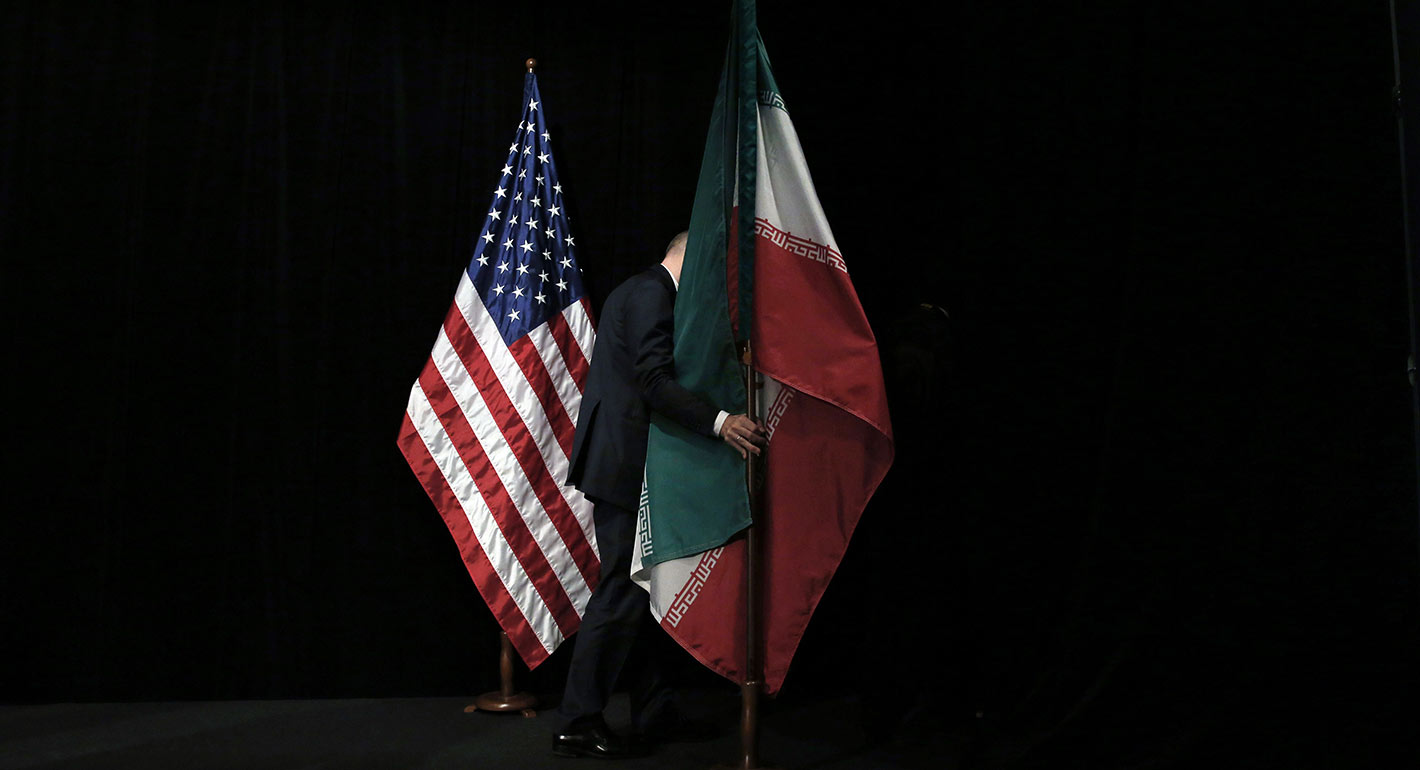
Iran is hurting badly from U.S. sanctions. And no one should rule out the possibility of an Iranian move to engage Washington. But right now, neither the United States nor Iran seems interested in serious negotiations.
Source: CNN
Wednesday marks the first anniversary of the Trump administration's decision to pick up its marbles and exit the Iran nuclear accord, otherwise known as the Joint Comprehensive Plan of Action, or JCPOA.
The sky hasn't fallen. But tensions are mounting; Iran has not yet bolted from the agreement or resumed its nuclear enrichment, but reports suggest Tehran may well stop abiding by some provisions in the JCPOA, particularly on research on advanced centrifuges, as payback against US sanctions.
The two countries aren't yet at war, though the Trump administration's deployment of a carrier strike group this week, in an apparent reaction to intelligence on the movements of Iran-aligned groups (as administration officials told The New York Times), is a worrisome sign. But the administration achieved neither its publicly stated goal of forcing Tehran back to the nuclear negotiating table nor its unstated goal of regime collapse or change.
This state of affairs is likely to persist. Iran is hurting badly from US sanctions. And we should never rule out the possibility of an Iranian move to engage Washington, though the smart money is betting that Tehran will try to outlast this administration -- though we can't rule out that Iran could walk away from the nuclear accord, either. Right now, neither the United States nor Iran seems interested in serious negotiations. If we're lucky, the two countries will avoid a serious military escalation, even though administration hawks appear to be itching for one. But diplomatically, both sides are on a road to nowhere. And here's why.
Trump has flirted with the idea of trying to negotiate a better deal with Iran and has offered to meet with Iranian President Hassan Rouhani to do so. Trump's grandstanding should not be taken seriously. The administration just turned the heat up even higher on sanctions. What's more, the administration seems to hail from the "our way or the highway" school of diplomacy. Last May, Secretary of State Mike Pompeo set out a dozen conditions Iran would have to meet before the administration would lift sanctions and establish diplomatic relations with Tehran. This was not a serious offer to negotiate, but rather a demand that Iran wave the white flag of surrender. Pompeo and especially super-hawk John Bolton, the national security adviser, aren't willing to consider a negotiation where they'd give as well as take; for both, compromise -- at least with Iran -- is seen as weakness, even appeasement.
The administration's strategy, then, appears to be regime change. Unsurprisingly, Pompeo, who championed this goal before entering the administration, has been coy about its real intentions, saying the United States isn't interested in a "military exercise" to change the Iranian regime. But the administration is doing everything it can to fracture and collapse the regime. Reneging on the nuclear deal, designating the Iranian Revolutionary Guard Corps as a foreign terrorist organization, and pulling out all the stops to reduce Iranian oil exports to zero are aimed not at changing regime behavior but changing the regime. Before joining the administration, Bolton was a tireless advocate of bombing Iran and changing its regime; he recently told The New Yorker that opposition to the regime was widening.
A policy of regime change is quixotic and reckless. The repressive power of the Iranian state is formidable; there's no public or organized political opposition to clerical rule, and millions of Iranians still support the regime. There is also no viable US military option to remove the regime, short of a full-scale invasion that would be a dangerous and fantastical proposition -- and Iran has all kinds of ways to hurt the United States and its allies very badly, throughout the region.
The Iranian economy is deteriorating, but there is no humanitarian catastrophe, and it's doubtful Iran's oil exports can be reduced to zero. There's no precedent for sanctions changing a nation's approach on vital national interests, let alone bringing a regime down. The regime is not nearly as brittle as Pompeo and Bolton appear to believe.
Equally important, US and Iranian political clocks are out of sync. Americans are impatient when it comes to foreign policy. Not so for the Iranians. As Iran's foreign minister recently opined, unlike the White House and members of Congress, Iran doesn't look at history in terms of US election cycles; it looks at "history in millennia." The Iranian regime has proven to be resilient, resourceful and patient in the face of US bullying and browbeating. Moreover, Iran's religious and security establishment are determined to use the United States as a foil to maintain support for the regime and control the population.
Tehran will most likely limp along until the US presidential election, relying on a combination of its own sanctions-busting, the refusal of some countries to knuckle under completely to US pressure to stop buying Iranian oil completely, and the return of a tighter oil market that would maximize revenues from its remaining sales. And Iran always has a Plan B, if muddling through doesn't pan out: resuming its nuclear program or even striking at the United States and its allies in the region, buckling down for confrontation, and demanding greater sacrifices from its public and relying more on a ruthless security apparatus to keep a lid on internal dissent.
Returning to the JCPOA, however, will be easier said than done. Nobody should be sanguine that a new administration would seamlessly pick up with Iran where the Obama administration left off. The Trump administration's maximum-pressure campaign will establish a more demanding domestic standard for judging the adequacy of any future US-Iranian agreements.
A Democratic administration will face continued Iranian meddling in the region, Iranian human rights abuses at home and hostility to the accord from Republicans. In fact, several Democratic presidential candidates have said that Iran will need to make more concessions, and there's a growing body of opinion that believes the United States should move to address the flaws in the accord. But after two more years of punishing sanctions, Tehran will be even more mistrustful and bitter -- and unwilling to make any additional concessions. A successor administration's effort to demand more without giving Iran more, in return, will be met with defiance.
The painful reality is that the trust and overlapping mutual interests necessary for a functional, let alone productive US-Iranian relationship, don't exist. And it's possible, even though both sides have been careful to avoid military escalation, that one might occur anyway. Bolton seems to think, quite mistakenly, that such a confrontation might play to America's advantage. The United States and Iran face a dangerous and uncertain future. America can't control Iran's leaders, who have divergent interests and their own domestic constraints and harbor deep suspicions toward their American foe.
The best advice we could give this administration would be not to provoke an escalation but to open a serious dialogue with Iran to avoid one; the best advice to the next one would be to keep that channel open and, before reaching any hard and fast conclusions, engage Iran on any number of issues, from the nuclear deal to regional security, to test the limits and parameters of the possible. Don't expect miracles or transformations. There won't be any. US-Iranian relations will be rough and coldly transactional for the foreseeable future, and if we're lucky, there won't be any serious shooting.

Nonresident Senior Fellow, Russia and Eurasia Program
Richard Sokolsky is a nonresident senior fellow in Carnegie’s Russia and Eurasia Program. His work focuses on U.S. policy toward Russia in the wake of the Ukraine crisis.

Senior Fellow, American Statecraft Program
Aaron David Miller is a senior fellow at the Carnegie Endowment for International Peace, focusing on U.S. foreign policy.
Carnegie India does not take institutional positions on public policy issues; the views represented herein are those of the author(s) and do not necessarily reflect the views of Carnegie, its staff, or its trustees.

How is AI reshaping space security, creating governance challenges, and where does international diplomacy stand today?


Tejas Bharadwaj, Almudena Azcárate Ortega

After the chill in ties between 2020 and 2024 that brought India–China relations to their lowest point in several decades, the two countries have engaged each other afresh. This paper argues that there are predominantly four imperatives guiding India’s approach to China, and they exist in an order of priority.

Saheb Singh Chadha

This piece argues that India’s central challenge is not managing a single flashpoint but resolving the underlying tension between expansion and institutional coherency of the BRICS grouping.

Vrinda Sahai

A partnership between India, a country of subcontinental size, and Africa, a continent of fifty-four countries, may seem asymmetric until one notes that both are home to nearly the same number of people—1.4 billion. This essay spells out the existing challenges to the partnership, its optimal potential, and the possible pathways to realize it over the next quarter-century.

Rajiv Bhatia

The U.S.–India semiconductor cooperation story is well-stocked with top-level strategic intent. What remains unresolved, however, are some underlying challenges that will determine whether the cooperation actually functions. Three such friction points stand out.

Shruti Mittal