

Research
- +6
Yasmine Farouk, Nathan J. Brown, Maysaa Shuja Al-Deen, …
{
  "authors": [
    "Michele Dunne"
  ],
  "type": "legacyinthemedia",
  "centerAffiliationAll": "dc",
  "centers": [
    "Carnegie Endowment for International Peace"
  ],
  "collections": [],
  "englishNewsletterAll": "menaTransitions",
  "nonEnglishNewsletterAll": "",
  "primaryCenter": "Carnegie Endowment for International Peace",
  "programAffiliation": "MEP",
  "programs": [
    "Middle East"
  ],
  "projects": [],
  "regions": [
    "North Africa",
    "Egypt"
  ],
  "topics": [
    "Political Reform",
    "Democracy",
    "Security",
    "Global Governance",
    "Foreign Policy"
  ]
}
Source: Getty
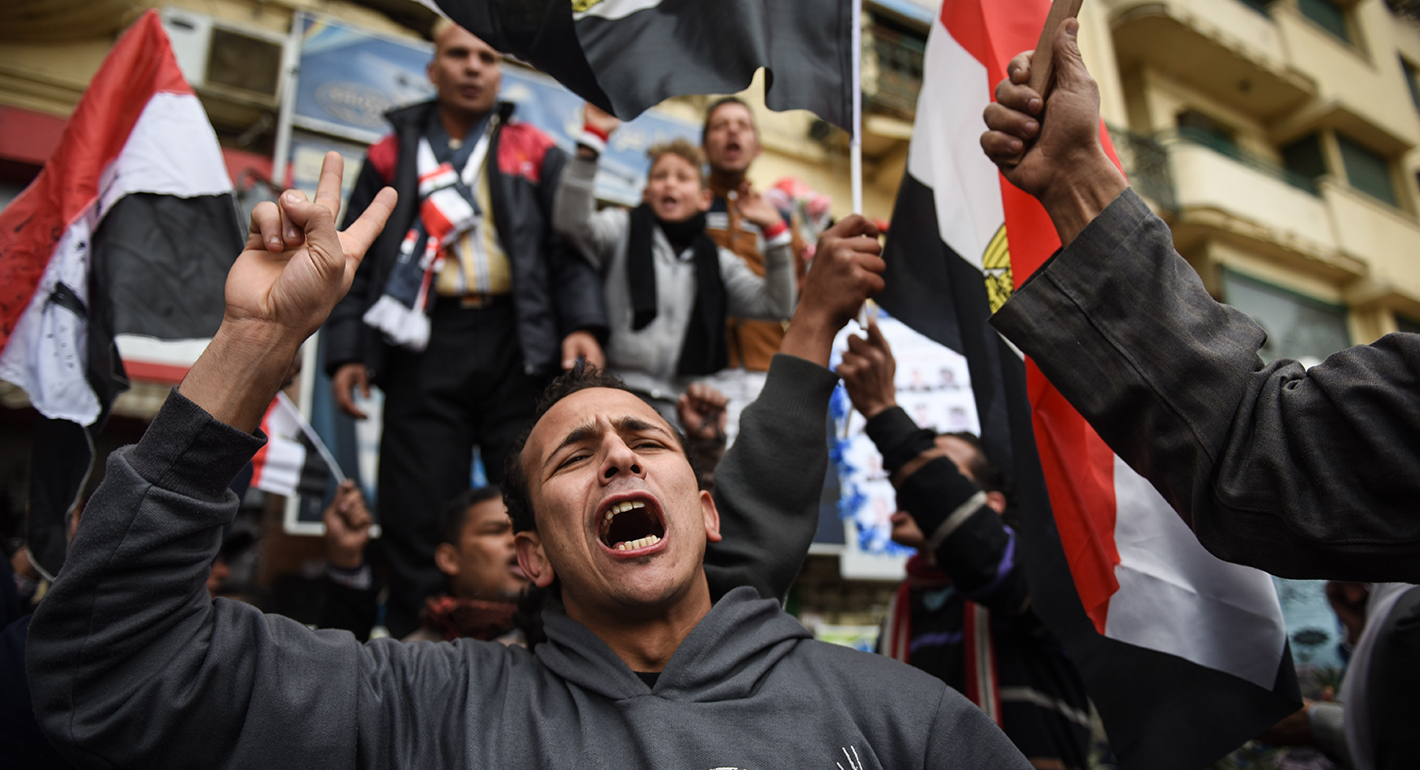
Nearly all political and social movements active before the coup have been crushed, leaving few leaders to formulate coherent protest demands or to negotiate with the military and security apparatus.
Source: Axios
Chaotic protests across Egypt this weekend — prompted by videos exposing corruption in President Abdel Fattah el-Sisi's military-backed government — underscore the population's weariness with economic hardship due in part to government austerity measures.
Why it matters: While Sisi markets Egypt as an island of stability in a turbulent region, popular dissatisfaction with his regime threatens that image. Whether the protests escalate or fizzle, the country remains a potential powder keg in a highly strategic location: straddling the Suez Canal, flanked by Israel and Libya, and across the Mediterranean from Europe.
Where it stands: Authorities have arrested several hundred protestors so far. Meanwhile, Sisi is in New York for the meeting of the UN General Assembly.
Background: Sisi has ruled with an iron fist, killing several thousand and imprisoning some 60,000.
Between the lines: While Sisi has sharply increased the military’s share of economic activity and political power, those benefits fall unequally, giving rise to internal power struggles.
The bottom line: While there is no clear path to peaceful change, Sisi’s continued rule promises to drive Egyptians into increasingly desperate circumstances, as well as to increase security headaches for Europe and the U.S., which funds Egypt’s military to the tune of $1.3 billion annually.

Former Nonresident Scholar, Middle East Program
Michele Dunne was a nonresident scholar in Carnegie’s Middle East Program, where her research focuses on political and economic change in Arab countries, particularly Egypt, as well as U.S. policy in the Middle East.
Recent Work



Yasmine Farouk, Nathan J. Brown, Maysaa Shuja Al-Deen, …

Robert Springborg, Emile Hokayem, Becca Wasser, …
Carnegie India does not take institutional positions on public policy issues; the views represented herein are those of the author(s) and do not necessarily reflect the views of Carnegie, its staff, or its trustees.

In any defense establishment, change is an ongoing process. However, despite the best of intentions, existing bureaucracies, bound by habit and years of socialization, have their limits in implementing transformative change.

Anit Mukherjee

After the chill in ties between 2020 and 2024 that brought India–China relations to their lowest point in several decades, the two countries have engaged each other afresh. This paper argues that there are predominantly four imperatives guiding India’s approach to China, and they exist in an order of priority.

Saheb Singh Chadha

This piece argues that India’s central challenge is not managing a single flashpoint but resolving the underlying tension between expansion and institutional coherency of the BRICS grouping.

Vrinda Sahai

A partnership between India, a country of subcontinental size, and Africa, a continent of fifty-four countries, may seem asymmetric until one notes that both are home to nearly the same number of people—1.4 billion. This essay spells out the existing challenges to the partnership, its optimal potential, and the possible pathways to realize it over the next quarter-century.

Rajiv Bhatia

The India–EU Free Trade Agreement (FTA) is shaping up to be one of the most consequential trade negotiations, both economically and strategically. But, what’s in the agreement, what’s missing, and what will determine its success in the years ahead
Vrinda Sahai, Nicolas Köhler-Suzuki