

Research
- +11
Frances Z. Brown, Nate Reynolds, Priyal Singh, …
{
  "authors": [
    "Frances Z. Brown"
  ],
  "type": "legacyinthemedia",
  "centerAffiliationAll": "dc",
  "centers": [
    "Carnegie Endowment for International Peace"
  ],
  "collections": [],
  "englishNewsletterAll": "democracy",
  "nonEnglishNewsletterAll": "",
  "primaryCenter": "Carnegie Endowment for International Peace",
  "programAffiliation": "DCG",
  "programs": [
    "Democracy, Conflict, and Governance"
  ],
  "projects": [],
  "regions": [
    "North America",
    "United States"
  ],
  "topics": [
    "Political Reform",
    "Democracy",
    "Foreign Policy"
  ]
}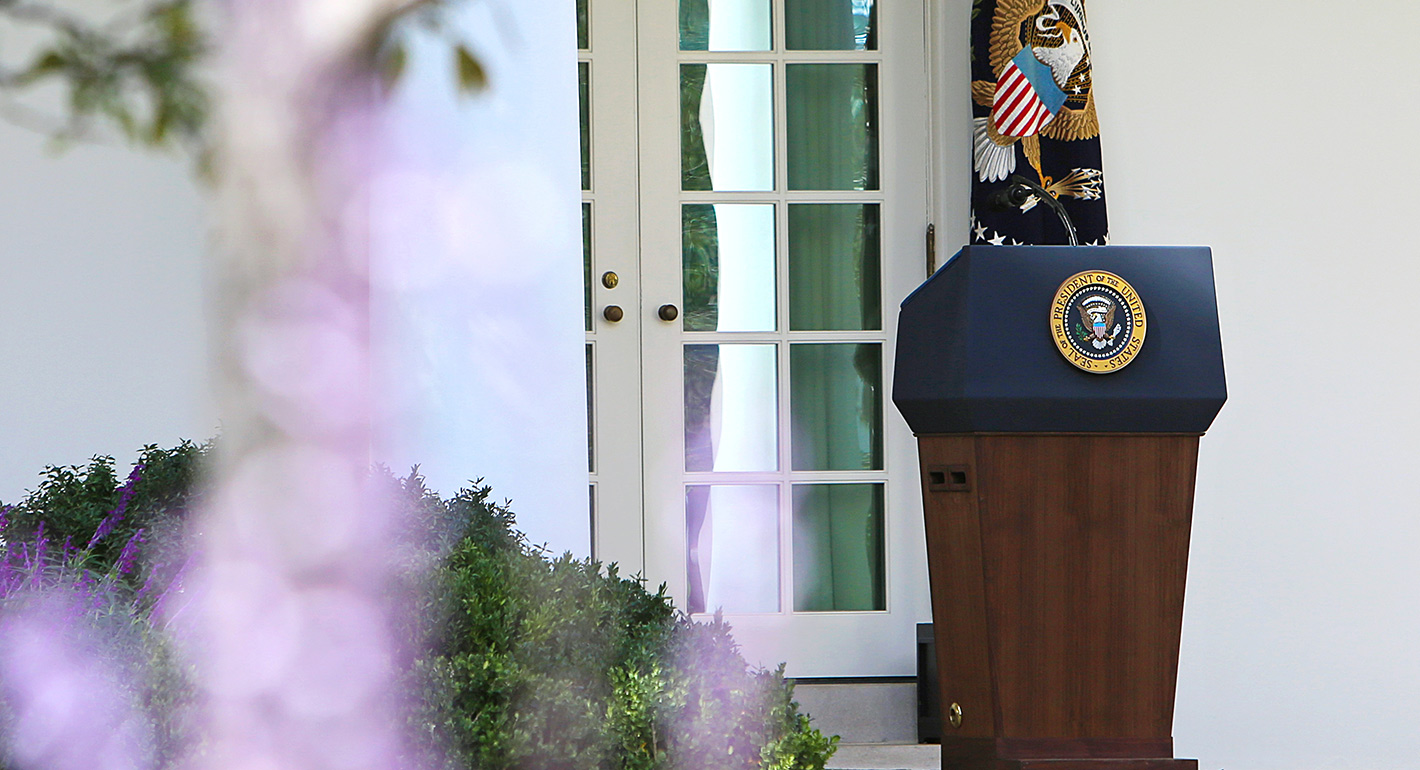
Source: Getty
How the president chooses his words is how he governs. If the White House’s words have lost their meaning, does anyone care?
Source: Washington Post
What happens if the president talks like a mafia boss toward a foreign leader? We have begun to find out. A rough transcript of President Trump’s call with the Ukrainian president has prompted shock from Democrats, and shock-that-there’s-any-shock from Republicans. But for me — a former White House national security staffer in both the Trump and Obama administrations — the call revealed what I had already seen firsthand: How the president chooses his words is how he governs.
I first discovered presidential lexicons run the world after joining the National Security Council staff in early 2016. In the Obama administration, sports analogies dominated White House speech from the Oval Office on down. This reflected the hard-work ethos: President Barack Obama reminded us that our job was to “leave it all on the field.” On the NSC staff, we were taking our turn as stewards of U.S. foreign policy, running “through the tape” until we could “pass that baton” to the next administration. And though it was late in Obama’s second term, he often reminded us: “Big things happen late in the fourth quarter.”
All the sports talk didn’t just reflect the high adrenaline. It also mirrored a particular vision of ourselves as public servants: teammates with a shared mission. Our job was to “move the ball down the field” toward solving big, complex problems — sometimes, problems so complex we needed to plot out the first 10 “plays.”
Admittedly, progress was often incremental: The president framed our goals in terms of hitting singles, doubles and the occasional home run. But we were reminded that “hard things are hard,” and when tackling hard things such as climate change or terrorism, incremental progress worked.
Above all, we spoke in terms of opportunities. NSC staffers inevitably had to respond to unforeseen crises every day, but our leadership urged us to stay focused on what we, in Obama-speak, called our “affirmative agenda” — and to put “points on the board” to achieve it. Someone passed out stickers exhorting us to “FIGHT CYNICISM” and “UNLOCK THE IMPOSSIBLE.”
After the 2016 election, I stayed on at the National Security Council. As my new leadership arrived in early 2017, I tried to take on a fresh vernacular to resonate with the new businessman in chief. I couched policy recommendations in terms of “good deal” or “bad deal.” I injected “return on investment” and “burden sharing” into my memos.
But I struggled to figure out the overarching objectives of the Trump team lexicon. What “affirmative agenda” was all this haggling meant to advance? Sure, “America First” was our new motto — but that didn’t provide specific guidance on tackling most national security dilemmas. Some officials tried to develop the slogans into a broader articulation of Trump foreign policy. But we all knew that one predawn presidential tweet could upend any carefully crafted policy message.
For months, I tried to explain to colleagues elsewhere in government what, exactly, the NSC position on a Middle Eastern country was. They complained that the White House’s statements kept changing, and I couldn’t argue. So I finally took to parroting President Trump’s own preferred response: “We’ll see what happens.” And when the president directly contradicted his team on myriad issues, I stopped pretending this was all a coherent messaging strategy. I copied his official spokespeople: “I will let the president speak for himself.”
I finally stumbled upon three key realizations about language in the Trump administration: First, getting the words right didn’t matter. The precise phrase to explain a U.S. policy position didn’t matter. Perfect talking points for the president’s conversations with foreign leaders really didn’t matter, because he wouldn’t use them anyway. In fact, the lack of clarity often let the president claim his words were misconstrued. The lack of clarity was the point.
Second, we had shifted from the language of opportunity to a language of threats. I filed away my “UNLOCK THE IMPOSSIBLE” stickers and adjusted to “protect our sovereignty” in an “extraordinarily dangerous world.”
And third, unlike the sports-team lexicon of the Obama White House, there was no longer a “team” at all. In the Trump administration, national security priorities were indistinguishable from personal interests.
Last week, Trump’s remarks about the whistleblower hit all these familiar notes of personal vendetta and vagueness: “You know what we used to do in the old days when we were smart? Right? With spies and treason, right? We used to handle them a little differently than we do now.”
Today, I wonder what lexicon Americans want their president to embrace when he speaks to the world. Do they want a quarterback trying to move the ball down the field? Or are they gratified by a leader speaking in menacing innuendo? And finally: If the White House’s words have lost their meaning, does anyone care?
In coming months, as the president says, we’ll see what happens.
This article was originally published in the Washington Post.

Vice President for Studies
Dr. Frances Z. Brown is a vice president for studies at the Carnegie Endowment for International Peace. Brown served on the White House National Security Council (NSC) staff over the past three presidential administrations. Her research focuses on U.S. foreign policy, Africa, the Middle East, and governance.
Recent Work

Frances Z. Brown, Nate Reynolds, Priyal Singh, …
Saskia Brechenmacher, Frances Z. Brown
Carnegie India does not take institutional positions on public policy issues; the views represented herein are those of the author(s) and do not necessarily reflect the views of Carnegie, its staff, or its trustees.

How is AI reshaping space security, creating governance challenges, and where does international diplomacy stand today?


Tejas Bharadwaj, Almudena Azcárate Ortega

After the chill in ties between 2020 and 2024 that brought India–China relations to their lowest point in several decades, the two countries have engaged each other afresh. This paper argues that there are predominantly four imperatives guiding India’s approach to China, and they exist in an order of priority.

Saheb Singh Chadha

This piece argues that India’s central challenge is not managing a single flashpoint but resolving the underlying tension between expansion and institutional coherency of the BRICS grouping.

Vrinda Sahai

A partnership between India, a country of subcontinental size, and Africa, a continent of fifty-four countries, may seem asymmetric until one notes that both are home to nearly the same number of people—1.4 billion. This essay spells out the existing challenges to the partnership, its optimal potential, and the possible pathways to realize it over the next quarter-century.

Rajiv Bhatia

The U.S.–India semiconductor cooperation story is well-stocked with top-level strategic intent. What remains unresolved, however, are some underlying challenges that will determine whether the cooperation actually functions. Three such friction points stand out.

Shruti Mittal