

Q&A
Dara Massicot, Aaron David Miller, Andrew S. Weiss
{
  "authors": [
    "Aaron David Miller"
  ],
  "type": "legacyinthemedia",
  "centerAffiliationAll": "",
  "centers": [
    "Carnegie Endowment for International Peace"
  ],
  "collections": [],
  "englishNewsletterAll": "",
  "nonEnglishNewsletterAll": "",
  "primaryCenter": "Carnegie Endowment for International Peace",
  "programAffiliation": "",
  "programs": [],
  "projects": [],
  "regions": [
    "North America",
    "United States",
    "Middle East",
    "Israel"
  ],
  "topics": [
    "Political Reform",
    "Foreign Policy"
  ]
}
Source: Getty
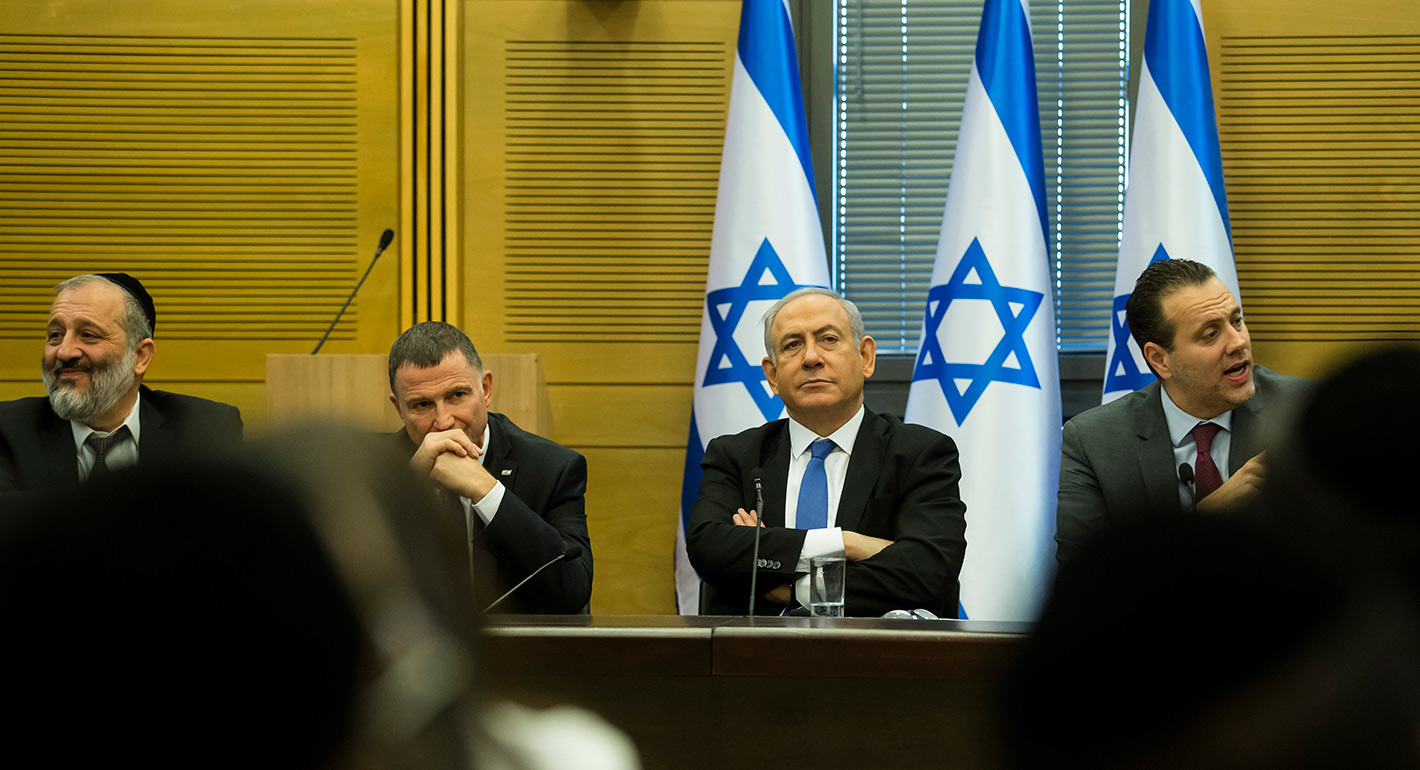
If anyone thought that Netanyahu would use his speech to the nation following news of the indictments to put country over party and go quietly into the night, they don't know Netanyahu.
Source: CNN
In Israeli politics, the old saw goes you can be dead—or dead and buried. Thursday's statement by the Israeli attorney general that Prime Minister Benjamin (Bibi) Netanyahu will be indicted on charges of bribery, fraud and breach of trust is likely going to put Netanyahu's political career in the latter box. It's almost certainly the beginning of the end of his political career.
However Bibi's story plays out -- and it will take time -- you can take this to the bank: Netanyahu will make this fight (and likely) exit as painful, prolonged and destructive as possible.
Here are some key takeaways:
If anyone thought that Netanyahu would use his speech to the nation following news of the indictments to put country over party and go quietly into the night, they don't know Netanyahu. I have known him since the 1980s and nothing is more important to him than his political ambitions, his desire to cling to power and his own sense of indispensability tethered in his own mind to the well-being and security of Israel and the Jewish people.
Netanyahu is in full attack mode as his speech Thursday reflected, and he's desperate. He's relentlessly and viciously attacked his enemies -- the courts, police, the Attorney General -- and accused them of an attempted coup, spilling his own blood and that of his family.
The intent is clear -- to tell his base that he's the victim of a vast conspiracy designed, as he said the other day, to put him down. And as the leader of Likud and prime minister still -- perhaps for as long as four months -- he will pull out every trick, maneuver and falsehood to maintain himself in power.
The intent is clear -- to tell his base that he's the victim of a vast conspiracy designed, as he said the other day, to put him down. And as the leader of Likud and prime minister still -- perhaps for as long as four months -- he will pull out every trick, maneuver and falsehood to maintain himself in power.
Thursday's decision by the attorney general to level charges of breach of trust, fraud and particularly bribery—the most damning charge — against a sitting Israeli prime minister is without precedent in Israel's political history. On top of the fact that Israel had no newly elected government despite two elections in six months, the country is now operating on legal and political terra incognita. And this process will take time.
Assuming that in the next two weeks no government can be formed and Netanyahu's Likud party doesn't abandon him to form a national unity government with Benny Gantz's Blue and White Party, or contest the next elections minus Netanyahu, Israel will go to a third election, probably in March, with Netanyahu as the Likud's leading candidate.
Israeli law states that an indicted prime minister -- as opposed to an ordinary minister -- does not need to resign until there's a conviction, though the attorney general may rule next week on motions arguing that an indicted prime minister should not be allowed to form a government.
As unimaginable and unbelievable as it seems, Netanyahu could run again, conceivably win and try to defend himself during a trial while leading the country. It's worth noting that former Prime Minister Ehud Olmert was indicted in 2009 (he had resigned by then) and it wasn't until 2016 that his conviction was upheld. He then served 16 months of a 27-month prison sentence. That was a seven-year process.
One factor that could expedite this process would be a decision by Likud party leaders that Netanyahu's indictment threatens the party and its future and the best course of action would be to choose a new leader, contest the next elections without Netanyahu or, if necessary, negotiate a national unity government and a rotating prime minister arrangement with Gantz.
One of Likud's leading lights, Gideon Saar, has already called for a Likud primary and put himself forward as a candidate to lead Likud in new elections. Others aren't so sure. Netanyahu's Foreign Minister Yisrael Katz has voiced support for Netanyahu, as have others.
But whether Likud is prepared to risk splitting the party and whether there's time before the clock runs out on government formation isn't at all clear.
There is fear of Netanyahu still; he's very popular within the party. And there's likely a fair amount of inertia to see the indictment process play out further. Likud has only had four leaders since 1977 -- Menachem Begin, Yitzhak Shamir, Ariel Sharon and Netanyahu.
Should any of the legal challenges against Netanyahu's continuing as prime minister look promising and/or public opinion somehow swells against him, that might prompt Likud acting. But with the point of no return to scheduling new elections only two weeks away, that doesn't appear likely.
Indeed, if a Likud leadership primary were to be held it would likely happen only when the Knesset dissolves and new elections are scheduled.
Israel -- a deeply divided but highly functioning country -- is at a historic turning point. A decade of Netanyahu's rule has solidified Israel's security situation and expanded its outreach in the Arab world, Latin and South America, India and China, not to mention Netanyahu's personal ties with both Trump and Putin.
But Netanyahu has divided the country further, injected an intense partisanship and tribalism, undermined the rule of law, coarsened the political dialogue, manipulated anger and hostility toward Israel's two million Arab citizens and foreclosed any hopes -- slim though they may be -- of a deal with Palestinians.
Israel needs new leadership and a fresh pathway to at least begin to heal internally. And Netanyahu's indictment may well provide it. For Likud, it offers a chance to break free from the sclerotic Netanyahu years and offer up new leaders.
For Gantz -- if his Blue and White party can hang together -- it offers the possibility of leading a new center-right bloc; for Israeli Defense Minister Avigdor Lieberman, revenge against Netanyahu for what he perceives as countless humiliations at Bibi's hands in their strange love-hate political relationship; and if a Unity Government is formed -- a way to jettison the religious parties and solidify his secular message.
Finally, for Israel's institutions that have so far acquitted themselves admirably in this historic process, Netanyahu's departure would provide a real boost of confidence and a lesson that others should heed —that no one in a democratic polity, no matter how talented or powerful, is above the law.

Senior Fellow, American Statecraft Program
Aaron David Miller is a senior fellow at the Carnegie Endowment for International Peace, focusing on U.S. foreign policy.
Recent Work


Dara Massicot, Aaron David Miller, Andrew S. Weiss



Sophia Besch, Eric Ciaramella, Steve Feldstein, …
Carnegie India does not take institutional positions on public policy issues; the views represented herein are those of the author(s) and do not necessarily reflect the views of Carnegie, its staff, or its trustees.

How is AI reshaping space security, creating governance challenges, and where does international diplomacy stand today?


Tejas Bharadwaj, Almudena Azcárate Ortega

After the chill in ties between 2020 and 2024 that brought India–China relations to their lowest point in several decades, the two countries have engaged each other afresh. This paper argues that there are predominantly four imperatives guiding India’s approach to China, and they exist in an order of priority.

Saheb Singh Chadha

This piece argues that India’s central challenge is not managing a single flashpoint but resolving the underlying tension between expansion and institutional coherency of the BRICS grouping.

Vrinda Sahai

A partnership between India, a country of subcontinental size, and Africa, a continent of fifty-four countries, may seem asymmetric until one notes that both are home to nearly the same number of people—1.4 billion. This essay spells out the existing challenges to the partnership, its optimal potential, and the possible pathways to realize it over the next quarter-century.

Rajiv Bhatia

The U.S.–India semiconductor cooperation story is well-stocked with top-level strategic intent. What remains unresolved, however, are some underlying challenges that will determine whether the cooperation actually functions. Three such friction points stand out.

Shruti Mittal