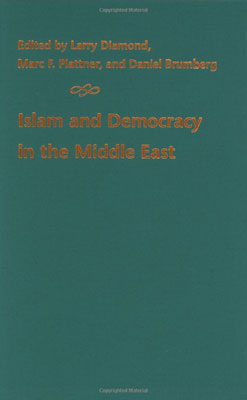
Drawing on the insights of some twenty-five leading Western and Middle Eastern scholars, Islam and Democracy in the Middle East highlights the dualistic and often contradictory nature of political liberalization. Political liberalization—as managed by the state—not only opens new spaces for debate and criticism, but is also used as a deliberate tactic to avoid genuine democratization.
Source: Johns Hopkins University Press, September 2003
Provides a comprehensive assessment of the origins and staying power of Middle East autocracies, as well as a sober account of the struggles of state reformers and opposition forces to promote civil liberties, competitive elections, and a pluralistic vision of Islam. Drawing on the insights of some twenty-five leading Western and Middle Eastern scholars, the book highlights the dualistic and often contradictory nature of political liberalization. As the case studies of Morocco, Algeria, Egypt, Jordan, Kuwait, Qatar, and Yemen suggest, political liberalization—as managed by the state—not only opens new spaces for debate and criticism, but is also used as a deliberate tactic to avoid genuine democratization.
Contributors:Shaul Bakhash, George Mason University; Ladan Boroumand, Abdorrahman Boroumand Foundation for the Promotion of Human Rights and Democracy in Iran; Roya Boroumand, Abdorrahman Boroumand Foundation; Jason Brownlee, Princeton University; Daniel Brumberg, Georgetown University; Abdelwahab El-Affendi, University of Westminster; Haleh Esfandiari, Woodrow Wilson International Center for Scholars; Abdou Filali-Ansary, editor of Prologues: revue maghrébine du livre; Michael Herb, Georgia State University; Ramin Jahanbegloo, Aga Khan University, London; Mehrangiz Kar, lawyer, writer, and human rights activist; E. Fuat Keyman, Koç University, Istanbul; Laith Kubba, National Endowment for Democracy; Vickie Langohr, College of the Holy Cross; Bernard Lewis, Princeton University; Russell Lucas, Wake Forest University; Abdeslam Maghraoui, Princeton University; Radwan Masmoudi, Center for the Study of Islam and Democracy, Washington, D.C.; Ziya Önis; Koç University; Soli Ozel, Bilgi University, Istanbul; William Quandt, University of Virginia; Jillian Schwedler, University of Maryland, College Park; Jean-François Seznec, Columbia University and Georgetown University; Emmanuel Sivan, Hebrew University; Mohamed Talbi, independent scholar; Robin Wright, Los Angeles Times.
About the Editors
Larry Diamond is senior fellow at the Hoover Institution, and codirector, with Marc Plattner, of the International Forum for Democratic Studies. He is also coeditor, with Marc Plattner, of the Journal of Democracy. Daniel Brumberg is visiting scholar with the Democracy and Rule of Law Project at the Carnegie Endowment and associate professor of government at Georgetown University.
Carnegie India does not take institutional positions on public policy issues; the views represented herein are those of the author(s) and do not necessarily reflect the views of Carnegie, its staff, or its trustees.
A partnership between India, a country of subcontinental size, and Africa, a continent of fifty-four countries, may seem asymmetric until one notes that both are home to nearly the same number of people—1.4 billion. This essay spells out the existing challenges to the partnership, its optimal potential, and the possible pathways to realize it over the next quarter-century.
As India’s economy recovers from the coronavirus pandemic, Indian businesses need efficient financial structures to regain their ground. Key reforms to India’s Insolvency and Bankruptcy Code could fill these gaps.
Access to cross-border data is an integral piece of the law enforcement puzzle. India is well placed to lead the discussions on international data agreements subject to undertaking necessary surveillance reforms.
After the coronavirus pandemic wanes, how will China’s reorientation of the Belt and Road Initiative to address global health concerns influence its relationships with South Asian countries?