
• Research
  • About
  • Experts
Carnegie India logoCarnegie lettermark logo
The Political Challenge of Yemen's Southern Movement

Source: Getty

Paper

The Political Challenge of Yemen's Southern Movement

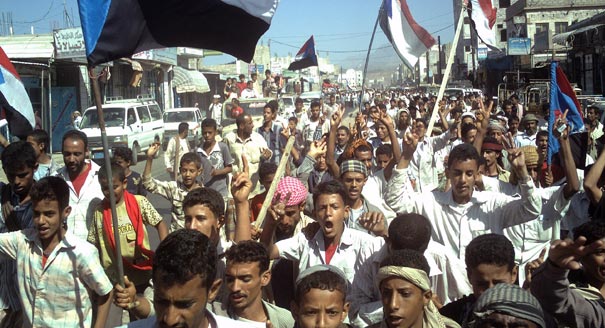
Yemen’s secessionist Southern Movement threatens the country’s stability, but a military campaign against it would only further inflame its supporters and increase support for al-Qaeda in the Arabian Peninsula. A political solution is required.

Link Copied
By Stephen Day
Published on Mar 23, 2010

Additional Links

Full Text

Yemen’s secessionist Southern Movement is undergoing a radical transformation that threatens the country’s stability. But a military campaign against the movement would only further inflame its supporters and increase support for al-Qaeda in the Arabian Peninsula. A political solution is required that addresses the unresolved problems from the country’s poorly-executed unification in the early 1990s.

Map: Yemen

Map of Yemen
  • view map
Map of Yemen showing current governorate boundaries and former North/South boundary.

Key Conclusions:

  • The demands of the southern leaders were originally moderate calls for equality, but a severe response from Yemeni President Saleh (who used government media to create scandals about the movement’s leaders and arrested religious figures) pushed the movement to demand secession.
     
  • Al-Qaeda’s leader in Yemen, Nasser al-Wahayshi, has declared support for the Southern Movement, but Southern leaders have thus far rejected his endorsement.
     
  • The primary problem in the South is not links between al-Qaeda and the Southern Movement, but unrest fueled by widespread opposition to the government and the perception of economic exploitation by the military and security forces.  

Policy Recommendations:

  • Arab leadership. Arab countries should lead the push for Yemen’s government to negotiate with southerners, improve economic development, and begin national reconciliation. Western-backed initiatives will only increase mistrust of the central government.
     
  • Reconciliation. Yemen’s government and representatives of the Southern Movement should commence national reconciliation talks. The talks must include domestic political opponents, southern women, and exiled southern leaders and members of the business community.
     
  • Address root causes. Instead of a military crackdown on the Southern Movement, the government needs to reduce corruption, respect human rights, and allow political opponents to peacefully organize.
     
  • Presidential transition. Saleh’s presidential term ends in 2013. Stepping down peacefully, and refusing to install a member of his family in his place, would go a long way in convincing the Southern Movement to drop its plans for secession.


“The success of the political effort in the South will require steady, outside pressure and effective mediation, preferably by an Arab leader like Jordan’s late King Hussein, who tried to assist Yemenis in 1994,” writes Day. But “ultimately, the success of such an effort will depend on Yemeni leaders on all sides, and their willingness to tackle problems left unsolved since the 1990s.”

About the Author

Stephen Day

Stephen Day
Middle EastYemenGulfPolitical ReformSecurityForeign Policy

Carnegie India does not take institutional positions on public policy issues; the views represented herein are those of the author(s) and do not necessarily reflect the views of Carnegie, its staff, or its trustees.

More Work from Carnegie India

  • Commentary
    The Impact of U.S. Sanctions and Tariffs on India’s Russian Oil Imports

    This piece examines India’s response to U.S. sanctions and tariffs, specifically assessing the immediate market consequences, such as alterations in import costs, and the broader strategic implications for India’s energy security and foreign policy orientation.

      Vrinda Sahai

  • Article
    Military Lessons from Operation Sindoor

    The India-Pakistan conflict that played out between May 6 and May 10, 2025, offers several military lessons. This article presents key takeaways from Operation Sindoor and breaks down how India’s preparations shaped the outcome and what more is needed to strengthen future readiness.

      Dinakar Peri

  • Book
    India and the Sovereignty Principle: The Disaggregation Imperative

    This book offers a comprehensive analysis of India's evolving relationship with sovereignty in a complex global order. Moving beyond conventional narratives, it examines how the sovereignty principle shapes India's behavior across four critical domains—from traditional military power to contemporary data governance.

      Rudra Chaudhuri, Nabarun Roy

  • Commentary
    NISAR Soars While India-U.S. Tariff Tensions Simmer

    On July 30, 2025, the United States announced 25 percent tariffs on Indian goods. While diplomatic tensions simmered on the trade front, a cosmic calm prevailed at the Sriharikota launch range. Officials from NASA and ISRO were preparing to launch an engineering marvel into space—the NASA-ISRO Synthetic Aperture Radar (NISAR), marking a significant milestone in the India-U.S. bilateral partnership.

      Tejas Bharadwaj

  • Article
    Hidden Tides: IUU Fishing and Regional Security Dynamics for India

    This article examines the scale and impact of Chinese IUU fishing operations globally and identifies the nature of the challenge posed by IUU fishing in the Indian Ocean Region (IOR). It also investigates why existing maritime law and international frameworks have struggled to address this growing threat.

      Ajay Kumar, Charukeshi Bhatt

Get more news and analysis from
Carnegie India
Carnegie India logo, white
Unit C-4, 5, 6, EdenparkShaheed Jeet Singh MargNew Delhi – 110016, IndiaPhone: 011-40078687
  • Research
  • About
  • Experts
  • Projects
  • Events
  • Contact
  • Careers
  • Privacy
  • For Media
Get more news and analysis from
Carnegie India
© 2026 Carnegie Endowment for International Peace. All rights reserved.





