
• Research
  • About
  • Experts
Carnegie India logoCarnegie lettermark logo
AI
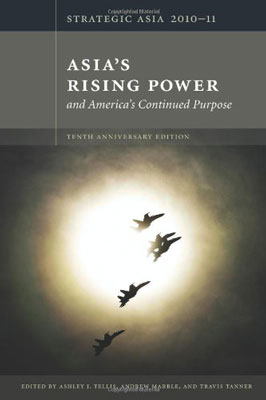
Strategic Asia 2010-11: Asia's Rising Power and America's Continued Purpose
Book

Strategic Asia 2010-11: Asia's Rising Power and America's Continued Purpose

This volume provides an integrated perspective on the major issues that influence stability in Strategic Asia. Leading experts examine Asia’s performance in nine key functional areas to provide a continent-wide net assessment of the core trends and issues affecting the region.

Link Copied
By Ashley J. Tellis, Andrew Marble, Travis Tanner
Published on Sep 29, 2010

Additional Links

Overview by Ashley J. Tellis

Source: The National Bureau of Asian Research

Co-edited and introduced by Ashley Tellis, with chapters by leading Asia specialists, this book, the tenth volume in NBR’s Strategic Asia series, takes stock of the Strategic Asia region by providing an integrated perspective on the major issues that influence stability in the region. In this volume, leading experts examine Asia’s performance in nine key functional areas to provide a continent-wide net assessment of the core trends and issues affecting the region.
 

Order this book, or read the introduction by Ashley J. Tellis for free.

About the Editors:

Ashley J. Tellis, Senior Associate at the Carnegie Endowment for International Peace and Research Director of the Strategic Asia Program at NBR, served in the U.S. Department of State as senior adviser to the Undersecretary of State of Public Affairs, and previously as senior adviser to the Ambassador at the U.S. Embassy in India. He also served on the National Security Council Staff as special assistant to the President and senior director for Strategic Planning and Southwest Asia. He is the author of India’s Emerging Nuclear Posture (2001) and co-author of Interpreting China’s Grand Strategy: Past, Present, and Future (2000), as well as the co-editor of seven most recent volumes of Strategic Asia, published by NBR.

Andrew Marble is the Editor at the National Bureau of Asian Research.

Travis Tanner is the Senior Project Director and Director of the Pyle Center for Northeast Asian Studies at the National Bureau of Asian Research.

About the Authors

Ashley J. Tellis

Former Senior Fellow

Ashley J. Tellis was a senior fellow at the Carnegie Endowment for International Peace.

Andrew Marble

NBR

Travis Tanner

NBR

Authors

Ashley J. Tellis
Former Senior Fellow
Andrew Marble
NBR
Travis Tanner
NBR
South AsiaEast AsiaSoutheast AsiaEconomyTradeClimate ChangeSecurityMilitaryForeign PolicyNuclear Policy

Carnegie India does not take institutional positions on public policy issues; the views represented herein are those of the author(s) and do not necessarily reflect the views of Carnegie, its staff, or its trustees.

More Work from Carnegie India

  • Article
    India–Africa Strategic Partnership: Challenges, Potential, and Possible Pathways

    A partnership between India, a country of subcontinental size, and Africa, a continent of fifty-four countries, may seem asymmetric until one notes that both are home to nearly the same number of people—1.4 billion. This essay spells out the existing challenges to the partnership, its optimal potential, and the possible pathways to realize it over the next quarter-century.

      Rajiv Bhatia

  • Commentary
    Emerging From the “Zombie State” of Trade Agreements: The India-EU FTA

    The India–EU Free Trade Agreement (FTA) is shaping up to be one of the most consequential trade negotiations, both economically and strategically. But, what’s in the agreement, what’s missing, and what will determine its success in the years ahead

      Vrinda Sahai, Nicolas Köhler-Suzuki

  • Article
    India’s Press Note 3 Gamble: Opening the FDI Door to China

    On March 10, 2026, India’s Union Cabinet approved amendments to Press Note 3, a regulation that mandated government approval on all foreign direct investment (FDI) from countries sharing a land border with India. This amendment raises questions primarily about whether its stated benefits will materialize and if the risks have been adequately weighed. This piece will address the same.

      Konark Bhandari

  • Commentary
    The Coming of Age of India’s Nuclear Triad

    The induction of INS Aridhaman, which features several technological enhancements, now gives India the third nuclear ballistic missile submarine to ensure continuous at-sea deterrent.

      Dinakar Peri

  • Article
    India’s Oil Security Strategy: Structural Vulnerabilities and Strategic Choices

    This piece argues that the present Indian strategy, based on opportunistic diversification and utilization of limited strategic reserves, remains inadequate when confronting supply disruptions. It evaluates India’s options in the short, medium, and long terms.

      Vrinda Sahai

Get more news and analysis from
Carnegie India
Carnegie India logo, white
Unit C-4, 5, 6, EdenparkShaheed Jeet Singh MargNew Delhi – 110016, IndiaPhone: 011-40078687
  • Research
  • About
  • Experts
  • Projects
  • Events
  • Contact
  • Careers
  • Privacy
  • For Media
Get more news and analysis from
Carnegie India
© 2026 Carnegie Endowment for International Peace. All rights reserved.





