

Commentary
Alexey Malashenko
Source: Getty
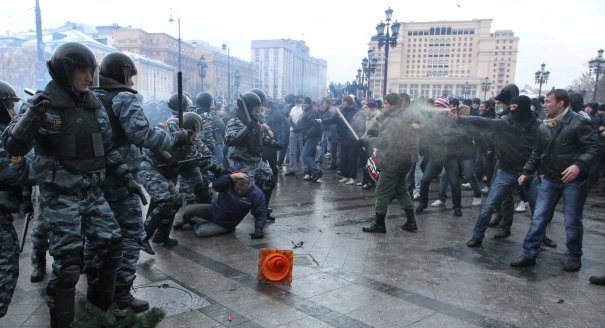
The mass unrest in Moscow this December has demonstrated the failure of the authorities to maintain stability in a multi-ethnic and multi-faith country.
The recent mass riots in Moscow should be recognized as a political crisis, or at least the warning sign of a crisis on the way. The riots were sparked by the murder of Yegor Sviridov, a Spartak football fan killed in a fight near a Moscow bus stop by Caucasian natives. Assessing these events requires extreme caution; it is all too easy to write an analysis that looks like a provocation for more violence, or, on the other extreme, seems entirely indifferent to the riots, as though nothing out of the ordinary happened at all. Russians must not exaggerate the situation, but neither can they ignore it.
First of all, Russians need a clear picture of exactly what happened during the recent unrest. There are two points of view on this. The first says the riots were simply a case of massive “disruptive behavior” tinged by ethnic tension, and the second says this was an interethnic clash packaged in the form of football fans’ brawls.
The first assessment is more convenient from the authorities’ point of view. It is easier to deal with hooligans. The second assessment requires a more serious approach and recognition of a real increase in the level of interethnic confrontation in Russia with the consequences that entails. This is not simply an academic matter. The official narrative of these events will determine what charges are pressed against those detained in Moscow and other cities for taking part in the riots: charges of engaging in a brawl are one matter, but charges of inciting interethnic tension are quite another.
But society seems inclined toward the second assessment.
If the authorities also end up taking this view of the December tragedy (and tragedy is the right word here), they should attempt to prevent a further rise in interethnic and religious tension. Any conflict with an interethnic element is complicated by the fact that it is impossible to clearly distinguish which party is in the right and which is wrong. This viewpoint clashes with the authorities’ general preference to operate on a simpler “black-and-white” paradigm.
To call the unrest a political crisis may sound a bit exaggerated, but it is true nevertheless. Unrest that brings thousands of people into the streets in Moscow, St Petersburg, and other Russian cities is indeed a political crisis for a multiethnic and multi-faith country such as Russia. This unrest reflects the authorities’ failures and their inability to maintain stability in a country of this diverse makeup. Evidence of the Kremlin’s unwillingness to face this issue can be found in the latent civil war in the North Caucasus, which has somehow grown commonplace and continues without significant public notice.
Is it not bad enough that the greater part of Russian society supports letting the North Caucasus separate from Russia? This is impossible in principle, but the number of people willing to get rid of the Caucasus and Caucasians will no doubt grow even higher after the December events.
These recent events represent a crossroads, not only in terms of interethnic relations but also with regard to the internal situation in Russia in general. What happened this December could happen again at any place and any time in Russia. A pretext for violence can always be found.
Of course, the authorities could be tempted to use this rise in interethnic tension to further their own personal aims and to suppress various forms of protest activity and clamp down further on society in general. But whether they are capable of calming the interethnic situation—which is also in their interest—is another matter.

Former Scholar in Residence, Religion, Society, and Security Program
Malashenko is a former chair of the Carnegie Moscow Center’s Religion, Society, and Security Program.
Recent Work
Alexey Malashenko
Alexey Malashenko
Carnegie India does not take institutional positions on public policy issues; the views represented herein are those of the author(s) and do not necessarily reflect the views of Carnegie, its staff, or its trustees.

This piece argues that India’s central challenge is not managing a single flashpoint but resolving the underlying tension between expansion and institutional coherency of the BRICS grouping.

Vrinda Sahai
As India’s economy recovers from the coronavirus pandemic, Indian businesses need efficient financial structures to regain their ground. Key reforms to India’s Insolvency and Bankruptcy Code could fill these gaps.

Anirudh Burman
Access to cross-border data is an integral piece of the law enforcement puzzle. India is well placed to lead the discussions on international data agreements subject to undertaking necessary surveillance reforms.

Smriti Parsheera, Prateek Jha
After the coronavirus pandemic wanes, how will China’s reorientation of the Belt and Road Initiative to address global health concerns influence its relationships with South Asian countries?
Deep Pal, Rahul Bhatia
Early in the outbreak, government researchers forecast several high-risk scenarios that were downplayed or ignored in public messaging.
Gautam I. Menon