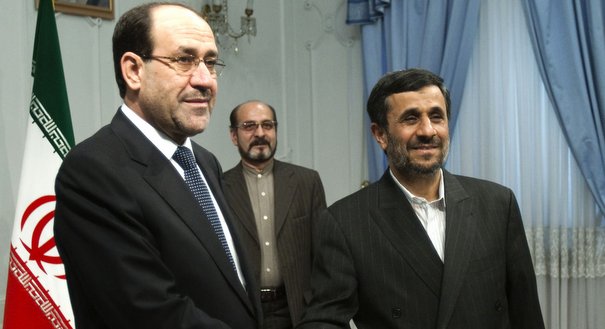
The formation of Iraq’s long-awaited government has been officially welcomed by the United States. After many unsuccessful attempts to nudge rival Iraqi factions toward compromise, Washington appears to have obtained what it had hoped and worked for: a government of national reconciliation with all ethnic, sectarian, and major political forces represented and a prime minister the United States could live with. Despite decrying Nouri al-Maliki’s weak and lackluster early performance and being troubled by signs of authoritarian tendencies in the latter part of his term and during the post-election process, American officials concluded that he remains the best available choice. There is a fly in the ointment, however—Maliki also has the backing of Iran. The United States and Iran de facto cooperated to keep Maliki as prime minister. As a result, the U.S. role in Iraq and its relationship with the Iraqi government have been permanently altered.
Maliki thus owes his position not only to his political skills, determination, and a willingness to bend rules and ride roughshod over opponents, but also to the simultaneous support of the United States and Iran. True, there are indications that Maliki was not Iran’s first choice for prime minister, and that Tehran might have preferred a candidate from the more Islamist Iraqi Supreme Islamic Council (ISCI), but when that proved impossible Iran embraced Maliki. In persuading Moqtada al-Sadr to back Maliki, Iran provided a major boost to Maliki’s efforts to remain prime minister.
Once al-Sadr’s Sadrist Trend (the strongest Shia party resisting Maliki’s leadership) gave in, all of the other Shia groups eventually followed. Then the United States, with strong support from the Kurdish parties and particularly from Kurdistan’s president, Massoud Barzani, convinced an extremely reluctant Iyad Allawi to accept Maliki’s leadership, thus bringing in Sunni support. Maliki is thus beholden to both Iran and the United States.
The situation appears to suit Maliki just fine. He wasted no time in signaling his intention not to get too close to the United States and not to renegotiate the current Status of Forces Agreement, which requires the United States to withdraw all of its troops from Iraq by the end of 2011. U.S. officials—particularly the military—have argued since the agreement was signed in November 2008 that Iraq would still need military support and that the agreement would therefore need to be renegotiated. Some still do. But in an interview with the Wall Street Journal on December 28, Maliki made it clear he sees no reason to renegotiate the agreement. Nor, he declared, does he intend to allow his nation to be pulled into alignment with Iran or with any other “axis or orbit,” whether that is the United States, Turkey, or other Arab nations.
Maliki, in other words, is beginning to sound much like the ambitious leaders who, during the Cold War, aspired to remain non-aligned—and even tried to play the United States and the Soviet Union against each other in order to obtain maximum benefits while claiming neutrality. In reality, few succeeded and were then forced to choose between the United States and the Soviet Union. Maliki too may quickly discover that non-alignment is impossible and have to choose. At that point, one can’t assume he will choose to align with the United States—the signs at this point are not encouraging.
The United States is trying to promote closer ties between Iraq and the Arab states as an antidote to Iranian influence and has even put strong pressure on many Arab regimes to improve their relations with Iraq. Washington’s campaign has met with limited success because Arab regimes, mostly Sunni-dominated, are suspicious of Maliki and the Iranian influence in Iraq.
Relations between Iraq and Saudi Arabia, which are key to an Iraqi rapprochement with the rest of its Sunni neighbors, have been particularly cold—the Saudis did not even congratulate Maliki on the formation of the new government. Iraq is responding in kind, with representatives of Maliki’s own State of Law coalition and of the broader Shia Iraqi National Alliance unleashing a barrage of anti-Saudi statements. The current focus in tensions is on a rumor that Saudi Arabia executed, without a real trial, 40 Iraqis guilty of simply trespassing on Saudi soil.
Whatever the merit of the accusation, the venom in relations between Saudi Arabia and Iraq is undeniable. Nor is it recent: a document posted by WikiLeaks shows that in 2007 the government of Iraq, including President Jalal Talabani, who is personally named, considered Saudi Arabia a greater danger to its interests than Iran.
On the domestic front, there are clear signs that the Islamist Shia parties are becoming more self-confident and trying to impose their ideas, pushing the country in a direction that is certainly more acceptable to Iran than to the United States. There is growing pressure on the universities to segregate men and women, for example, and establishments that sell alcohol, now limited to those owned by non-Muslims, complain that they cannot get their licenses renewed.
Iraq may yet pull closer to the United States and its allies in the region. It may conclude that it still needs military support and allow some sort of U.S. military presence. To a large extent, the future of U.S./Iraqi relations depends on how dexterous Maliki becomes at playing the non-aligned game. Even if Maliki concludes that strong ties to the United States are important to counterbalance the role of Iran, the United States will have to rethink its presence and its role in Iraq. If Washington continues seeing itself as the dominant outside power, defending Iraq against the illegitimate machinations of Iran, and enjoying a unique relationship with the government, it will find itself out of step with the new government in Iraq and the new, self-confident, and assertive Maliki. This could undermine its position even further.
The United States has little choice but to accept the new reality: it is just one of two major countries competing to influence a new government that is as dependent on Iran as it is on the United States. The outcome of this competition is still very much in doubt.